

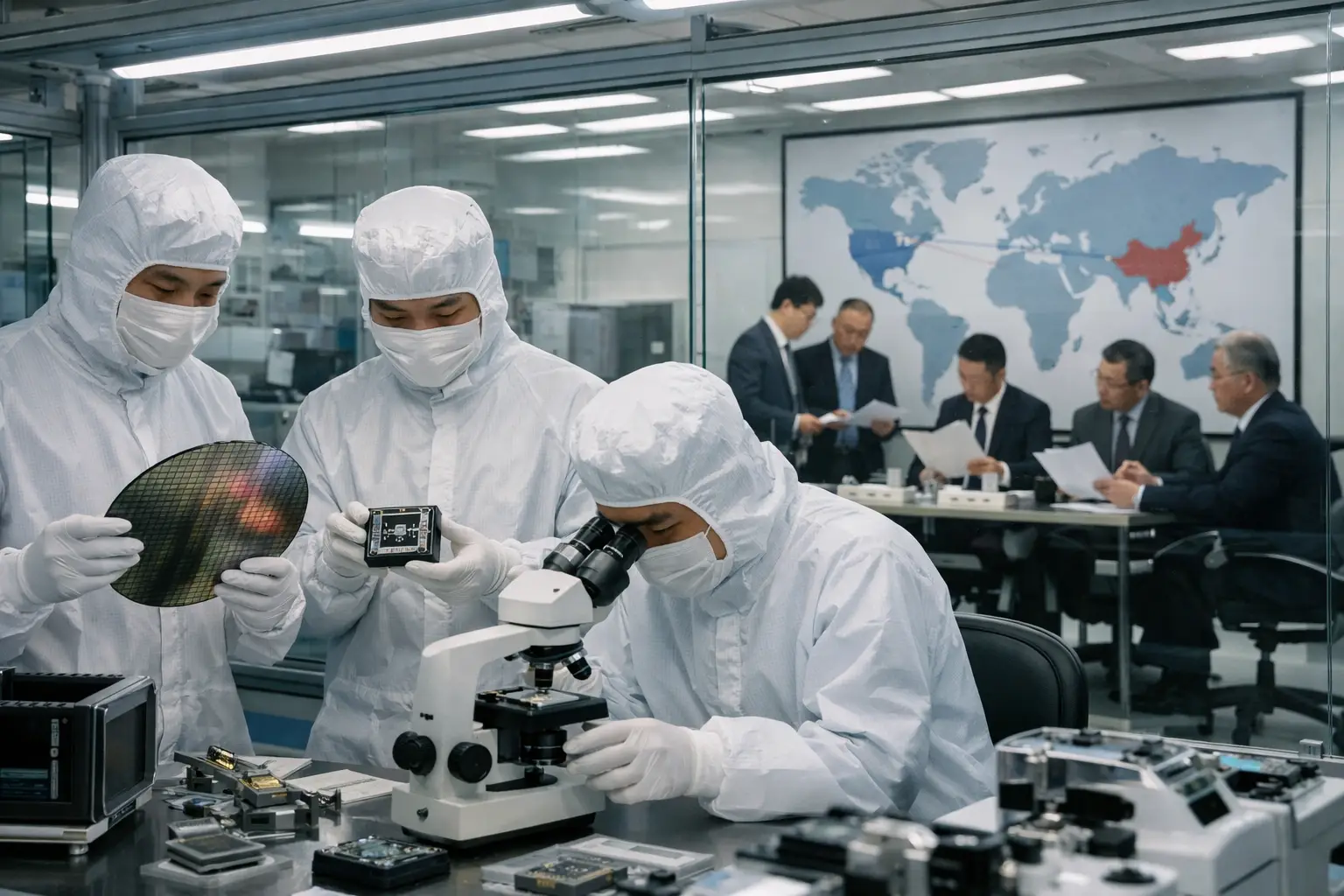
The controversy around Nvidia and its chief executive, Jensen Huang, has sharpened attention on a central fault line in the global technology economy: the dependence of the artificial intelligence boom on a narrow group of high-performance chip suppliers. Nvidia, whose processors are widely used to train and run advanced AI systems, sits at the intersection of commercial demand, national security concerns and industrial strategy. That position has made the company more than a technology vendor; it has become a reference point in the rivalry between the United States and China.
For China, the issue is structural. Its technology groups need cutting-edge computing power to sustain progress in AI models, cloud services and advanced industrial applications. Yet access to the most powerful chips is constrained by U.S. export controls, which are designed to limit the transfer of technologies that could strengthen a strategic competitor. The role of the U.S. Bureau of Industry and Security is particularly significant because export licensing decisions can influence what hardware reaches foreign markets and under what conditions.
The pressure has also exposed the limits of China’s domestic semiconductor ambitions. Beijing has promoted self-reliance in critical technologies, but advanced chips require complex supply chains, specialized design tools and sophisticated manufacturing capacity. The Ministry of Commerce of the People’s Republic of China has repeatedly treated technology restrictions as a major trade and development issue, reflecting the broader political stakes attached to access to computing power. In this environment, any dispute involving Nvidia quickly becomes part of a much larger debate about technological sovereignty.
For Washington, the challenge is to balance commercial leadership with strategic control. U.S. companies remain central to the global AI ecosystem, and Nvidia’s market position illustrates the strength of American chip design. At the same time, policymakers have treated the most advanced processors as sensitive assets because they can support both civilian innovation and military-relevant capabilities. The consequence is a fragmented market in which access to AI hardware depends not only on price and availability, but also on regulation and geopolitics.
The Nvidia episode therefore matters beyond the company itself. It underlines how AI development is no longer shaped only by software talent or investment capital, but also by export rules, supply-chain resilience and state policy. As demand for computing power expands, China’s need for advanced chips and America’s effort to control their distribution will remain defining forces in the next phase of the AI race.


