

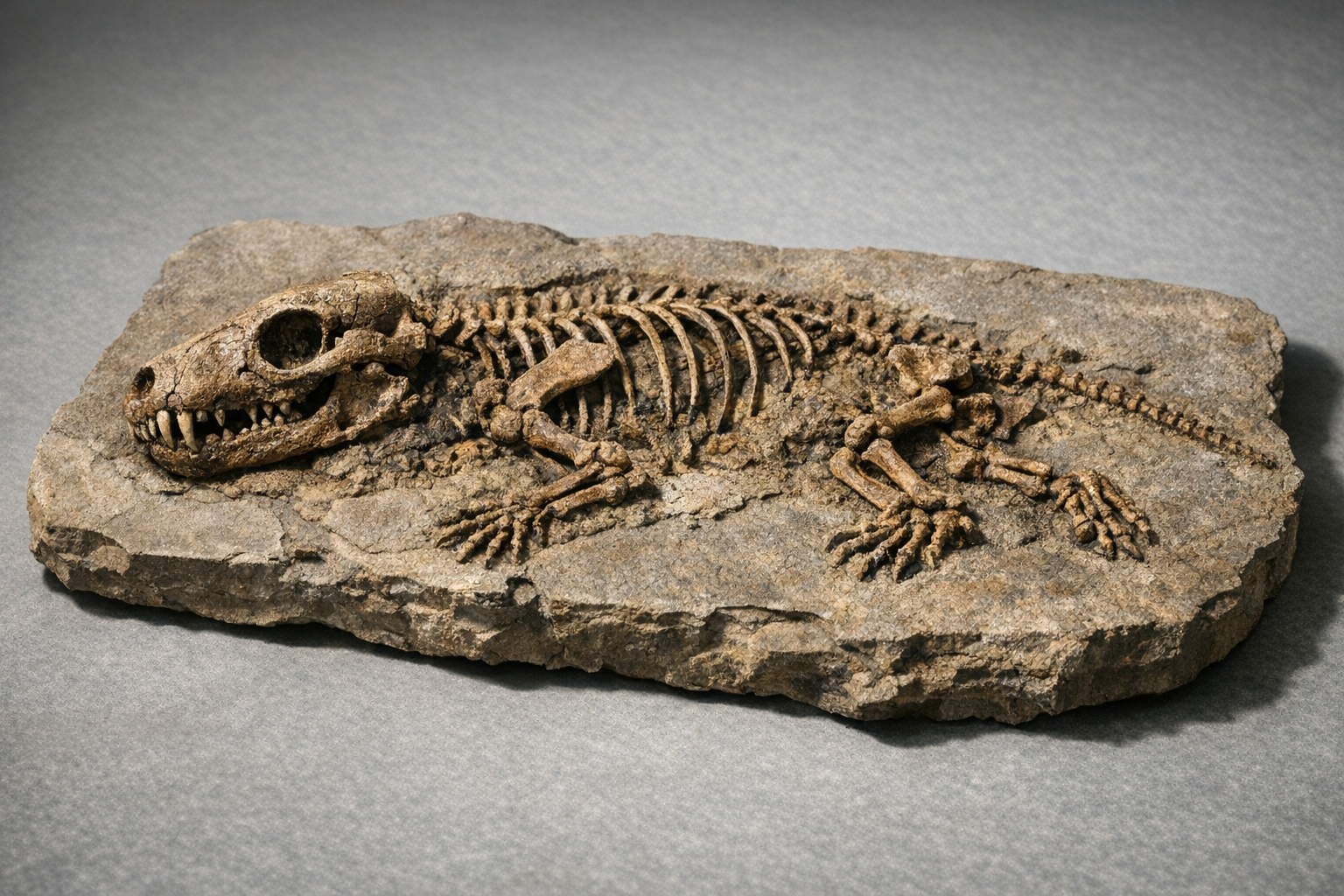
New fossil evidence indicates that some early mammal relatives may have given birth to live young far earlier than established accounts of reproductive evolution suggest. Researchers publishing in Frontiers in Mammal Science report that anatomical features in a 236-million-year-old specimen attributed to cynodonts are consistent with viviparity, the condition of giving birth to live offspring rather than laying eggs.
Cynodonts, a group of advanced synapsids from the Triassic period, are considered a pivotal lineage in the transition to true mammals. The specimen described in the study dates to approximately 236 million years ago and contributes a rare data point on reproductive anatomy in deep time. The authors frame the find as the first compelling fossil evidence to support the hypothesis that components of mammalian viviparity may have been present in non-mammalian synapsids.
The research team used comparative anatomical analysis to identify features in the fossil that the paper interprets as compatible with internal gestation. While the study does not report direct preservation of an embryo, the authors argue that the combination of skeletal traits and their phylogenetic position within cynodonts strengthens the case for a reproductive shift toward live birth in this branch of the synapsid tree. The paper situates the evidence within broader discussions of how reproductive strategies evolved ahead of other mammalian characteristics.
The authors caution that additional specimens and further investigations are necessary to confirm the interpretation and to establish how widespread viviparity may have been among Triassic synapsids. If corroborated, the finding would revise timelines for the emergence of live birth in the lineage that led to modern mammals and will prompt targeted searches for comparable preservation in other Triassic deposits. The study, peer-reviewed and published in Frontiers in Mammal Science, underscores the potential for new fossil discoveries to reshape understanding of early mammalian biology.


