

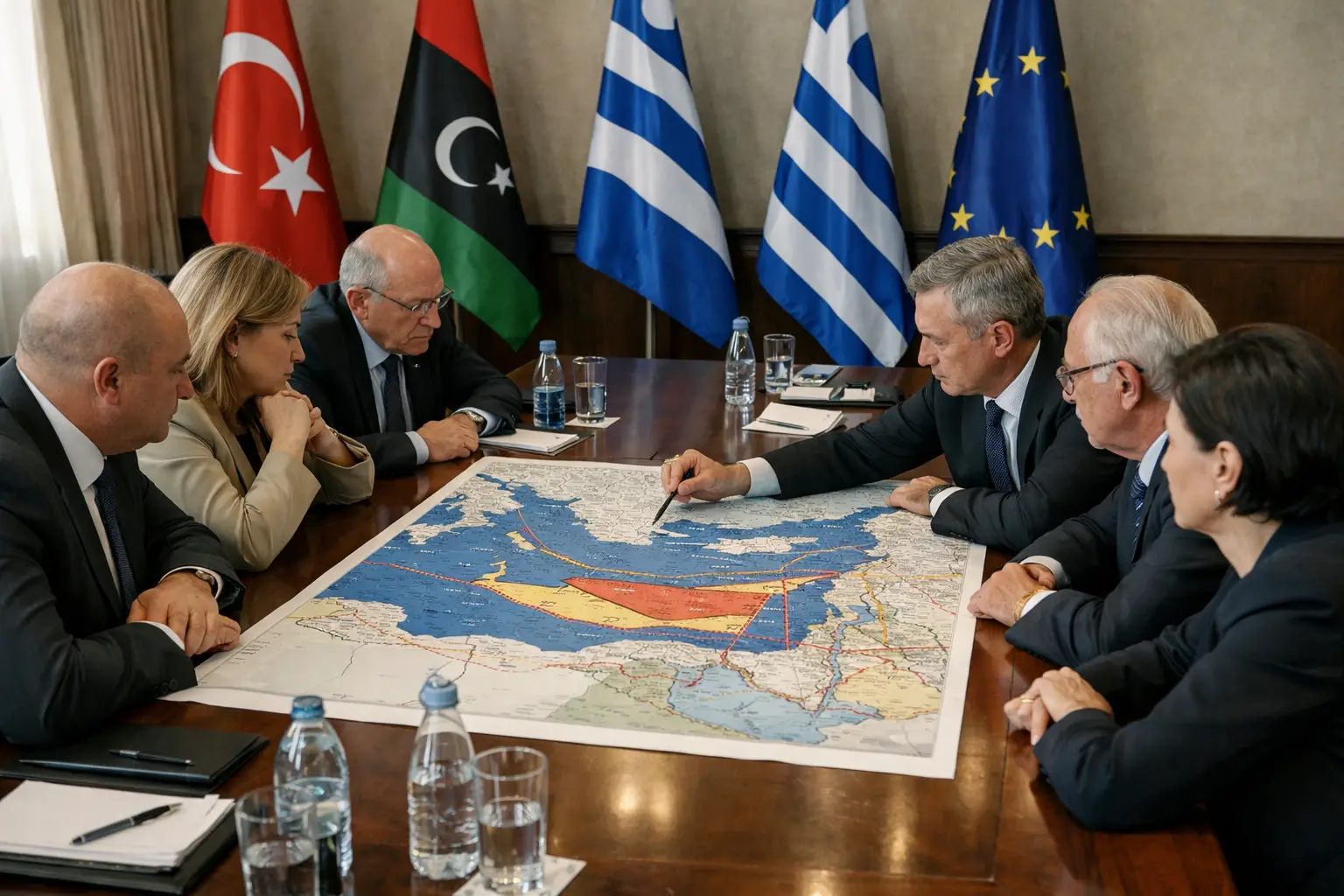
Turkey and Libya’s plan to redefine maritime boundaries in the Mediterranean has opened a new phase in a dispute already marked by competing legal and strategic interests. The initiative, linked to the creation of an economic corridor, has drawn strong objections from Greece and has placed the European Union more directly in the diplomatic fallout. At issue is not only the drawing of lines at sea, but the authority to shape economic activity across one of the world’s most sensitive maritime regions.
The planned arrangement between Ankara and Tripoli concerns waters where boundaries carry substantial political and economic weight. Maritime delimitations can determine jurisdiction over shipping routes, seabed activity, fisheries and potential energy development. When such lines intersect with areas claimed or monitored by neighboring states, they quickly become matters of sovereignty as well as commerce. Greece’s Foreign Ministry has made clear its opposition to moves it views as affecting Greek maritime interests, turning the proposed corridor into a regional point of contention.
For Turkey’s Foreign Ministry and Libya’s government, the project links maritime planning with economic connectivity. The political sensitivity lies in the fact that any revised boundary framework in the Mediterranean can influence regional balances beyond the two signatories. Greece’s objections reflect a broader concern that bilateral understandings should not determine maritime space when neighboring states consider their own rights to be involved. That concern has pushed the matter from a bilateral initiative into a wider diplomatic dispute.
The involvement of the European Union adds another layer to the standoff. As Greece is an EU member state, objections raised in Athens inevitably carry weight in Brussels, particularly when maritime jurisdiction and regional stability are implicated. The dispute also comes in a Mediterranean context where economic corridors, energy interests and security calculations often overlap. Without a mutually accepted framework, the proposed Turkey-Libya boundary plan is likely to remain a point of friction between national ambitions and European diplomatic concerns.


