

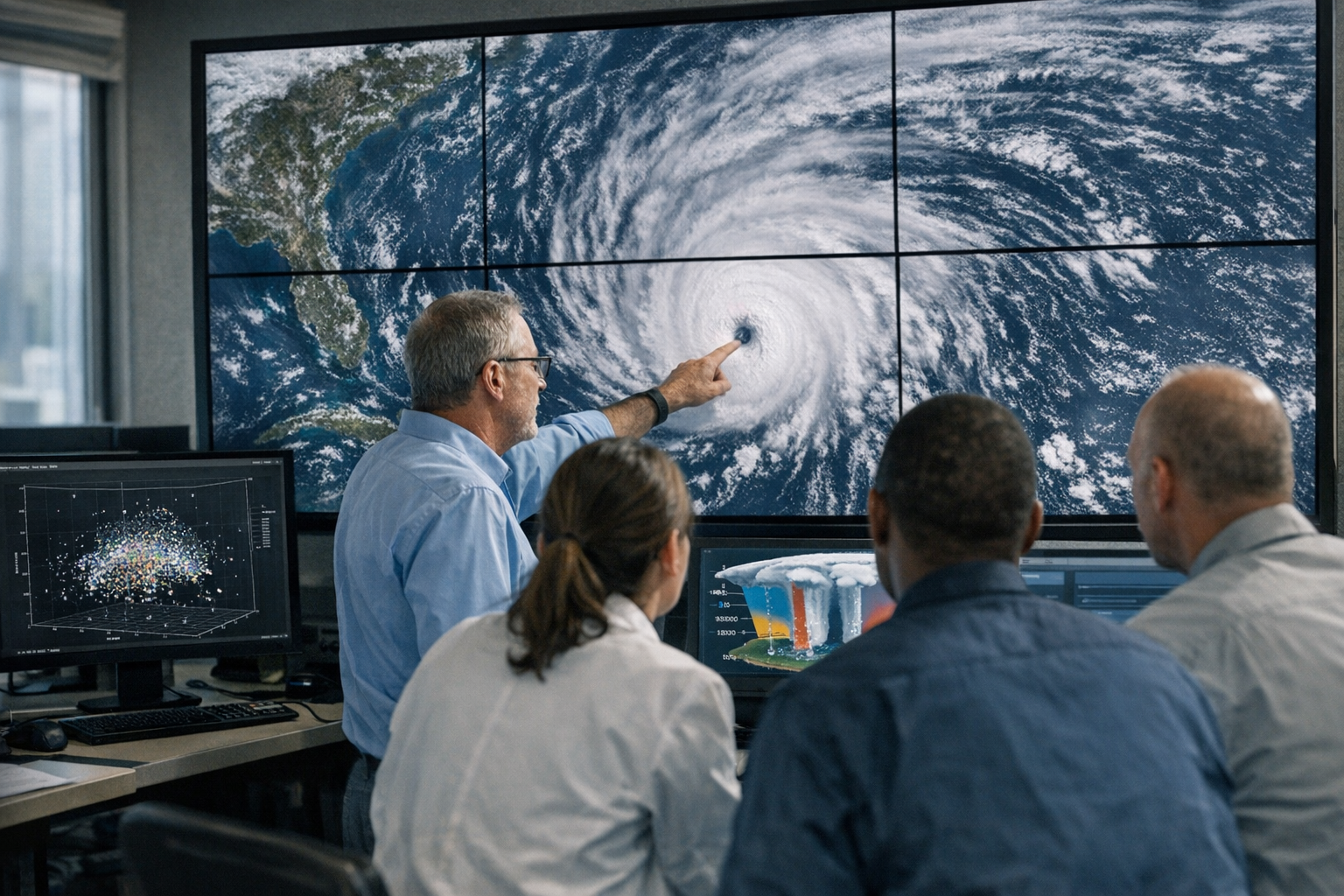
Artificial intelligence has transformed large-scale weather forecasting, producing skillful predictions that in some cases rival traditional physics-based systems. Yet when it comes to sudden changes in the strength of tropical cyclones, machine-learning approaches often fall short. Accurate intensity forecasts require resolving fine-scale processes and interactions that remain difficult to capture from available observations and training data, leaving forecasters with greater uncertainty about storm impacts.
Several factors explain this shortfall. Small-scale inner-core dynamics, such as eyewall replacement cycles and rapid intensification events, unfold on spatial and temporal scales that are sparsely observed over open ocean. Operational agencies such as NOAA and ECMWF rely on ensembles and high-resolution physics models to represent those processes, but those systems still face limits when data are thin or when sub-grid physical interactions dominate the outcome.
Machine-learning models are constrained by the quality and variety of their training sets and by how well they encode physical laws. Models trained on historical cases can struggle to generalize to novel situations, particularly for the inner core of hurricanes where ocean–atmosphere coupling and turbulence are decisive. In addition, many AI systems trade interpretability for performance, making it harder for scientists to diagnose why a model missed a rapid change in intensity and to correct systemic biases.
The operational consequences are tangible: underestimated intensity can complicate evacuation decisions, resource staging and the allocation of emergency response. Forecasters therefore tend to present probabilistic intensity guidance and emphasize uncertainty, combining AI-derived products with physics-based forecasts and expert judgment to support decision makers and the public.
Research efforts are focusing on hybrid approaches that blend machine learning with explicit physical constraints, and on improving observations from satellites, aircraft and targeted field campaigns to better sample the processes that drive intensity change. Progress is incremental: while AI enhances many aspects of forecasting, closing the gap on hurricane intensity prediction will require richer data, physics-aware models and sustained collaboration between the modelling and observational communities.


