

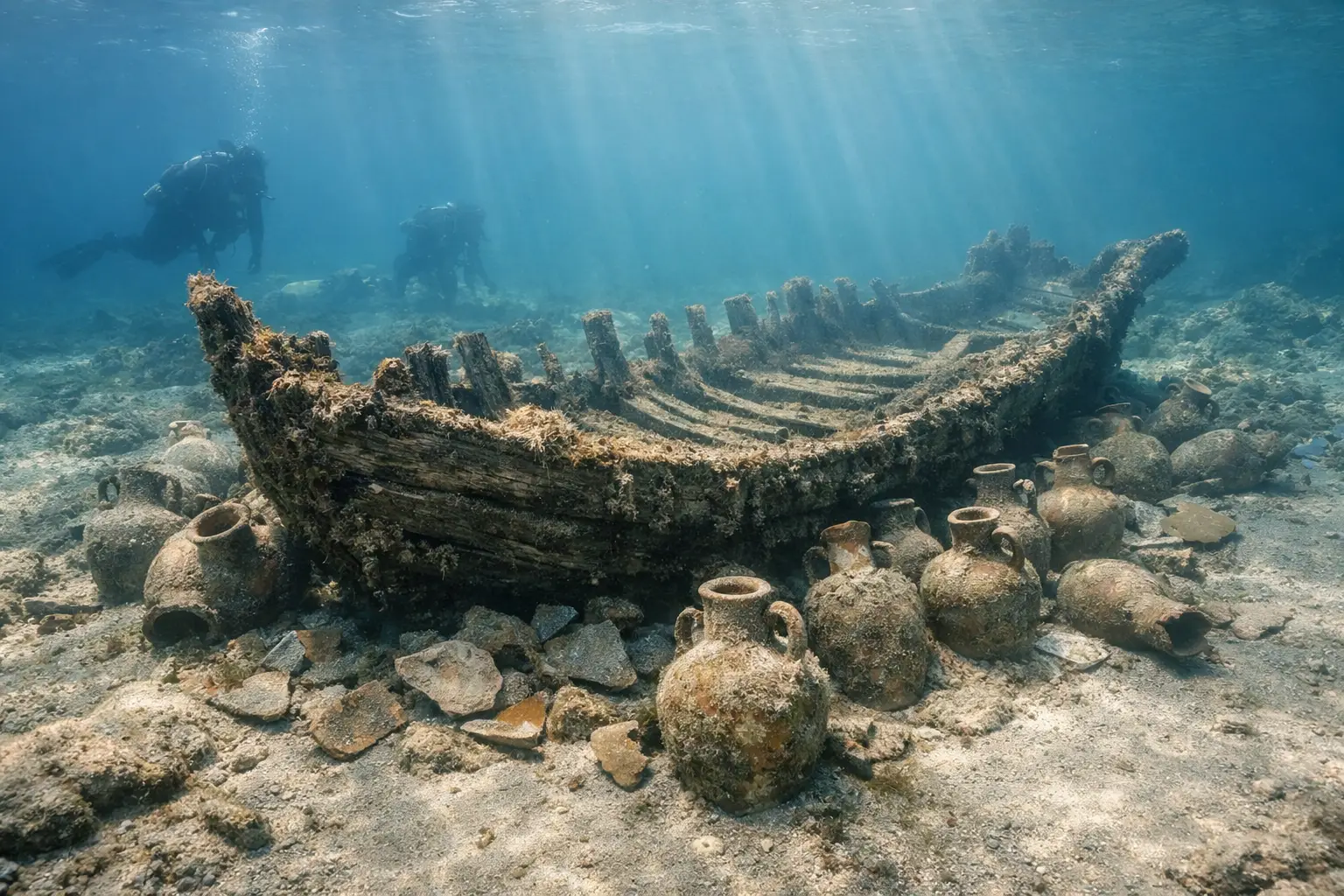
Archaeologists involved in a recent project have identified a submerged site off the coast of Turkey that they tentatively date to roughly 2700–2400 B.C. The team reports that the wooden structure of the vessel has almost entirely vanished, but a concentrated assemblage of cargo remains — notably a group of pottery vessels — which provided the primary clues for the chronological estimate. If the date holds up under further study, specialists say the find would stand as the earliest shipwreck known to science.
The proposed age derives from detailed study of the objects recovered around the site. Scholars examined the pottery and associated materials, using their typology and contextual relationships to place the assemblage within the early Bronze Age horizon. These material indicators — rather than a surviving hull — anchor the preliminary chronology. The presence of distinguishable trade goods within the wreck offers direct evidence of maritime transport and cross-coastal exchange during this period.
Excavation of such deeply buried and fragmentary underwater sites presents technical and preservation challenges typical of underwater archaeology. Organic hull timbers rarely survive in many marine environments, leaving ceramics and other durable cargo as the principal datable items. Researchers emphasize that confirmation will require additional laboratory analyses, comparative study with contemporaneous assemblages, and formal publication and peer review of the full dataset.
Beyond its chronological significance, the discovery has potential implications for understanding early seafaring and economic networks in the eastern Mediterranean. The cargo assemblage could illuminate production centers, trade routes and the nature of coastal commerce in the early Bronze Age. The research team anticipates continued fieldwork alongside conservation efforts and collaboration with regional authorities to document the site comprehensively and make the evidence available to the wider scholarly community.


