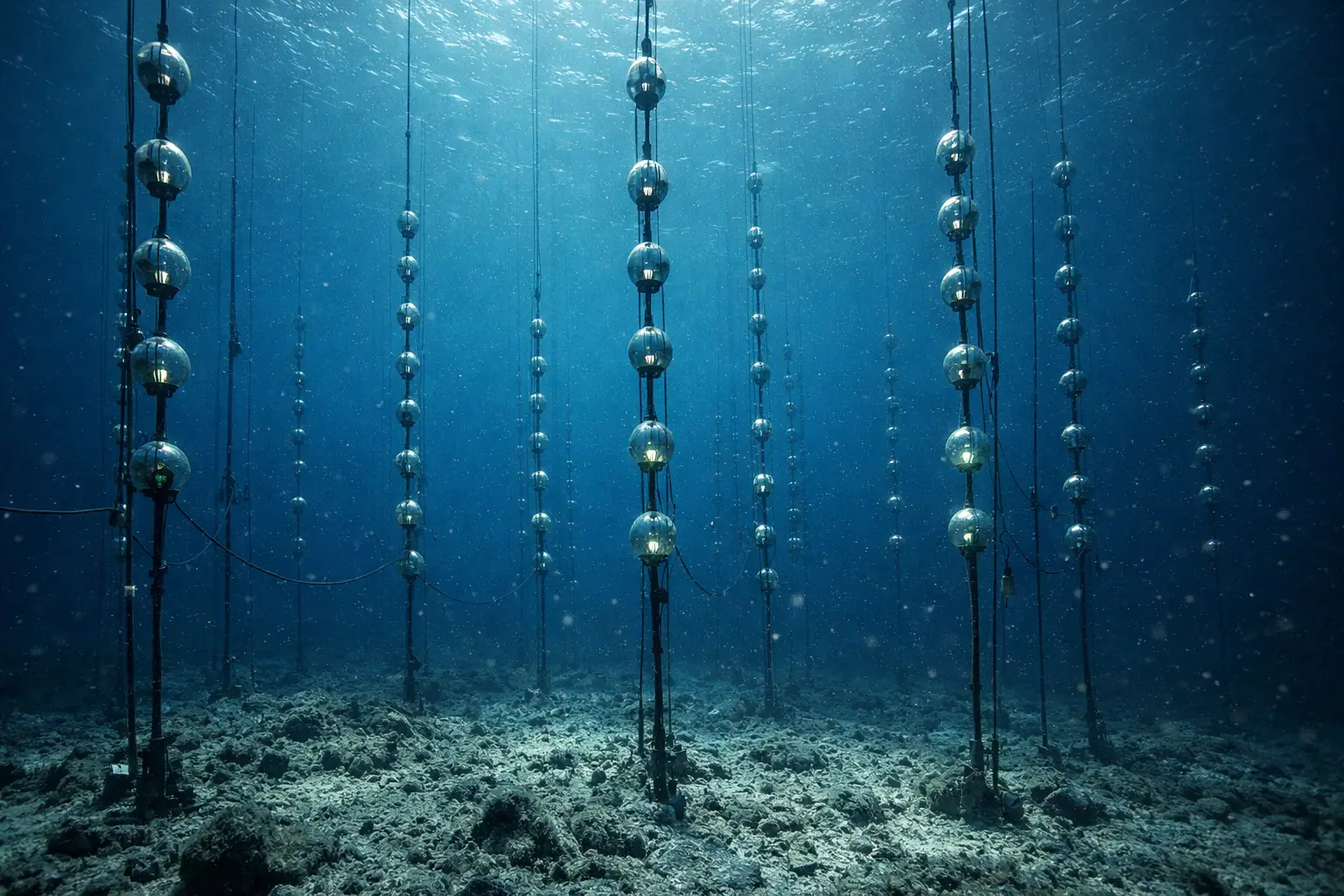
Deep beneath the Mediterranean, an international team is using neutrinos to examine one of modern science’s most basic assumptions: that the laws of physics behave the same way everywhere in the universe. Researchers from the KM3NeT collaboration analyzed 5,828 atmospheric neutrino candidate events recorded by KM3NeT/ORCA, a neutrino telescope installed in the depths of the Mediterranean Sea.
The test focuses on Lorentz invariance, a principle at the center of Albert Einstein’s theory of relativity. In practical terms, it underpins the idea that the outcome of physical laws does not depend on an observer’s constant motion or orientation in space-time. This symmetry is not a technical footnote: it is one of the foundations on which much of twentieth- and twenty-first-century physics has been built.
Neutrinos offer a distinctive way to examine that foundation. These particles can travel across enormous distances and pass through matter with very little interaction, making them useful messengers for tests of fundamental physics. In this case, the events studied were atmospheric neutrino candidates, detected by an instrument designed to observe faint light signals produced when neutrino interactions occur near the detector.
The scientific motivation extends beyond confirming a well-established theory. Several approaches that attempt to reconcile gravity with quantum physics allow for the possibility that Lorentz invariance may not be exact under all conditions. Finding signs of such a departure would challenge a central assumption of relativity; finding none helps narrow the range of theories that can describe nature at its most fundamental level.
The analysis by KM3NeT illustrates how large underwater observatories are becoming tools not only for particle astrophysics but also for precision tests of the rules governing the universe. The Mediterranean detector turns rare interactions into data, allowing researchers to probe questions that connect Einstein’s legacy with unresolved problems at the frontier of modern physics.