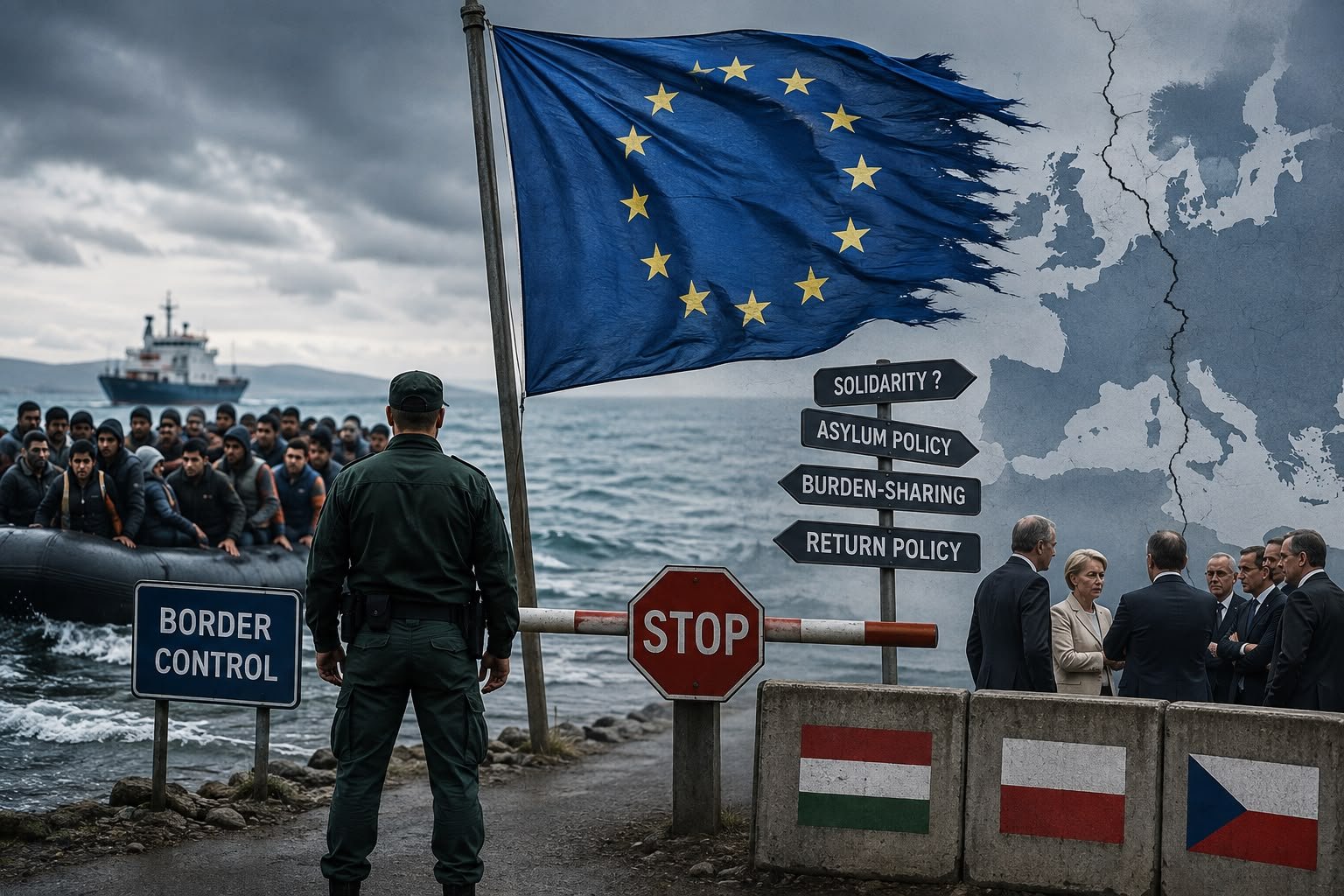
For more than a decade, the European Union has struggled to develop a coherent and credible migration policy. Despite repeated promises of comprehensive reform, the Union continues to respond to migration crises in an ad hoc and reactive manner. While migratory pressure on Europe’s external borders has become increasingly intertwined with geopolitical tensions, the EU remains constrained by institutional fragmentation, conflicting national interests, and a persistent lack of political resolve.
The European Commission has presented successive migration pacts, solidarity mechanisms, and action plans, all intended to address structural shortcomings within the Common European Asylum System. Yet the underlying problems remain largely unresolved. Member States continue to disagree on burden-sharing, border management, asylum procedures, return policies, and the extent to which migration governance should be centralized at the European level. As a result, political compromises often produce policies that satisfy neither frontline states nor countries further removed from the Union’s external borders.
At the heart of the problem lies a fundamental contradiction. The European Union has successfully established an area of free internal movement through the Schengen Area, yet it has never fully developed a common framework capable of effectively securing its external borders. The sustainability of Schengen ultimately depends on the credibility of external border management. However, responsibility remains unevenly distributed among Member States, while political authority remains fragmented between national governments and European institutions. In practice, responsibility is shared, but accountability is diluted.
For many years, Italy represented the weakest link in the European migration architecture. Owing to its geographical position in the central Mediterranean, the country faced a disproportionate share of irregular arrivals while repeatedly arguing that European solidarity extended little beyond political declarations. Increasingly, however, Spain appears to be assuming a similar role. The regularisation policies pursued by the Sánchez government, under which significant numbers of undocumented migrants may obtain legal status, have been criticised by opponents as creating incentives for irregular migration by signalling that unlawful residence may eventually lead to legal recognition. Supporters, by contrast, argue that such policies acknowledge the economic contributions of individuals who have lived and worked in Spain for many years. Regardless of one’s assessment, the debate illustrates a broader reality: Europe continues to lack a genuinely common migration policy. National governments pursue divergent strategies whose consequences inevitably extend beyond their own borders.
The contrast between Western and Eastern Europe further illustrates the depth of this policy divide. Several Central and Eastern European governments, including Hungary and Poland, have consistently prioritised strict border protection, physical barriers, restrictive asylum procedures, and robust migration controls. Their position is based on the premise that effective sovereignty begins with effective border management. Critics argue that aspects of these policies may conflict with international legal obligations and humanitarian principles. Nevertheless, the divergence between Eastern and Western approaches reflects fundamentally different conceptions of state responsibility, national identity, and migration governance. As long as these competing visions remain irreconcilable, a unified European migration policy will remain elusive.
Europe’s internal divisions have not gone unnoticed by neighbouring states. Countries such as Turkey and Morocco have repeatedly demonstrated that migration can serve not only as a humanitarian issue but also as a geopolitical instrument. Periods of diplomatic tension have occasionally coincided with a relaxation of border controls or reduced efforts to prevent irregular departures toward Europe, thereby increasing migratory pressure on the EU’s external frontiers. Whether interpreted as deliberate coercion or strategic leverage, such episodes highlight Europe’s structural dependence on the cooperation of transit countries.
This dependence creates a significant strategic vulnerability. As long as third countries recognise that relatively limited migration flows can generate profound political divisions within the European Union, migration itself becomes a source of diplomatic leverage. Financial assistance, visa liberalisation, trade negotiations, and broader foreign policy objectives increasingly become linked to migration cooperation. Under such circumstances, the European Union often negotiates from a position shaped less by strategic autonomy than by the desire to avoid another migration crisis.
Perhaps the most significant weakness of the European approach is its reactive character. Migration rises to the top of the political agenda only during periods of heightened pressure at the external borders or when domestic political tensions intensify. Emergency measures are adopted, extraordinary European Council meetings are convened, and ambitious declarations are issued. Once immediate pressures subside, however, political momentum gradually dissipates, leaving the structural deficiencies largely untouched. Consequently, the Union remains trapped in a recurring cycle of crisis management rather than pursuing long-term strategic governance.
A credible migration policy should not require a choice between humanitarian responsibility and effective border control. Both are essential components of a sustainable system. Individuals genuinely in need of international protection deserve fair, efficient, and timely asylum procedures. Equally, those whose applications are rejected should be subject to effective return procedures consistent with international law. These principles must be complemented by credible external border management and a coherent European strategy that reduces dependence on the political calculations of neighbouring transit states.
The European Union was founded on the principle that collective action provides greater security and prosperity than fragmented national policies. Yet migration remains one of the clearest examples of the Union’s inability to translate that principle into practice. As long as national political considerations continue to outweigh common strategic objectives, Europe will remain vulnerable both to recurring migration crises and to external actors capable of exploiting its internal divisions.
Ultimately, Europe’s greatest vulnerability does not lie along the Mediterranean coastline or at its eastern land borders. It lies within its own political institutions. Until the European Union demonstrates the capacity to formulate and implement a genuinely common migration strategy, it risks allowing external actors, not Brussels, to shape the future of European migration policy.