

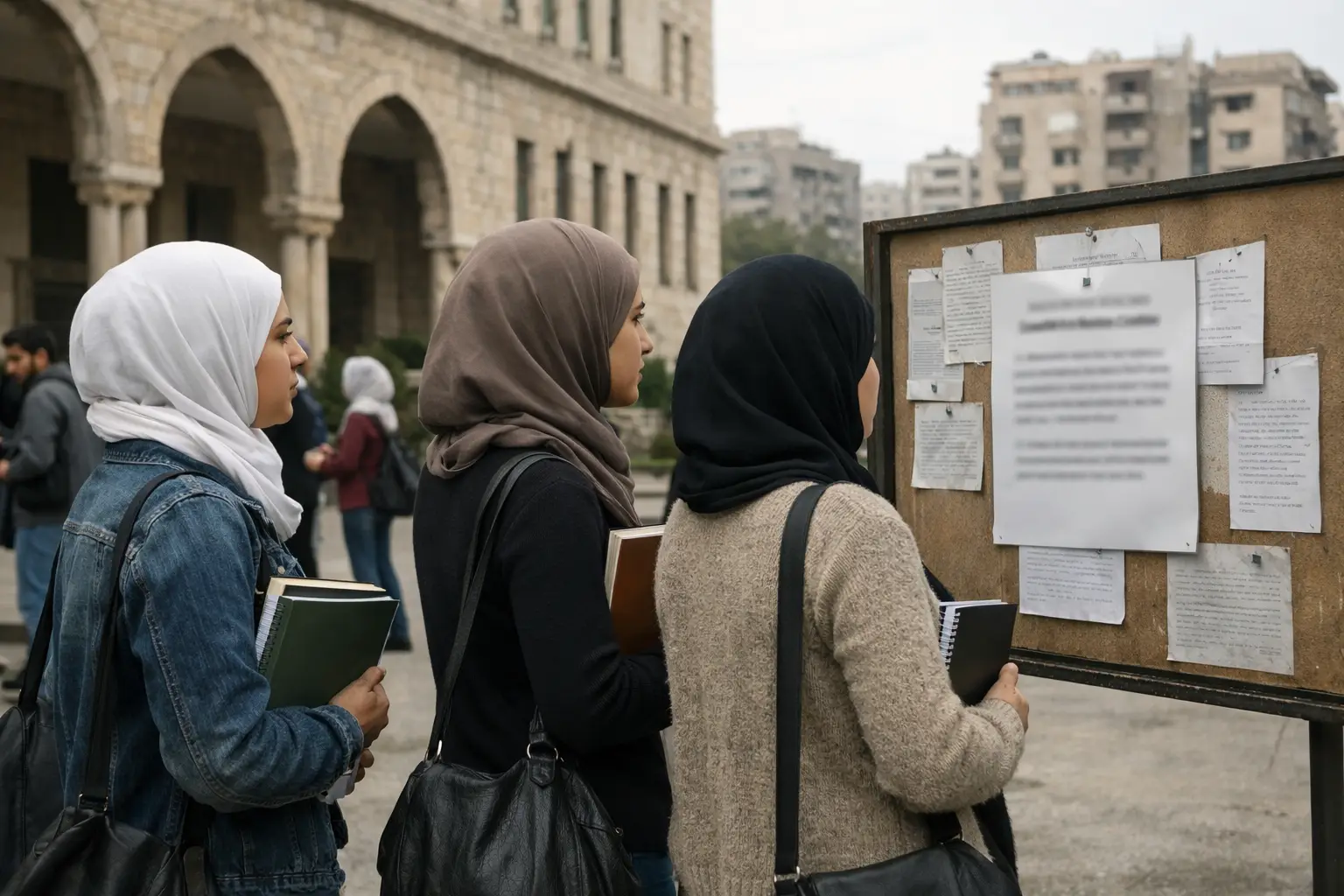
A new restriction on women’s access to selected university courses in Syria has opened a politically sensitive debate over the direction of the country’s education policy. Syrian tertiary institutes have announced that women will not be admitted to some courses, a decision that has drawn criticism from those who see it as a possible early signal of how the new Syrian government intends to approach public life, gender equality and institutional reform.
The decision matters because university admission rules do more than organize lecture halls. They shape access to professional qualifications, careers and public-sector employment, particularly in states where higher education remains one of the main routes to social mobility. Limits placed on women’s study choices can therefore have effects beyond campus, narrowing the fields in which women are able to train and compete. For advocates of women’s rights, the concern is not only the immediate exclusion from specific courses but also the precedent created when eligibility is defined by gender.
The announcement has arrived at a moment when the policies of the new authorities are being scrutinized for indications of continuity or change. In that context, education has become a test of governance as much as a domestic administrative issue. A restriction in higher education can quickly become a proxy for broader questions about legal protections, institutional autonomy and the role women will be permitted to play in the country’s reconstruction and public institutions. Critics have framed the measure in those terms, warning that it could mark the beginning of a wider rollback of rights.
The full impact will depend on the scope of the excluded courses and on whether the policy is temporary, limited or expanded. Those details are essential for students, families and universities seeking clarity before enrollment decisions are made. They are also important for foreign governments, aid organizations and academic partners that assess education policy as part of their engagement with Syria. Without clear safeguards, even a narrow ban can undermine confidence that educational access will be governed by equal criteria.
For now, the controversy has placed women’s access to education at the center of the new government’s agenda. Its next steps will determine whether the measure remains an isolated rule affecting certain programs or becomes part of a broader pattern in which gender shapes access to institutions. In a country where universities are tied to professional opportunity and national recovery, the question is not only who may study, but what kind of rights framework will guide the new administration.


