

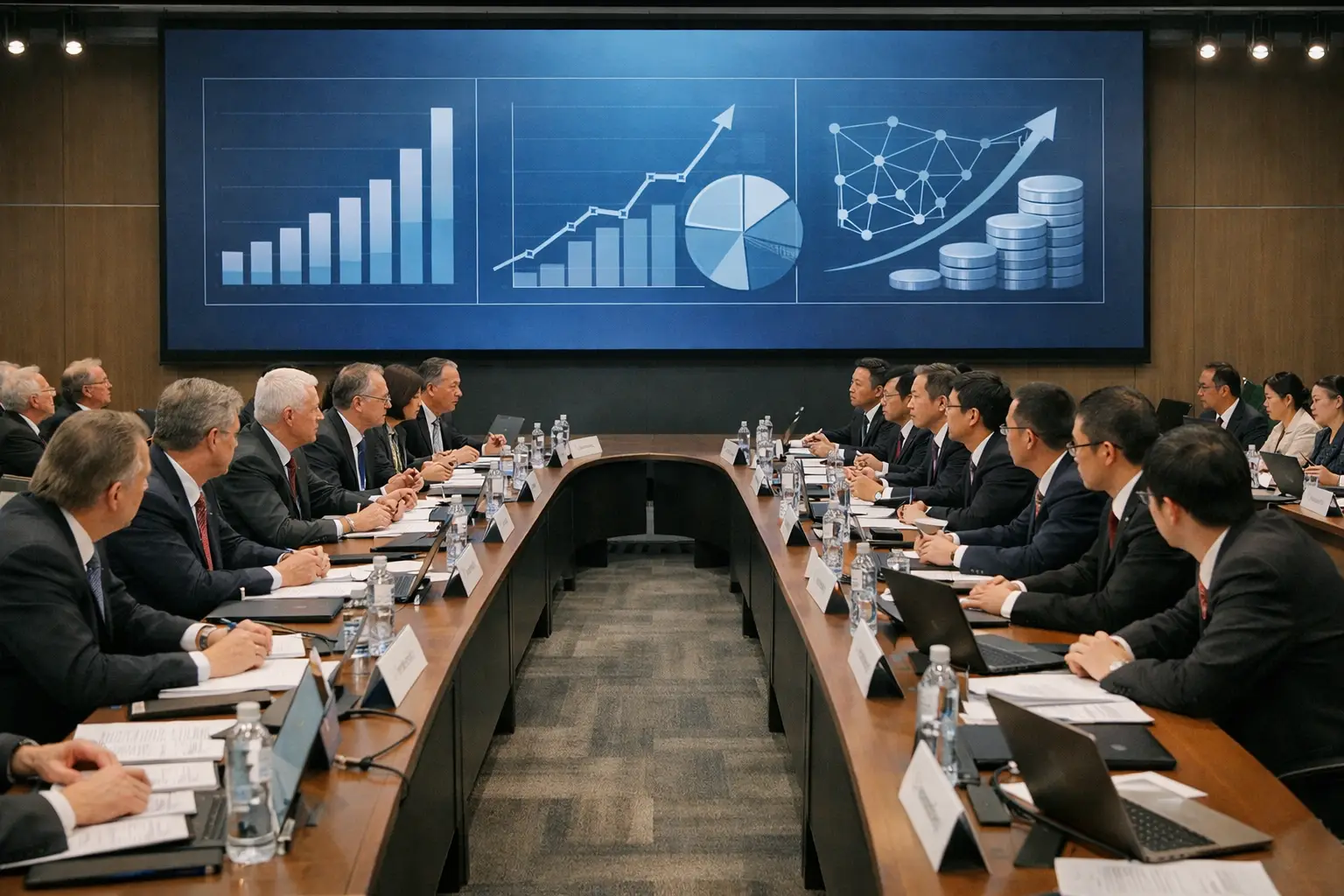
APEC in Shenzhen will bring into close view a set of economic and technological tensions as delegations from the United States and the China meet amid accelerating private and public investment in artificial intelligence. The summit hosted by APEC takes place against a backdrop of strong capital flows into AI-related firms, increased government support for chip and data-infrastructure projects, and concentrated innovation clusters such as Shenzhen.
The investment wave has created a mix of market opportunities and policy challenges. Venture funding, corporate research programs and state-backed initiatives are expanding capacity for compute, talent and specialized hardware. At the same time, differences in export controls, procurement rules and industrial policy regimes are complicating cross-border trade in critical components and services. Observers note that these dynamics intersect with financial-market behavior, creating conditions that some analysts characterise as heightened risk for overvaluation in segments of the AI sector.
Officials and business leaders in Shenzhen are expected to address practical topics that affect both economic stability and technological interoperability. Discussions are likely to cover transparency around investment flows, frameworks for managing export constraints while limiting unintended disruptions to supply chains, and common approaches to safety testing and certification for advanced systems. The combination of commercial scale in Chinese manufacturing hubs and global demand for semiconductors and cloud capacity makes coordination on these points consequential for markets and firms worldwide.
Outcomes at APEC could influence investor sentiment and the shape of regulatory cooperation beyond the region. A constructive set of understandings—whether through shared data on critical infrastructure, harmonised standards for system robustness, or stepped-up channels for private-sector risk management—would affect where capital flows and how companies organise cross-border operations. With Shenzhen as the meeting ground, the event will test how economic diplomacy can respond to a rapid technological expansion that spans both the public and private spheres.


