

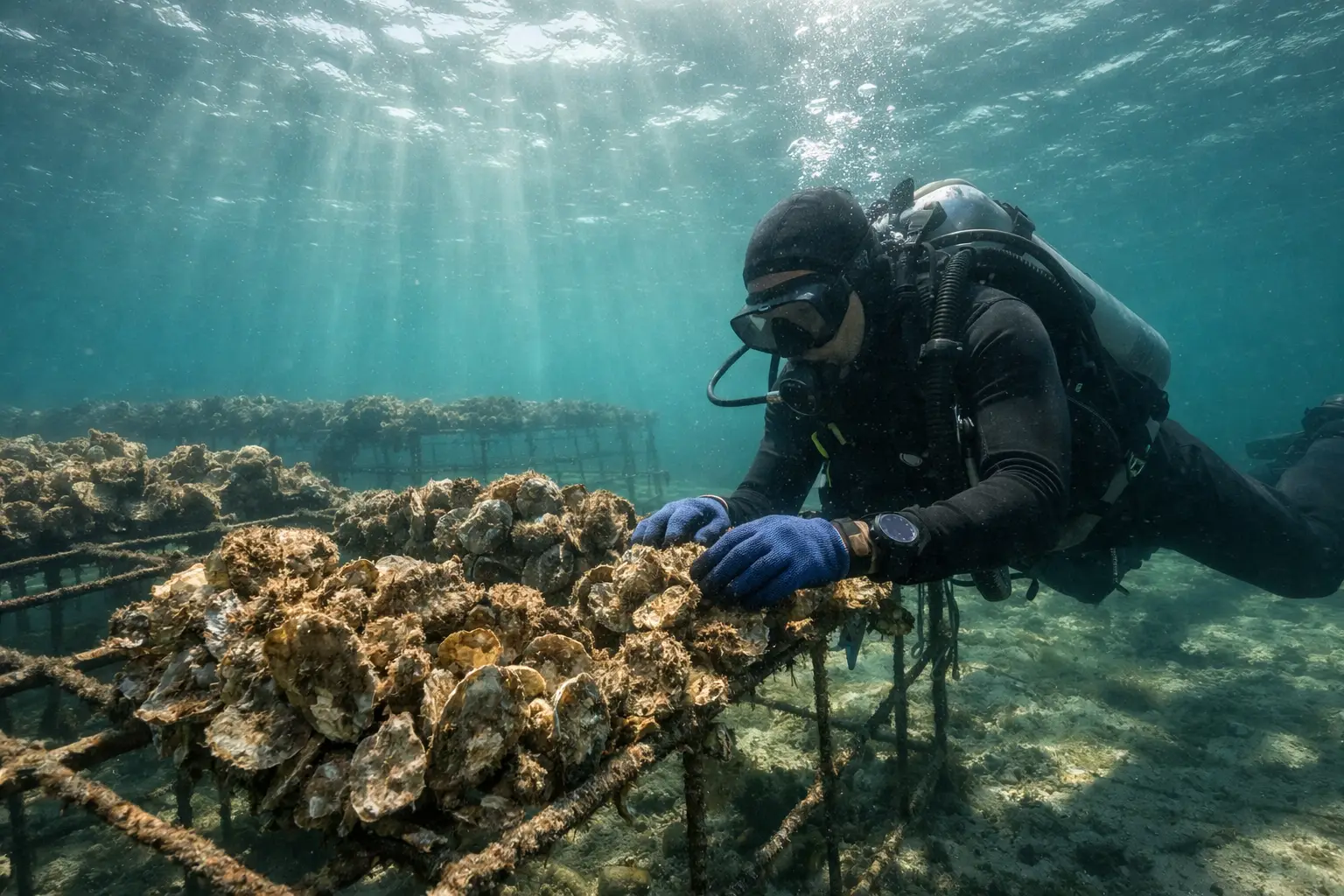
Oyster reefs’ global contribution to planetary health has been substantially underestimated, according to a new estimate that places their potential gross ecosystem product at about $12 trillion per year. The figure frames reef benefits in economic-like terms — measuring the annual flow of ecosystem goods and services that underpin human well-being and natural resilience. Researchers used the gross ecosystem product concept to aggregate diverse functions provided by oyster reefs, showing how these coastal habitats deliver measurable value across climate regulation, water quality, fisheries and coastal protection.
Oyster reefs perform a range of ecological tasks that translate into societal benefits. They filter water, improving clarity and lowering nutrient loads; they sequester carbon in sediments; they reduce wave energy and erosion along shorelines; and they create complex habitats that support fish and invertebrate populations important to local fisheries. Those services have direct implications for coastal economies, public health and biodiversity conservation, particularly in regions where communities rely on nearshore resources and natural buffers against storms.
Despite this potential, many oyster habitats are degraded or lost, and current management often fails to capture their full value. Restoring reef structure, protecting remaining beds from further damage, and integrating these habitats into coastal planning are central steps identified to unlock the estimated benefits. Efforts would require coordinated governance, sustained financing and the application of restoration techniques tailored to local conditions, alongside monitoring to track ecological and socioeconomic outcomes.
The valuation underscores how nature-based solutions can be incorporated into broader strategies for climate adaptation, fisheries management and water quality improvement without replacing conventional conservation science. Translating the $12 trillion estimate into on-the-ground gains will depend on policy choices, investments and community engagement that prioritize reef recovery and stewardship. For policymakers and resource managers, the analysis offers a quantitative lens to reassess priorities for coastal restoration and to evaluate trade-offs in land and sea use planning.


