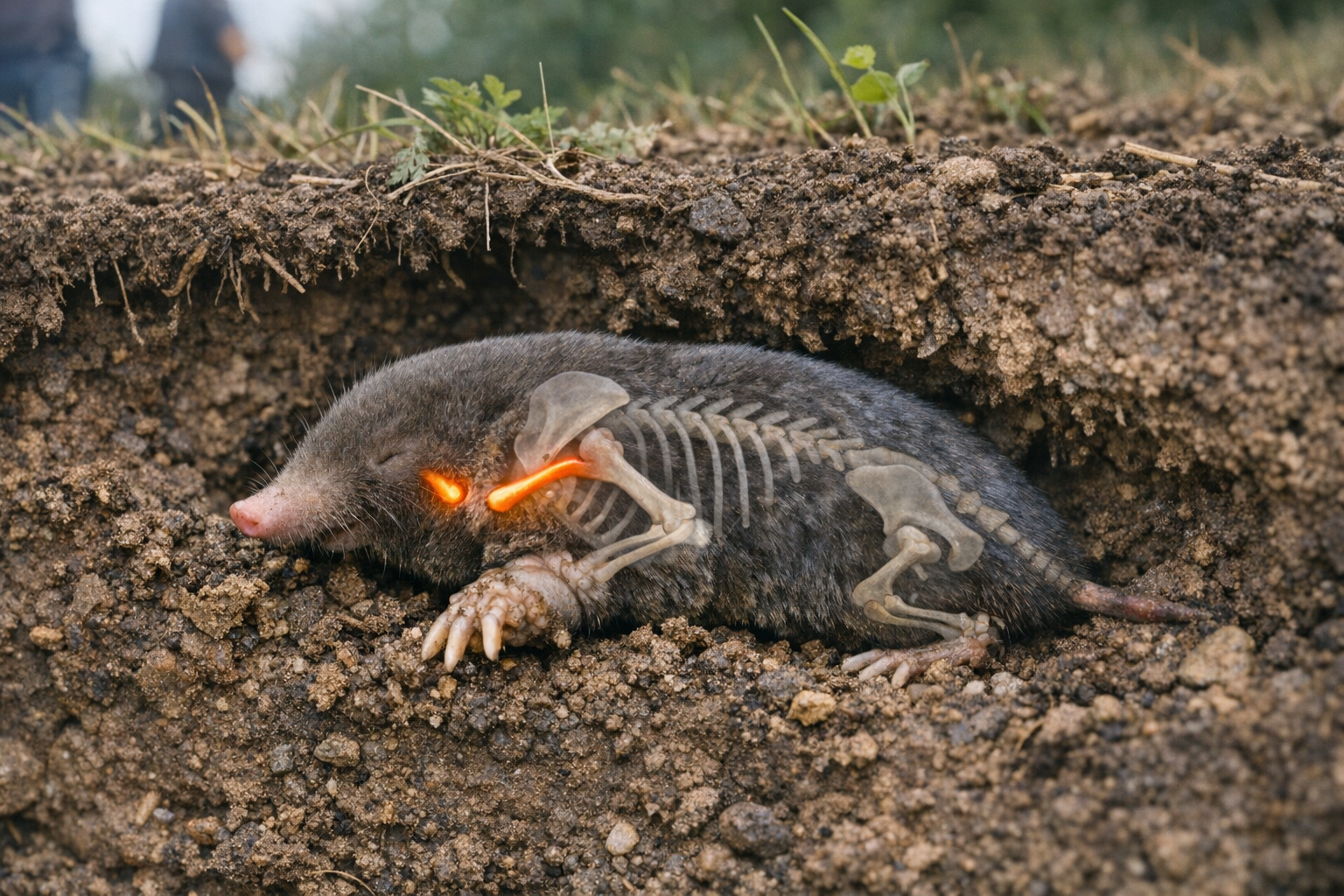
Mole shoulder anatomy has been shown to diverge sharply from the pattern found in most terrestrial quadrupedal mammals. A recent analysis of the internal microstructure of shoulder bones in underground moles (family Talpidae) reveals that the clavicle plays a more prominent role in bearing mechanical loads than the scapula, the bone that typically supports body weight and transmits forelimb forces in land-dwelling quadrupeds.
The study examined internal bone architecture, a standard proxy for habitual loading, and found load-related structural signatures concentrated in the clavicle rather than the scapula. In many quadrupeds the scapula acts as the principal strut transferring limb forces to the trunk; the pattern identified in moles indicates a redistribution of that responsibility toward the clavicle. This anatomical configuration aligns with the distinctive mechanics of animals that operate extensively below ground.
The finding adds a new dimension to comparative shoulder anatomy by highlighting how differing locomotor and behavioral demands can reshape the contribution of individual bones within the same joint complex. Because internal bone structure reflects long-term mechanical use, the observed differences signal a functional specialisation in mole forelimbs. Such specialisation is relevant for interpreting how fossorial — or digging — lifestyles influence the skeleton, and it refines expectations for shoulder morphology across mammalian lineages with varied ecologies.
Beyond immediate anatomical description, the results have implications for multiple fields. In functional morphology and evolutionary biology, the study provides an empirical basis for reassessing which shoulder elements best indicate load-bearing behaviours in both living and fossil species. For those reconstructing locomotion from fragmentary remains, the emphasis on clavicular architecture in moles suggests that researchers should give greater weight to that bone when inferring underground or powerful forelimb use. The work therefore contributes to a more nuanced view of how skeletal systems adapt to extreme or specialised modes of life.