

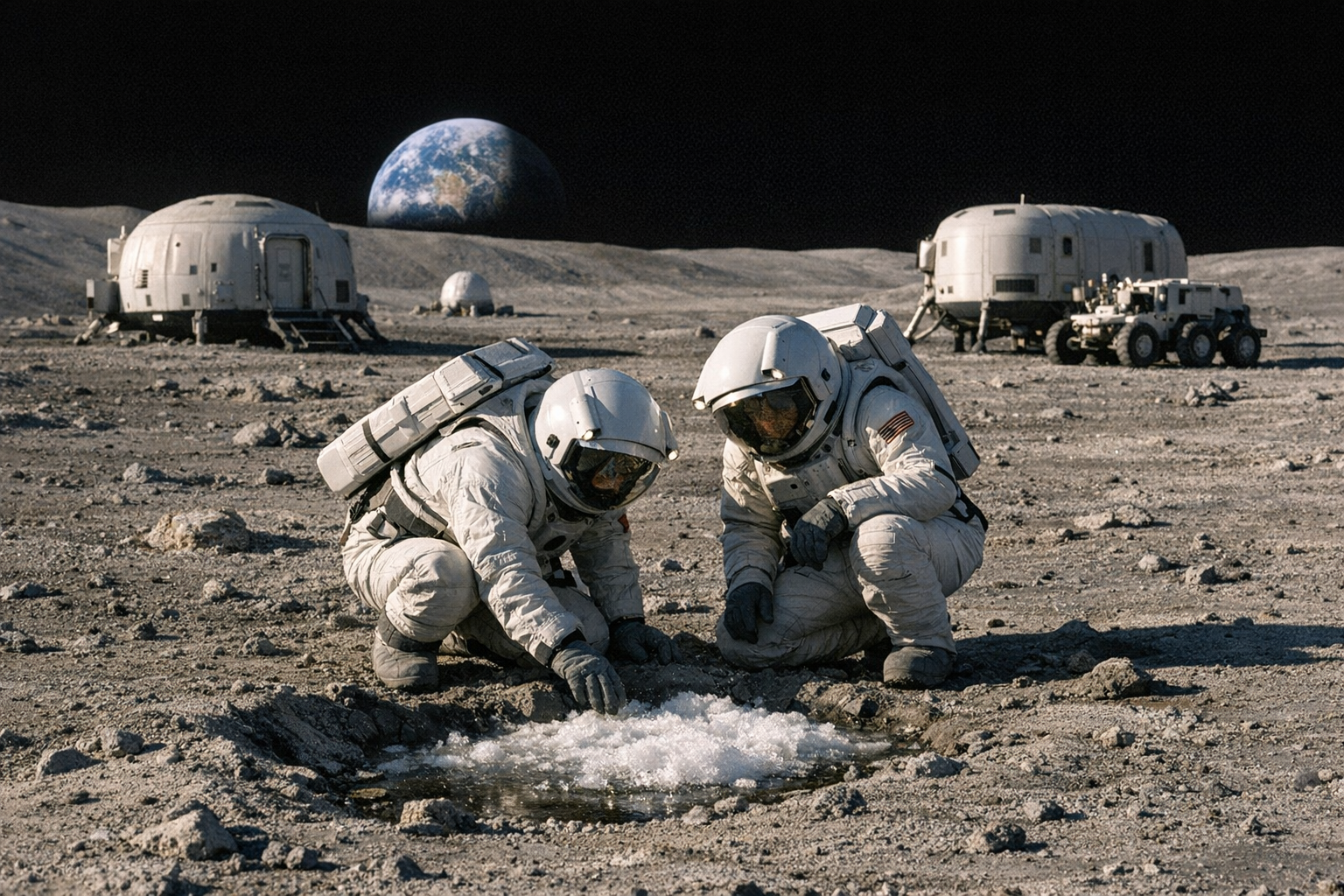
Limited lunar water reserves discovered in permanently shadowed polar craters have cooled ambitions for large-scale settlements on the moon. The initial findings that prompted visions of bases, villages and even industrial hubs now face a harsher assessment: scientists find the amount and distribution of accessible ice are far from sufficient to sustain densely populated cities or heavy industry without massive resupply from Earth.
Remote observations and analyses indicate that water on the lunar poles exists primarily as small deposits of ice and hydrated minerals trapped in extremely cold, permanently shadowed regions. That ice is often mixed with regolith and concentrated in localized “cold traps,” making extraction technically difficult and energetically costly. These physical constraints mean that the raw resource is both scarce and scattered rather than abundant and evenly available.
The practical consequences affect the scale and design of future outposts. Limited in-situ water constrains life-support capacity, forces strict recycling regimes, and prioritizes uses—drinking water and air reclamation typically take precedence over propellant production or industrial processes. As a result, planners are likely to favor compact research stations and temporary habitats over full-scale towns, and to rely on tightly integrated systems that minimize water loss and maximize reuse.
Policy and commercial strategies will need to adapt. Companies and space agencies must invest in detailed resource surveys, more efficient extraction and recycling technologies, and logistics that account for sustained resupply from Earth. The scarcity of accessible water also raises operational, economic and legal questions about how surface locations are allocated and protected under existing international frameworks. For now, the picture emerging from the poles suggests a future of targeted, small-scale human presence rather than large urban centres on the lunar surface, with science-driven priorities guiding next steps in exploration.


