

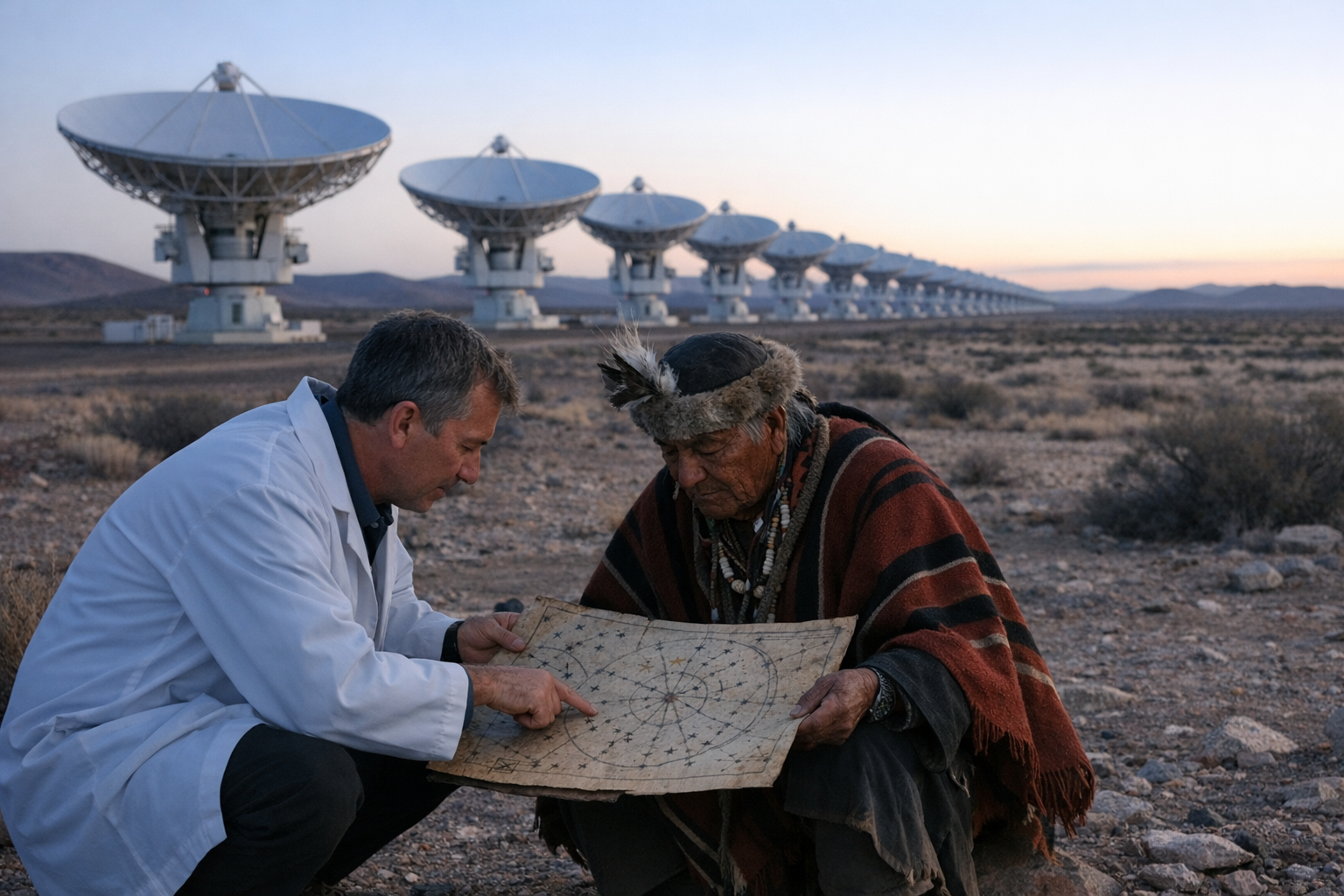
Human sky observation stretches back millennia, rooted in practices that helped communities mark time, navigate seasonal change and organise agricultural life. What today is studied as cosmology and astrophysics represents a recent phase in a long continuum of techniques and interpretations applied to the heavens. Understanding that continuity sheds light on why contemporary scientific infrastructures must account for historical records and living traditions when they expand into new territories of research and data collection.
The SKA project, or Square Kilometre Array Observatory, has emerged as a prominent example of this dynamic. Its multinational scale and the location of radio arrays across Southern Hemisphere sites have prompted exchanges between scientists, archivists and local communities. These interactions range from the use of documentary and oral sources to situate observations within longer histories, to practical discussions about land, access and the stewardship of sites that carry cultural significance.
Bringing together historical archives, community-held memory and contemporary research highlights several concrete needs. First, long-term data curation must be matched by careful preservation of documentary and intangible heritage to ensure that contextual information remains available for future study. Second, ethical engagement frameworks are necessary so that custodians of local knowledge participate on equitable terms. Third, cross-disciplinary collaboration—between historians, archivists, anthropologists and instrumental scientists—can broaden the interpretive lens applied to astronomical data and help avoid the erasure of non-scientific perspectives.
The experience surrounding the SKA points to broader implications for large-scale science: infrastructure projects intersect with memory landscapes and legal, cultural and technical systems. Recognising and integrating this overlap does not weaken scientific inquiry; it can enrich research outcomes, support heritage protection and foster more resilient models of cooperation. For fields from astronomy to cultural heritage management, the ongoing dialogue offers practical lessons on how to align cutting-edge inquiry with respect for the past and the communities that continue to interpret the sky.


