

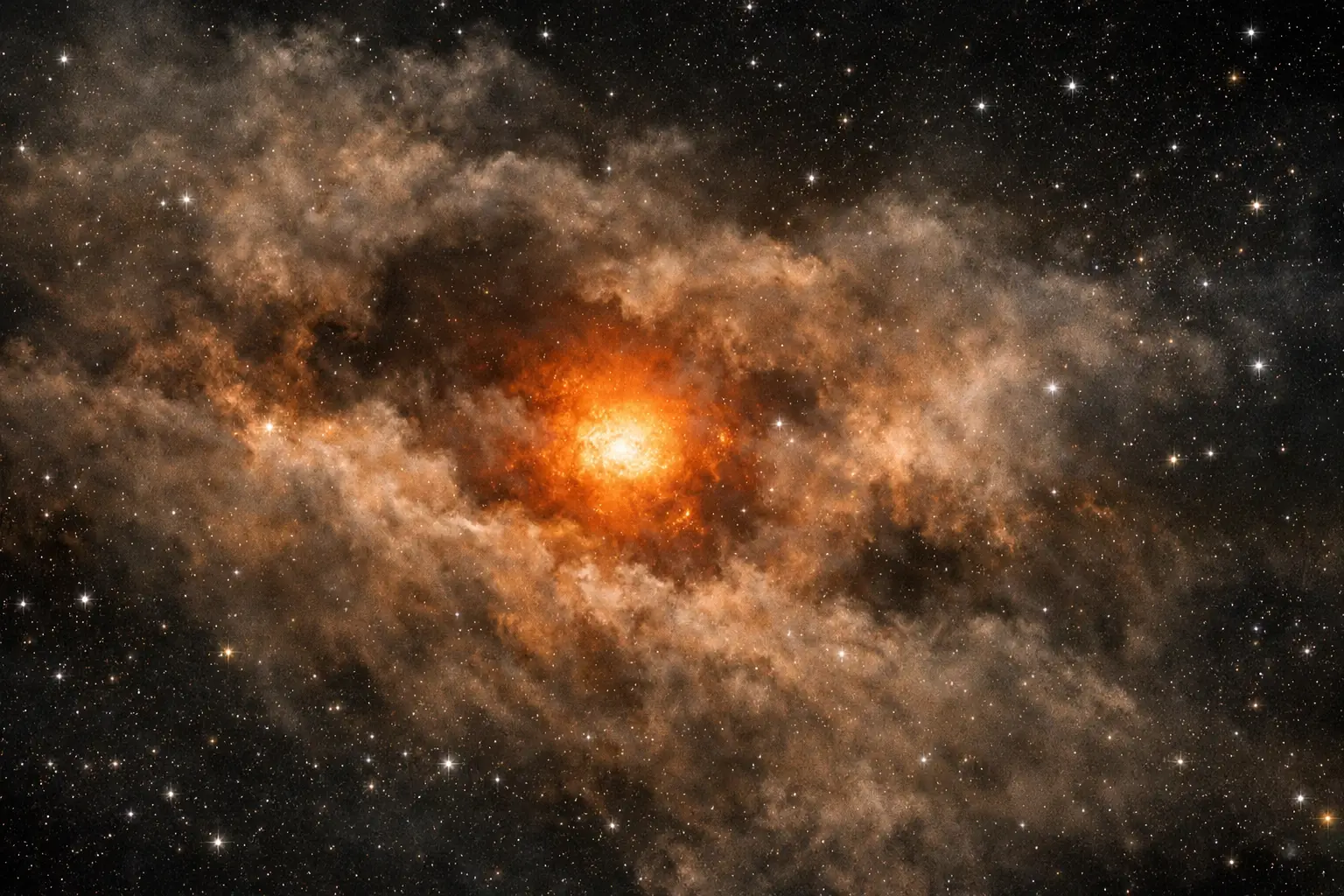
Stars seem reassuringly constant from Earth, but their apparent calm can hide complex physical change. The Sun is a useful point of comparison: it is a relatively low-mass star and is expected to shine with broad stability for billions of years. More massive stars, though rarer, live very different lives because their greater mass drives more extreme internal pressures, faster fuel consumption and shorter evolutionary phases.
The sudden dimming seen in some mature stars is not simply a matter of a star switching off. Stellar brightness depends on the balance between gravity, nuclear fusion and the movement of energy through a star’s interior and outer layers. As a star ages, that balance changes. Its core composition evolves, its atmosphere can expand, and material can be pushed outward into the surrounding space. These processes can alter both the star’s true luminosity and, just as importantly, the amount of visible light that reaches observers.
One key mechanism involves material shed by an ageing star. Gas lifted from the outer layers can cool far enough for dust to form. When that dust lies along the line of sight, it absorbs and scatters visible light, making the star appear to fade, sometimes sharply. The energy has not necessarily vanished; some of it may be re-emitted at longer, infrared wavelengths. This distinction is central to modern astronomy, where observations across different parts of the spectrum help separate a real decline in output from light being blocked or redistributed.
Space observatories and long-running sky surveys have made these episodes easier to identify because they can track changes that the human eye would miss. Institutions such as NASA and the European Space Agency support missions that monitor stellar light over time, building records of variability across large populations of stars. Those records matter because a temporary luminosity dip can reveal mass loss, atmospheric instability and late-stage stellar evolution.
For scientists, these fading events are not minor curiosities. They offer evidence of how stars return material to their surroundings, enriching space with elements and dust that can later become part of new stars, planets and planetary systems. The contrast with the steadier Sun also helps place our own star in context. What looks like a simple point of light can, near the end of its life, become a changing system whose brightness records the physics of ageing matter under gravity.


