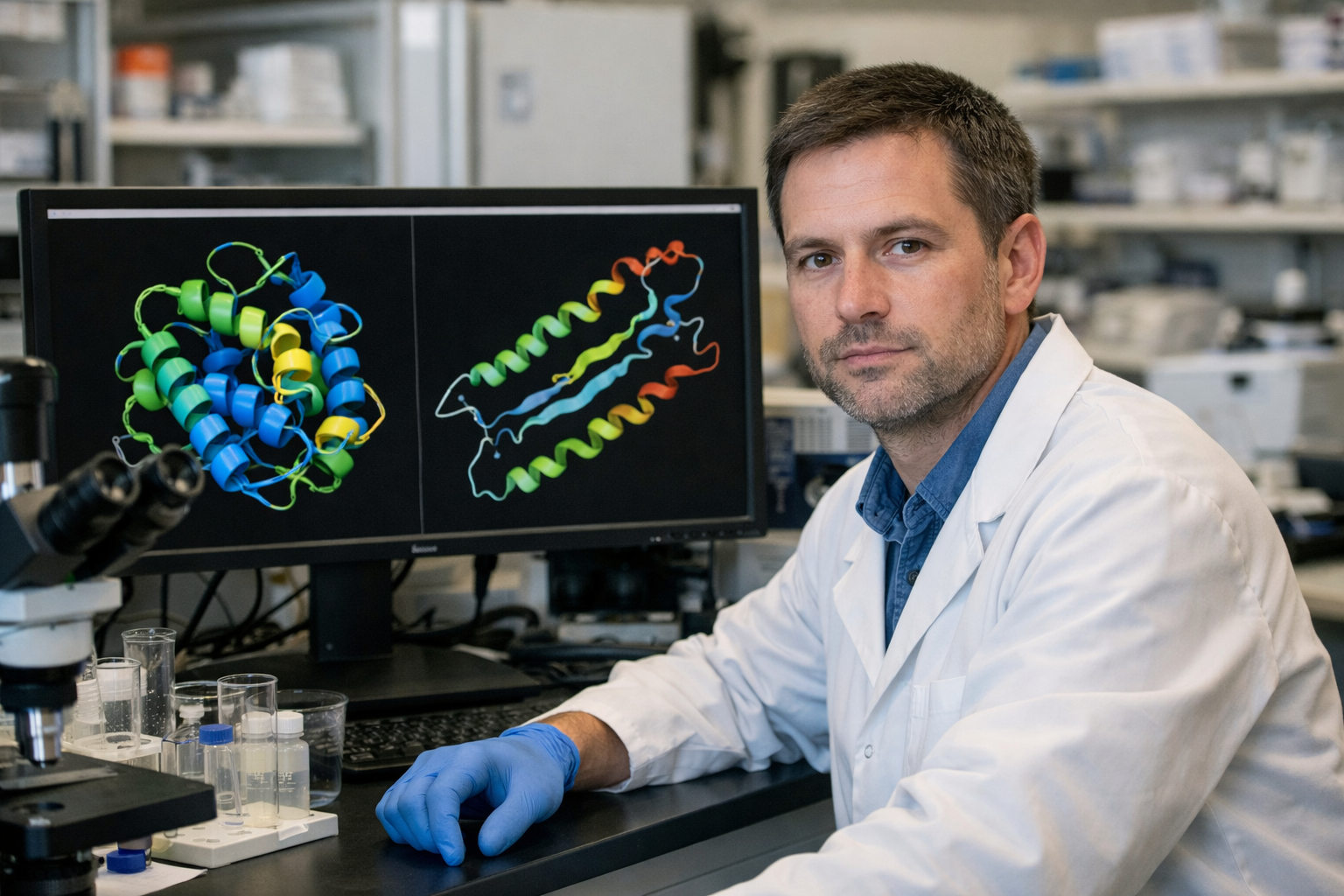
Novel approach enables a broader view of molecular motion by nudging AI predictions away from a single outcome. Scientists at the Institute for Molecular Science (IMS) and the Graduate University for Advanced Studies, SOKENDAI have adapted the computational workflow around AlphaFold3 so that the software can produce a wider array of plausible structures. The change targets the longstanding challenge of modelling conformational change, a central property of many proteins that underpins catalysis, signalling and transport.
The team introduced a controlled repulsive interaction among alternative models generated by the program. By imposing a mild repulsive force between predicted structures, the algorithm is pushed to explore alternative minima on the protein folding landscape rather than converging repeatedly on the same dominant pose. Applied to AlphaFold outputs, this maneuver increases structural diversity among predictions and surfaces states that default settings rarely capture.
This methodological adjustment does not change the underlying physics encoded in the neural network; instead, it alters how candidate models are sampled and selected. The result is a computational ensemble that better reflects the range of shapes a protein can adopt. For experimental groups, such ensembles can guide the design of validation studies and help prioritise which conformations to pursue with laboratory techniques. For computational scientists, the modification offers a route to integrate model diversity into downstream analyses without discarding the predictive power of modern deep-learning frameworks.
The work highlights a pragmatic direction in the evolution of AI-enabled structural biology: refining sampling strategies to complement advances in model accuracy. By addressing a practical limitation of AlphaFold3, researchers at IMS and SOKENDAI provide a tool that expands how prediction outputs can be interpreted and used, particularly when protein function depends on motion between distinct shapes. As AI tools continue to advance, such focused refinements may be key to bridging the gap between static models and the dynamic behaviour observed in biological systems.