

Unlock the Editor’s Digest for free
Roula Khalaf, Editor of the FT, selects her favourite stories in this weekly newsletter.
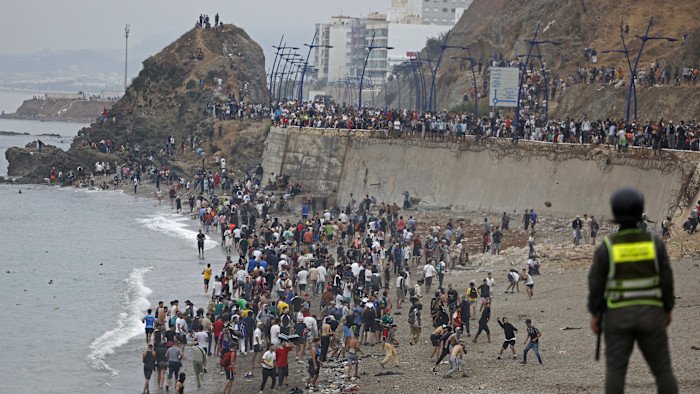
A picture is worth a thousand words. Or facts. The images of tens of thousands of migrants overwhelming border controls to enter the Spanish North African enclave of Ceuta from Morocco are shocking. So is the death toll of more than 70. The massive influx offered the perfect illustration for anti-immigration politicians of a Europe under threat of invasion. “Remember that picture,” said Donald Trump.
Spain’s socialist prime minister Pedro Sánchez has made a point of defying and irking Trump, whether on defence spending, policy towards Israel or tech regulation. So he could have expected the American president’s antipathy. But not the hostility he has received from Spain’s European partners. The Ceuta incident has opened up an extraordinary rift within the EU. It has left Sánchez, one of few western leaders who espouses a liberal immigration policy on moral and pragmatic grounds, looking isolated.
The EU’s Schengen internal borderless travel zone is only as secure as its weakest external frontier. Each of its member states has an interest in what the other one does. But the reactions of European capitals to the Ceuta influx were hasty, ill-informed and self-serving. Italy’s rightwing prime minister Giorgia Meloni immediately demanded Spain’s suspension from the Schengen zone. Denmark’s centre-left premier Mette Frederiksen, an immigration hardliner, and several other EU leaders echoed Meloni’s call to varying degrees. French President Emmanuel Macron ordered extra border patrols.
They seem to ignore that Ceuta is de facto outside the Schengen zone. Travellers from the enclave have to show passports and visas to enter the Spanish mainland. It is probably harder for an illegal migrant to make it to the mainland from Ceuta, a small and highly patrolled territory, than from Morocco itself. The vast majority of the 60,000 people who swam or clambered their way into Ceuta last week had returned to Morocco within 24 hours.
Spain’s European partners also appear to have ignored Morocco’s part in this drama. Madrid has been careful not to blame Rabat. It needs its co-operation, in the short term to take back the Ceuta migrants and longer-term on migration control and security. It is a reminder that the EU’s immigration control depends on collaboration with its neighbours. But given the reports of a lack of usual personnel on the Moroccan side of the border, Madrid has good reason to believe Rabat allowed the influx as an act to pressure Spain. Why? Because Morocco has done it before.
In 2021, several thousand migrants were able to overwhelm Spanish border controls in Ceuta during a diplomatic row between the two countries over the disputed region of Western Sahara which is under Morocco’s control. Spain has since shifted position to support Rabat’s plan for autonomy for the region under Moroccan sovereignty. Spain’s offence this time could be a recent attempt by Sánchez to improve relations with Algeria, Morocco’s arch-rival.
When Belarus weaponised irregular migrant flows into Poland in 2021 or before that Turkey into Greece, the EU pledged full solidarity. But not this time. Now Spain is being blamed by its EU friends.
Spain certainly has questions to answer about intelligence failures in this instance or insufficient border infrastructure in Ceuta. But it had half the number of irregular border crossings of Italy last year according to Frontex, the EU’s border agency. As Gerald Knaus of the European Stability Initiative think-tank has pointed out, Spain is also much better than Italy at taking back from other EU member states irregular migrants who first entered the bloc via its territory — 1,366 versus against a measly 60 in 2024 — a crucial part of EU immigration policy.
Recommended

It is unusual for EU members to turn on each other in public in the way they have on Spain, one of the bloc’s few remaining leftwing governments. Sánchez is deemed unacceptably lax on immigration when nearly every other leader is hardening their policy. The real cause of tension? A proposed amnesty for irregular migrants who have lived in Spain for at least five months. It was supposed to cover 500,000 people but more than 1.2mn applied. In a letter on Saturday, Meloni, Frederiksen and 20 other leaders called on the EU to prioritise “strengthening our external borders and addressing all policies that can serve as pull factors, such as the regularisation of very large number of irregular migrants”. There’s not much research to back up the claim that amnesties encourage further illegal migration, but it is an easy claim to make.
The Ceuta influx risks undermining public confidence in EU border policy. But a knee-jerk reaction by EU leaders will not help. Instead, the panic speaks volumes about the political moment the EU is in: the beginning of a coming cycle of elections in Germany, France, Spain, Poland and Italy, where incumbents are under threat from far-right anti-immigration insurgents. Even Meloni is being outflanked on issue. Ceuta offers a frightening spectacle. It is not the real story.
[email protected]
Source:
www.ft.com


