

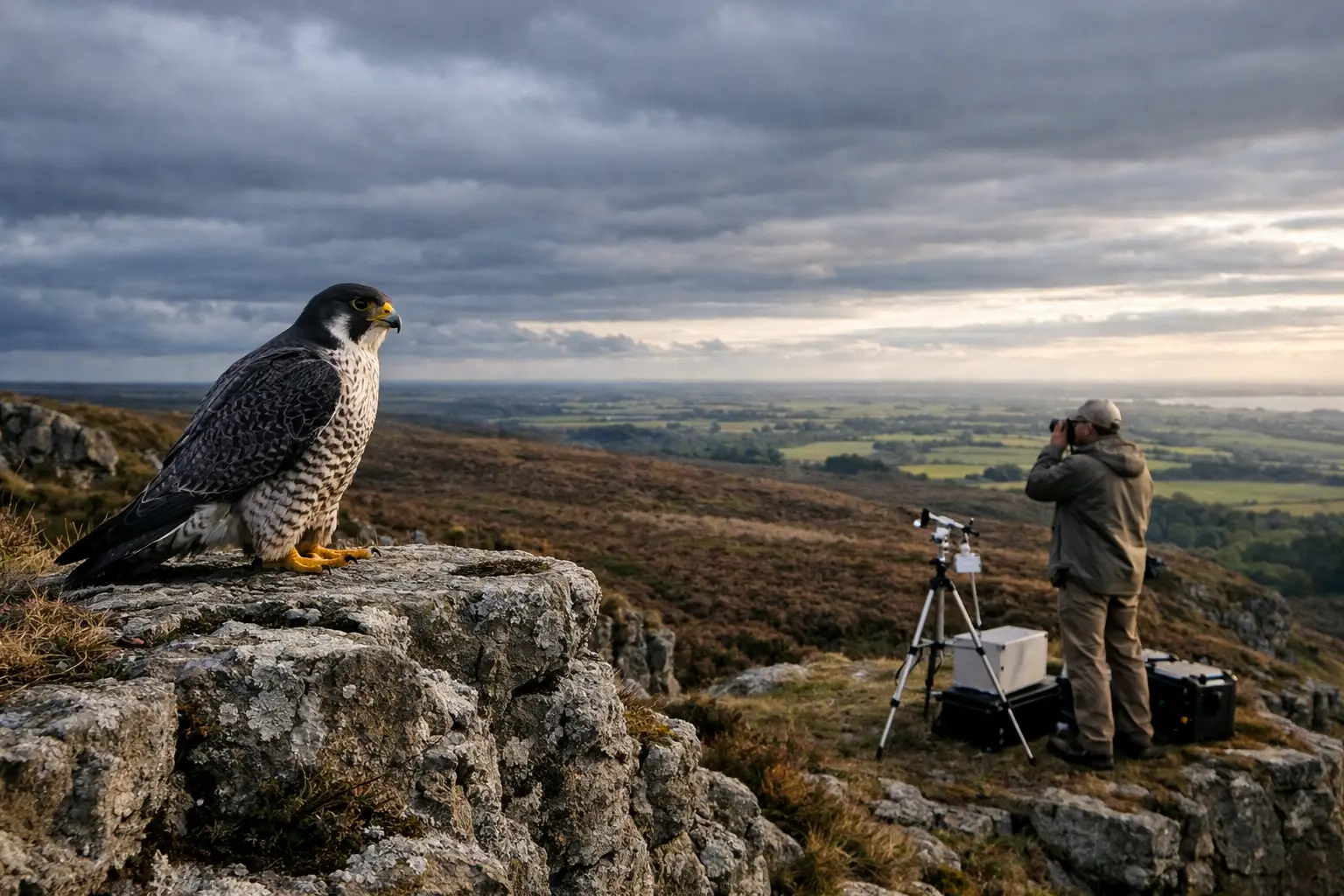
Britain could become a significantly more suitable home for the peregrine falcon by the end of the century, as warming temperatures reshape the conditions available to wildlife. A new study finds that the area of the United Kingdom suitable for the species could increase by 74% by 2080 under a high-emissions climate scenario, creating a notable shift for the bird widely recognised as the fastest animal on Earth.
The finding highlights one of the more complex effects of climate change: while many species face shrinking ranges, others may find new or expanded areas that match their ecological needs. For peregrine falcons, the projected increase does not automatically mean a larger population or guaranteed expansion. Suitable territory indicates that conditions may become more favourable, but actual outcomes depend on nesting sites, prey availability, human disturbance and conservation pressures.
The study’s projection is tied to a high-emissions pathway, a scenario in which global warming continues to intensify because greenhouse gas reductions remain limited. Such pathways are used by climate scientists to examine how ecosystems may respond under different futures. The Intergovernmental Panel on Climate Change has repeatedly warned that higher emissions increase the scale and speed of environmental disruption, even when some species appear to gain potential habitat in specific regions.
For Britain, the possible expansion of peregrine-suitable areas adds to the growing evidence that wildlife management will have to adapt to fast-changing climatic conditions. Conservation planning has traditionally focused on protecting existing habitats, but climate-driven range shifts can require broader monitoring, flexible protected areas and attention to landscapes that may become important in future decades. Birds of prey are also closely linked to the health of wider ecosystems, making changes in their distribution relevant beyond a single species.
The peregrine falcon has long been a symbol of aerial speed and adaptability, but the new projection is not a simple good-news story. A warmer climate may open space for some animals while placing severe pressure on others, altering ecological balances in ways that are difficult to predict. The 74% increase estimated for 2080 offers a clear example of how climate change can redraw wildlife maps, with consequences that will depend on both global emissions and local conservation choices.


