

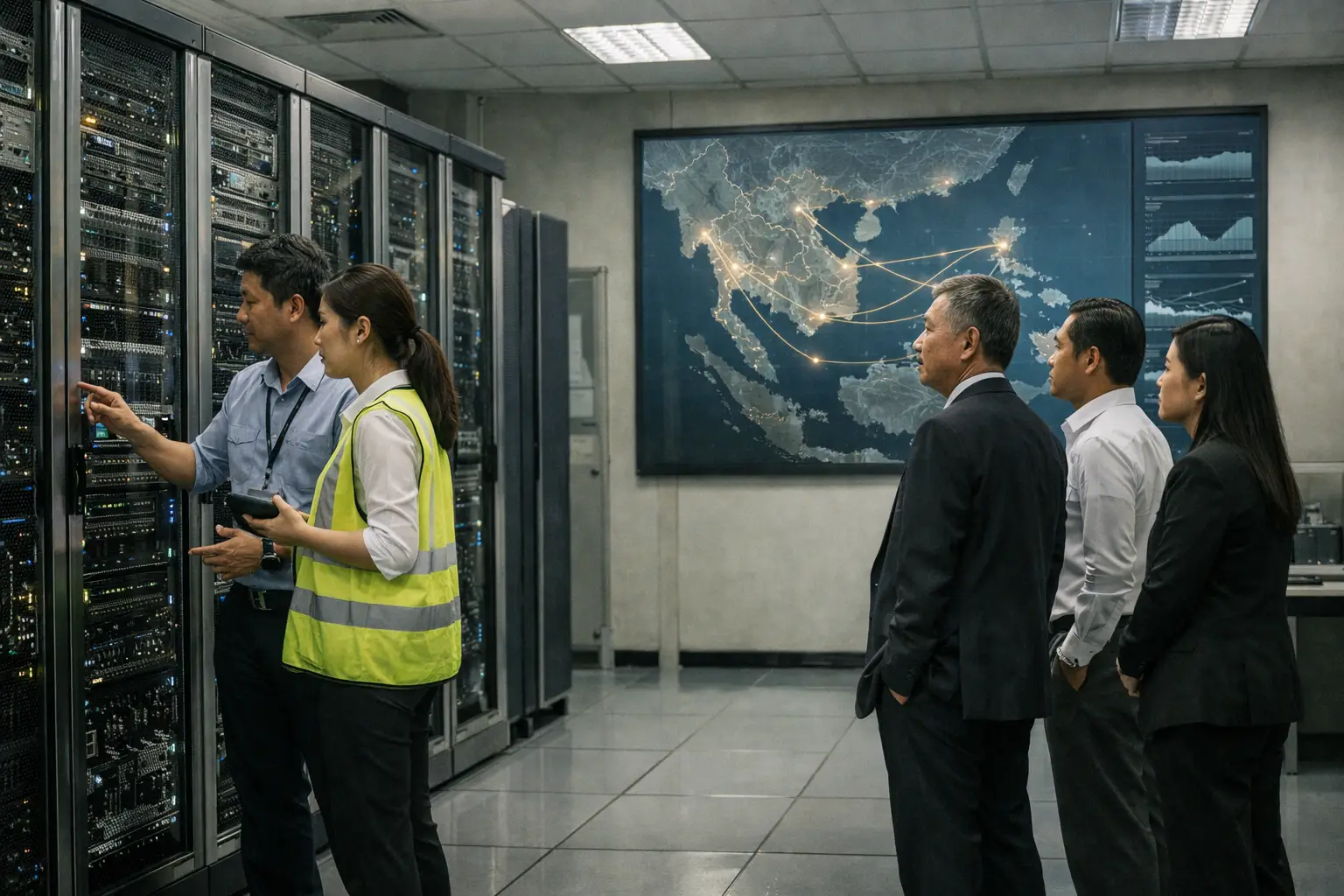
Access to advanced AI chips has become an increasingly difficult constraint for companies operating in China, where U.S. export controls limit the availability of the most powerful processors used to train and run artificial intelligence systems. The restrictions have not eliminated demand. They have shifted part of it beyond China’s borders, where firms can use computing capacity hosted offshore rather than obtaining the restricted hardware directly. Southeast Asia has emerged as a particularly important location in that adjustment.
The mechanism is straightforward: when the chips themselves are hard to import, access to servers equipped with those processors can become an alternative route. For companies building large models or deploying advanced artificial intelligence tools, the decisive resource is not only ownership of the semiconductor, but also the ability to use it at scale. Offshore computing services can therefore reduce the practical impact of hardware restrictions, even when the chips remain outside China.
The United States is working to close that gap. Export controls overseen by the U.S. Department of Commerce and its Bureau of Industry and Security are intended to prevent the most advanced computing power from strengthening capabilities that Washington considers sensitive. The growing use of overseas data centers complicates that goal, because the transaction may involve remote access to computing resources rather than the physical shipment of a controlled chip to China.
This creates a new enforcement challenge for the global semiconductor supply chain. Controls designed around exports of hardware must now contend with cloud infrastructure, data-center services and cross-border computing arrangements. Southeast Asian markets sit at the center of that pressure because they are geographically close to China, deeply connected to regional technology networks and attractive for companies seeking scalable digital infrastructure. The issue also increases scrutiny on service providers, who may face greater demands to verify how advanced computing resources are used.
The contest over AI chips is therefore moving beyond factories and customs controls. It is becoming a broader struggle over access to computing power itself. For Chinese companies, offshore capacity offers a way to keep developing advanced AI systems despite tighter restrictions. For the United States, the same practice risks weakening the effect of its controls. The result is a more complex regulatory frontier, where the location of servers can matter as much as the destination of the chips.


