

Unlock the Editor’s Digest for free
Roula Khalaf, Editor of the FT, selects her favourite stories in this weekly newsletter.
When the final whistle blew at the men’s football World Cup two weeks ago, Fifa president Gianni Infantino’s position seemed impregnable. Despite controversies and complaints about ticket prices, the tournament was a dazzling success, its revenues dwarfing those of previous World Cups. But Infantino’s scheme to set up a new company housing Fifa’s commercial interests and sell stakes to private investors triggered an extraordinary backlash across much of the global game. With rebel federations and associations gathering signatures for an extraordinary meeting and no-confidence vote, he should stand down.
In another form and different hands, some version of Infantino’s plan might have worked. There is nothing inherently wrong with further commercialisation of international football provided it balances all stakeholders’ interests. The flood of private investment and TV money particularly into European leagues has had some important positive effects — helping to upgrade stadiums, slow rising ticket prices and reduce financial blow-ups at clubs.
Commercial innovations in this World Cup showed the potential to unlock further value; compared to some other global sports, TV and sponsorship revenues still left money on the table. Maximising returns to expand football in developing countries beyond its strongholds in Europe and the Americas makes sense in principle.
But Fifa doesn’t need outside investors to do this. Infantino pointed to how the Spanish and French football leagues sold stakes to private equity. But they were seeking fresh capital after the Covid pandemic badly weakened their finances. Fifa, by contrast, has $2.7bn in reserves, and is projecting $15bn revenues in the four-year cycle ending with this year’s tournament. It could hire talented executives to boost value.
Many national associations, even if they would have benefited from higher distributions, also balked at diverting some of that value unnecessarily to private investors. Pressure would very likely increase for further expansion of the World Cup or Club World Cup — diluting the rarity value and crowding the match calendar to the detriment of football’s wider ecosystem.
All this has, ironically, only highlighted the need for another element of Infantino’s plan — separating Fifa’s role as regulator of world football from its commercial activities — but not as the Fifa president envisaged it. Infantino drew up his commercial plan in secret, without the knowledge of top lieutenants, and gave Fifa’s 211 member associations 53 days to take it or leave it.
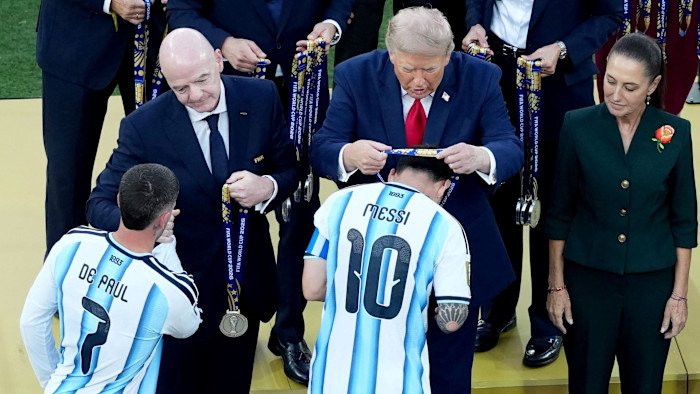
It included an anchor investor run by the brother of Donald Trump’s son-in-law. Much of the football world has viewed with distaste Infantino’s courting of the US president, epitomised for many by Infantino awarding Trump a Fifa “peace prize” last year and the suspension of a red card ban for US striker Folarin Balogun last month after Trump intervened (Fifa insists its disciplinary committee acted independently). In a different era, in 2015, it was US law enforcement that played the primary role in exposing corruption at Fifa which forced Sepp Blatter’s resignation after 17 years as president. Infantino was supposed to clean up Fifa.
The latest debacle has instead laid bare the lack of transparency and checks and balances that concentrates vast power in the Fifa president’s hands. While Fifa is a non-profit association, no corporation with multibillion-dollar revenues would tolerate the equivalent of a joint CEO and chair devising a major business initiative without consulting senior management and the board. Fifa now needs a far more sweeping shake-up of governance than what took place a decade ago. A red card for Infantino would be an important first step.
Source:
www.ft.com


