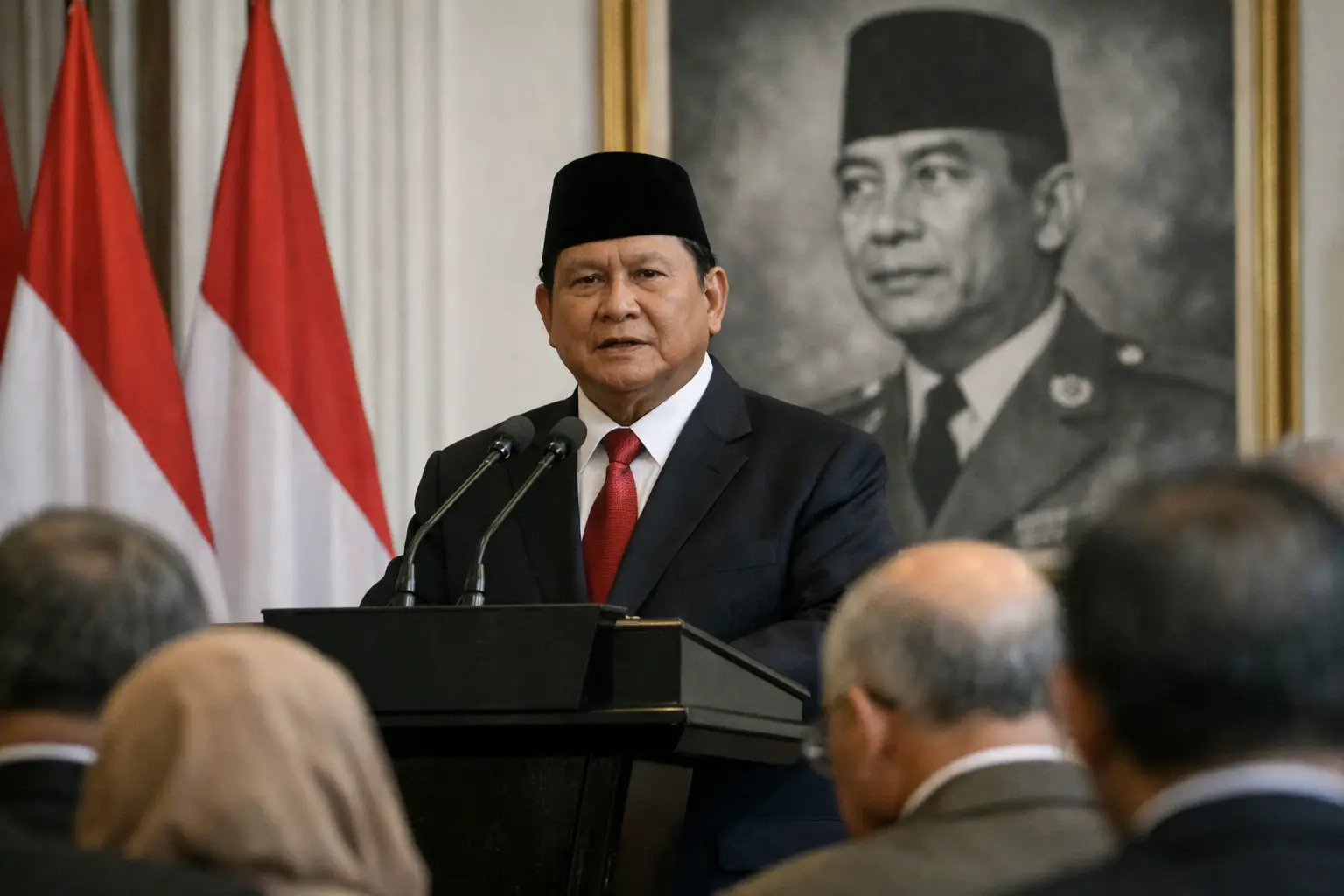
Indonesia’s new posture under Prabowo Subianto is being read through the long shadow of Sukarno, the country’s founding president and one of the most recognizable voices of post-colonial diplomacy. The comparison matters because Jakarta is again seeking to present itself not merely as a large Southeast Asian state, but as an independent power able to speak across divides in a fragmented international order.
Prabowo, who took office after winning Indonesia’s 2024 presidential election, inherited a country that had already gained diplomatic visibility under Joko Widodo. Indonesia is a member of the G20, the largest economy in Southeast Asia and a central player in ASEAN. Its traditional doctrine of a “free and active” foreign policy has allowed Jakarta to avoid formal alignment with major power blocs while maintaining relations with competing partners, including the United States and China.
The Sukarno reference carries historical weight. In 1955, Indonesia hosted the Bandung Conference, a landmark gathering of Asian and African states that helped define anti-colonial solidarity and later influenced the Non-Aligned Movement. That legacy remains part of Jakarta’s diplomatic identity, particularly when Indonesian leaders address conflicts, development gaps and the structure of global governance. The official Indonesian presidency continues to frame the country’s external engagement around sovereignty, independence and a wider role for the Global South.
For Indonesia, the challenge is turning symbolic ambition into consistent influence. A more assertive voice can strengthen Jakarta’s position in debates over trade, security, climate finance and multilateral reform, but it also requires careful management of regional expectations. Within Southeast Asia, Indonesia is often expected to balance national priorities with leadership inside ASEAN, where consensus can limit rapid diplomatic action.
The effort to echo Sukarno’s international stature therefore reflects more than nostalgia. It signals a desire to place Indonesia at the centre of discussions that extend beyond its immediate neighbourhood. Whether that approach produces measurable diplomatic gains will depend on how Prabowo combines rhetoric, institutional continuity and practical engagement with partners across competing geopolitical camps.