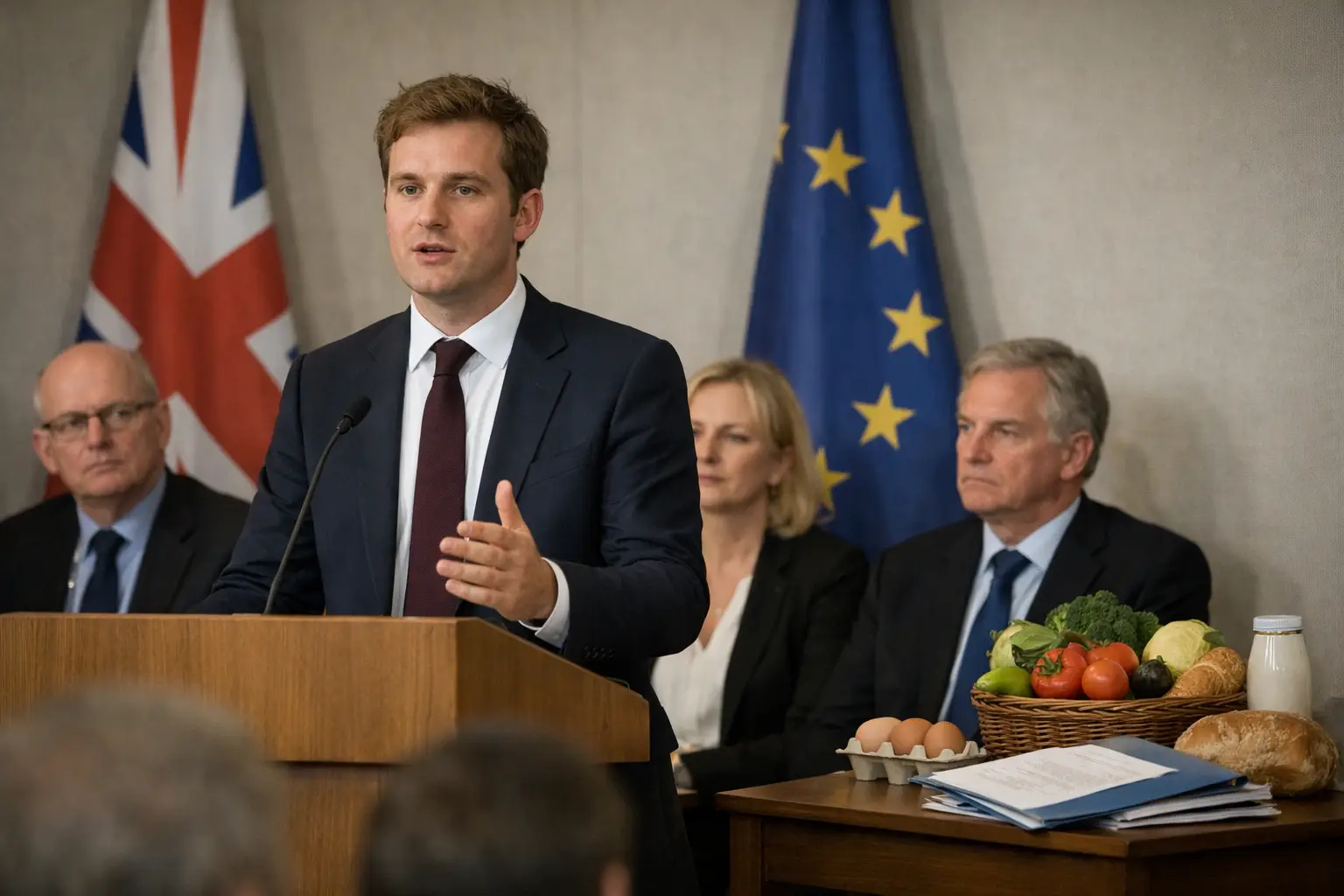
Britain would gain a formal voice but not a vote over European food rules under a proposed reset of post-Brexit relations, Hamish Falconer, the UK minister responsible for European affairs, has said. The position reflects the central compromise facing London as it seeks closer practical ties with the European Union while remaining outside its decision-making structures.
The issue is especially sensitive because food and agricultural standards sit at the heart of cross-border trade. Since Brexit, businesses moving animal products, plants and related goods between Britain and the EU have faced additional checks and paperwork. A new arrangement on food rules could ease some of that burden, but it would also require the UK Government to accept a degree of alignment with rules set in Brussels.
Falconer insisted that Britain would not be reduced to a passive observer. His argument is that a new deal could give the UK channels to discuss, scrutinise and influence policy before rules take effect, even though the final vote would remain with EU member states and institutions. That distinction is likely to define the political debate: supporters of a closer arrangement will point to smoother trade, while critics will focus on the absence of a formal British vote.
For the United Kingdom, the question is not only constitutional but economic. Food producers, retailers and logistics firms have long argued that regulatory friction increases costs and uncertainty. Any agreement capable of reducing border complexity would be closely watched by sectors that depend on predictable supply chains. At the same time, the EU has consistently guarded the integrity of its single market, making full voting rights for a non-member state impossible under the bloc’s current framework.
The proposed reset therefore highlights the limits of post-Brexit cooperation: London can seek access, consultation and influence, but not the institutional power it held as a member state. Whether that balance proves politically acceptable will shape the next phase of UK-EU relations, particularly in areas where regulation directly affects trade, consumers and domestic policy choices.