

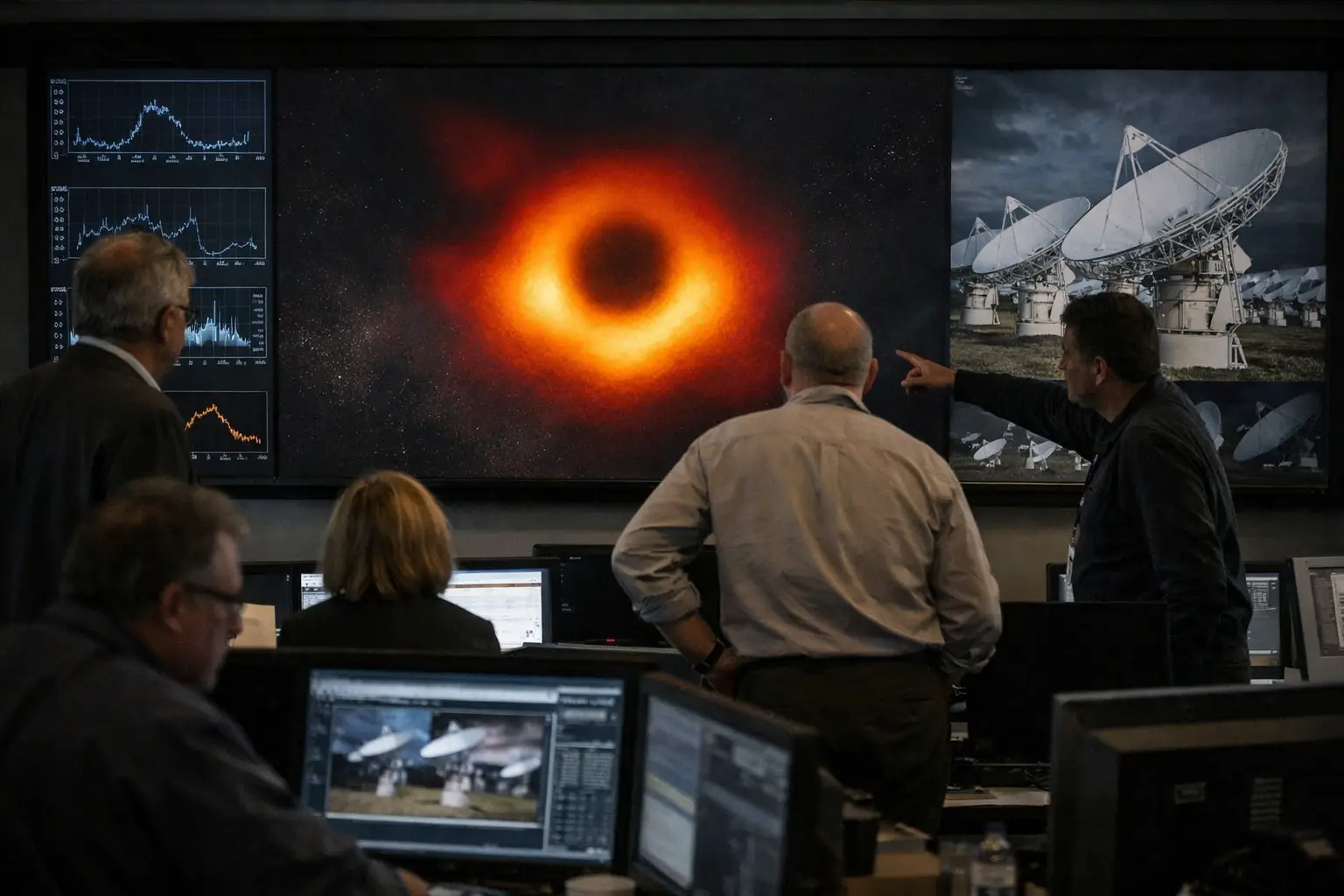
The first image of a black hole, unveiled on April 10, 2019, remains one of the defining scientific visuals of the century. It showed the object at the heart of the galaxy M87, around 55 million light-years from Earth, as a bright asymmetric ring surrounding a dark central region. A new study has now delivered an independent result, putting fresh attention on the question that has followed the image since its release: how accurately does it represent an object that cannot be photographed in any ordinary sense?
The original image was produced by the Event Horizon Telescope Collaboration, an international effort that links radio observatories across the planet to create an Earth-sized virtual instrument. That method, known as very long baseline interferometry, does not simply take a snapshot. It combines signals gathered from separated telescopes and reconstructs an image from incomplete data. For that reason, independent checks are particularly important in astronomy, where the processing choices made between observation and final image can shape what the public sees.
M87 offered scientists a uniquely powerful target for this first attempt because the black hole at its center is massive enough to appear within reach of the network’s resolving power, despite its immense distance. The 2019 result was interpreted as strong visual evidence of the shadow expected around a black hole, framed by emission from extremely hot material moving under intense gravity. The new independent result does not reduce the significance of that breakthrough; rather, it adds another layer of scrutiny to one of modern science’s most recognizable images.
The broader importance reaches beyond a single picture. Images of black holes test the behavior of matter and light in regions where gravity dominates all other forces. They also provide a rare way to compare observation with the predictions of general relativity near an event horizon. Because the image of M87 became a cultural symbol as well as a scientific dataset, confirming its robustness through separate analysis strengthens confidence in the methods used to turn radio signals into evidence.
For the public, the debate is a reminder that landmark images in science are not static trophies. They are results that remain open to verification, refinement and challenge. The M87 image earned its place in history because it made the invisible visible for the first time. The latest independent work keeps that achievement within the normal discipline of research: extraordinary observations gain authority not from being iconic, but from surviving repeated tests.


