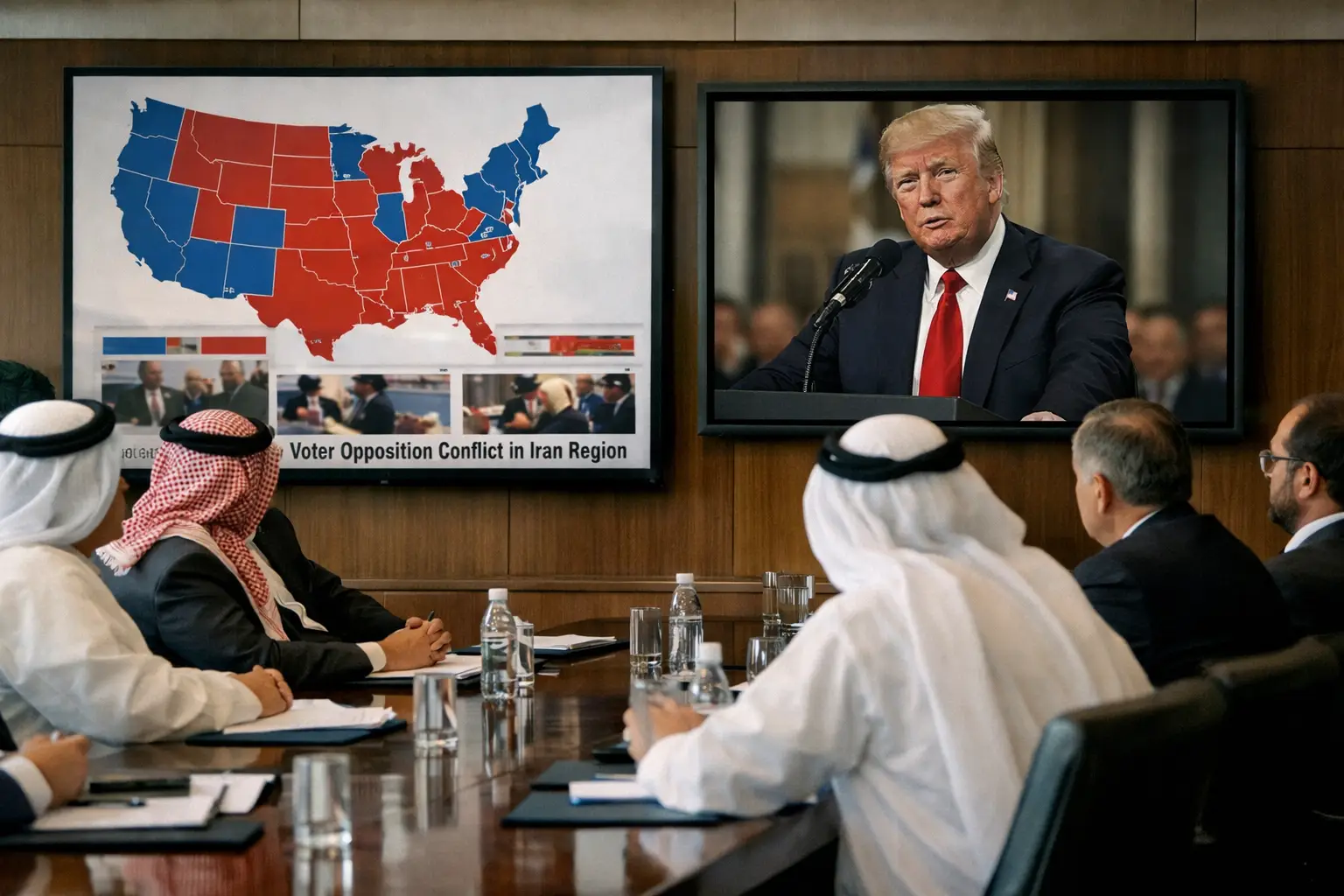
American voters have delivered a political message with consequences far beyond Washington. The midterm results exposed the depth of opposition to Donald Trump’s war with Iran, a conflict that has placed Gulf countries under sustained pressure for months. For governments in the region, the vote has created cautious optimism that the fighting between the United States and Iran could move toward an end.
The conflict has left Gulf states in an exceptionally difficult position. Geographically close to Iran and closely tied to global energy and trade routes, they have had to navigate the consequences of a war driven by decisions in Washington and Tehran. The longer the confrontation has continued, the more regional governments have been forced to manage risks they did not control, from diplomatic strain to the broader uncertainty surrounding security in the Gulf.
The midterm vote does not end the war by itself, and it does not automatically change American policy. But the result has weakened the political case for continuing a conflict that voters have shown they do not support. For Donald Trump, the message from the electorate places the war at the center of domestic political pressure. For Gulf governments, that pressure matters because any shift in Washington’s calculations could alter the course of the confrontation with Iran.
The region’s optimism is therefore measured rather than celebratory. Gulf countries remain caught between two adversaries whose decisions can reshape the security environment around them. Still, the electoral backlash in the United States offers a possible path out of a conflict that has dominated regional concerns for months. If American political pressure translates into a push to reduce hostilities, Gulf states would be among the first to feel the effects.
The significance of the vote lies in the connection between domestic politics and foreign policy. A war fought abroad has become a liability at home, and that change is being watched closely in capitals across the Gulf. The coming period will show whether voter opposition in the United States is strong enough to influence the direction of Washington’s Iran policy and bring a conflict-weary region closer to stability.