

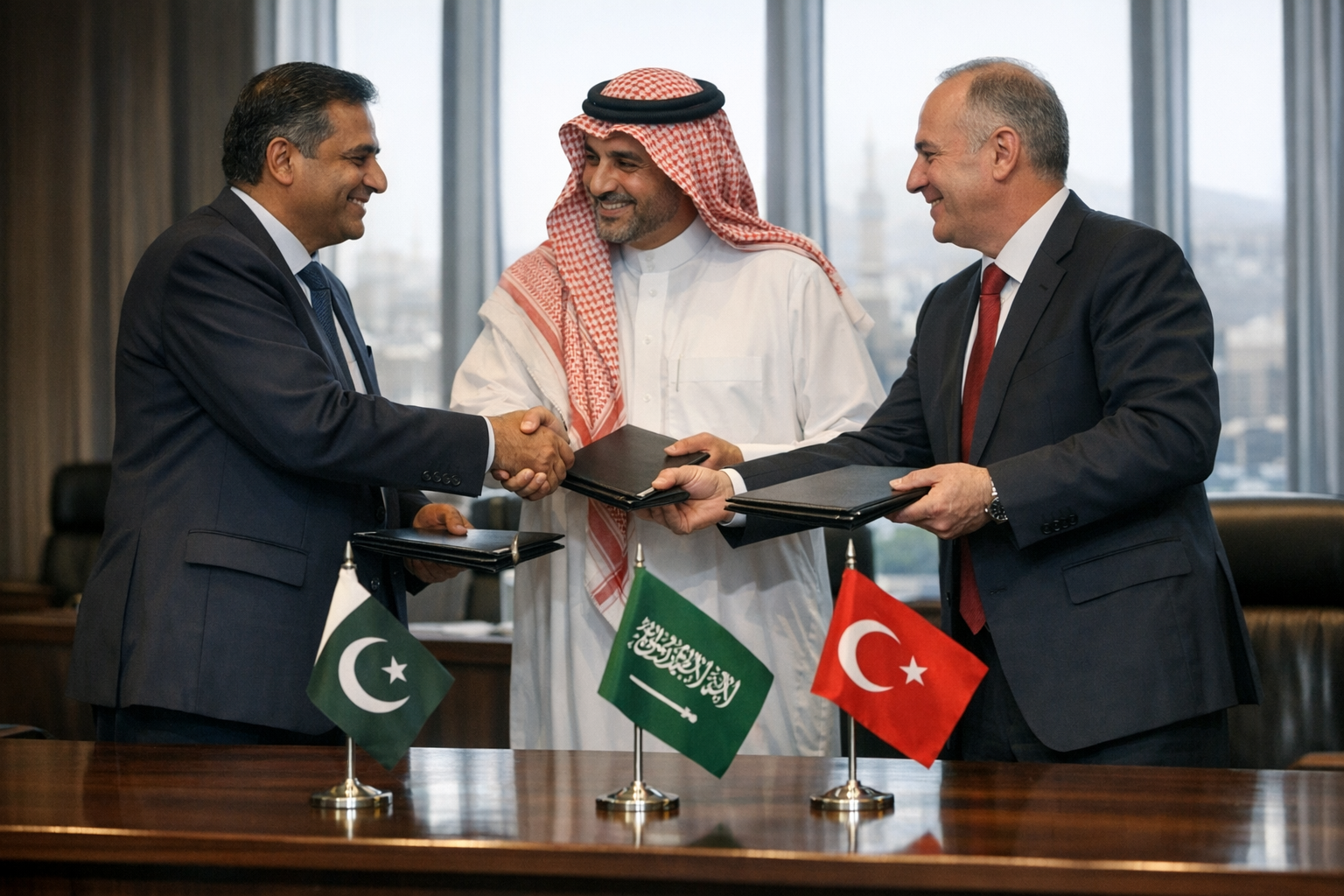
Few firm details have been released about the defence agreement announced between Pakistan, Saudi Arabia and Turkiye, often referred to in media coverage as the “Mecca Pact.” Official statements confirm the existence of a joint security understanding among the three capitals, but the text of the instrument, its legal classification and the operational arrangements have not been published. The limited information available consists primarily of high-level announcements without accompanying treaty language or implementation timelines.
The absence of a full public text leaves several practical questions unanswered. It is not publicly specified whether the agreement establishes a standing command structure, provisions for joint deployments, basing rights or specific article-based mutual-defence obligations. Domestic ratification procedures and whether parliamentary approval is required in each state are also not detailed. For official positions, each country’s foreign ministry maintains its public portals: Ministry of Foreign Affairs of Pakistan, Ministry of Foreign Affairs of Saudi Arabia and Ministry of Foreign Affairs of Türkiye.
Context is central to assessing the pact’s significance. The announcement arrives amid broader shifts in regional security dynamics and evolving defence partnerships across the Middle East and South Asia. Without detailed provisions, however, it is difficult to determine whether the agreement is primarily symbolic, focused on intelligence-sharing and exercises, or designed to create binding military commitments. The level of integration envisaged, procurement and training arrangements, and how the pact interfaces with existing bilateral agreements remain unspecified.
Next steps for clarity will be the publication of the agreement text and any implementing documents, along with statements clarifying timelines and institutional arrangements. Observers will also monitor whether follow-up memoranda of understanding, parliamentary deliberations or operational announcements provide concrete measures. Until such documentation is released, assessments of the pact’s practical impact on regional security and alliances will be necessarily constrained by the limited public record.


