
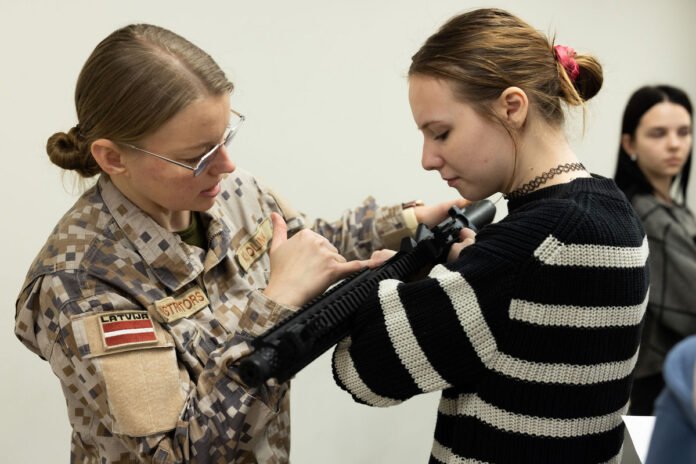
There was debate in Latvia about the program, Āboliņš says. But it was “surprisingly calm.” The crucial thing, he argues, was that the government introduced it gradually. The first courses began in 2018 in 13 schools, all on a voluntary basis. More schools joined each year. By the time the course became mandatory on September 1, 2024, most were already taking part. Russia’s full-scale invasion of Ukraine did the rest.
Āboliņš is built as broadly as Skanis. The two soldiers served together in Afghanistan, and the local training chief calls his boss “Father” with visible respect. The colonel has two children. His 18-year-old daughter is currently taking part in the national defense program and likes it, he says. “I just feel sorry for her instructors. They know that I hear about their performance.”
Skanis has two children as well, both daughters. “The 4-year-old loves my job, especially the uniform.” Then he pauses. And the older daughter? “My 19-year-old is a pacifist.” His smile disappears. “She remembers my deployments to Afghanistan. She was a little girl then. To her, my being a soldier means being away from her.”
How does a country in defense mode deal with young people who do not want to touch a weapon? “We don’t force anyone,” Skanis says. If someone is a convinced pacifist or says that his religion forbids it, the instructors ask for a presentation in the classroom instead. At least in peacetime.
“If war comes to Latvia, everyone needs to be ready,” Skanis says. “Some say they’ll fly away, but there won’t be any planes leaving anymore.”
That said, pacifism is much less prevalent in Latvia than elsewhere in the EU. Across the bloc, willingness to fight for one’s country tends to be low in Western Europe and markedly higher in the states that live in Russia’s shadow.
For Latvia, the threat lies just across the border. The country shares a 176-mile border with Russia and a 107-mile border with Belarus, a country firmly within Russia’s sphere of influence that served as a staging ground for Russia’s full-scale invasion of Ukraine.
For Latvia, the threat lies just across the border, as it shares a 176-mile border with Russia.
For the course’s female instructor, Monika Lazdina, the war in Ukraine was also the turning point. She quit her job in finance and joined Latvia’s National Guard. After 72 hours of teacher training, the 32-year-old mother of two now teaches national defense. In the classroom, the slight woman with the blond ponytail is firm but quiet — a contrast to Skanis and his thundering bass voice.
“I try not to think too much about the possibility of war,” Lazdina tells me. If war comes to Latvia, she says, her first move would be to try to get her children out of the country. And then she would come back. “I would stay and fight.”
Source:
www.politico.com


