

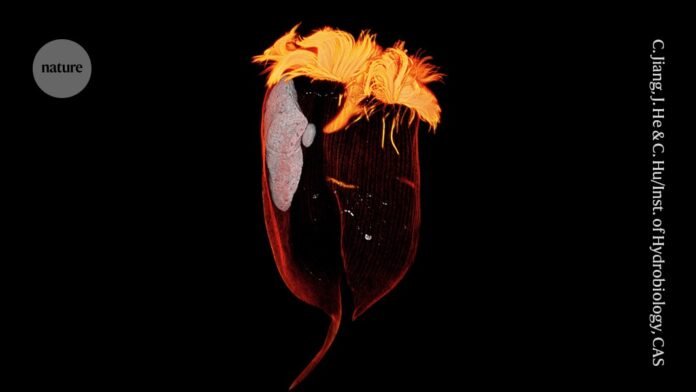
The newly discovered organelle was found in ciliates (like this Entodinium caudatum). These eukaryotic organisms live in the rumen of herbivores.Credit: Chuanqi Jiang, Jinying He & Che Hu/Inst. of Hydrobiology, CAS
Scientists have identified a new type of cellular organelle inside microbes that live in the guts of ruminant animals such as sheep and cows.
In a paper published in Science on 30 April1, researchers describe an oval-shaped structure that they discovered inside rumen ciliates — a type of single-celled organism that lives inside ruminants.
These subcellular structures, called hydrogenobodies, were found to contribute to the generation of methane livestock. The organelle removes oxygen and releases hydrogen, which archaea in the rumen use as fuel to produce methane. Burping livestock contribute around 30% of global methane emissions produced by human activities, and the authors say their discovery could inspire new ways to reduce these emissions.
“This opens new opportunities to modulate the rumen microbiome more precisely” to make animals’ digestion more efficient and lower the methane they produce, says Oscar Gonzalez-Recio, a geneticist who studies the rumen microbiome at the University of Edinburgh, UK.
Tiny emitters
Ciliates make up 25% of microbial mass in the rumen — a specialized stomach compartment in ruminants that acts as a fermentation vat to break down plant matter. But these tiny organisms have been understudied because of technical challenges in isolating their DNA and analysing them without contamination from other organisms, says study co-author Wei Miao, a hydrobiologist at the Chinese Academy of Sciences in Wuhan, China.
Some of these organisms have tens of thousands of chromosomes, says Zhongtang Yu, a rumen microbiologist at Ohio State University in Columbus.
Previous studies had sequenced only 53 rumen ciliate genomes, says Yu, who was part of the first study to have sequenced the genome of a rumen ciliate in 20192.

Methane might be made by all living organisms
In the latest study, Miao and his colleagues collected ciliates from the rumens of cattle, sheep, goats and deer. By sequencing the genomes of those ciliates and combining their work with previously published genetic data sets, the team created a database comprising 450 ciliate genomes. The researchers also identified 65 species of rumen ciliates, 45 of which had not been genomically sequenced before.
“That’s a very good, useful resource for us. We have now more genetic material that we can look into,” says Yu.
The presence of large amounts of two ciliate species was associated with high methane emissions when measured in 100 dairy cows. The researchers also found that sheep that produced high levels of methane had nearly 100 times the amount of a type of ciliates called Dasytricha compared to sheep fed the same diet that emitted low levels of methane.
Hydrogenobody organelles
Looking closely inside Dasytricha cells, the researchers identified a unique oval-shaped structure that they named the hydrogenobody. The inside of this organelle looked like a honeycomb matrix.
Source:
www.nature.com


