

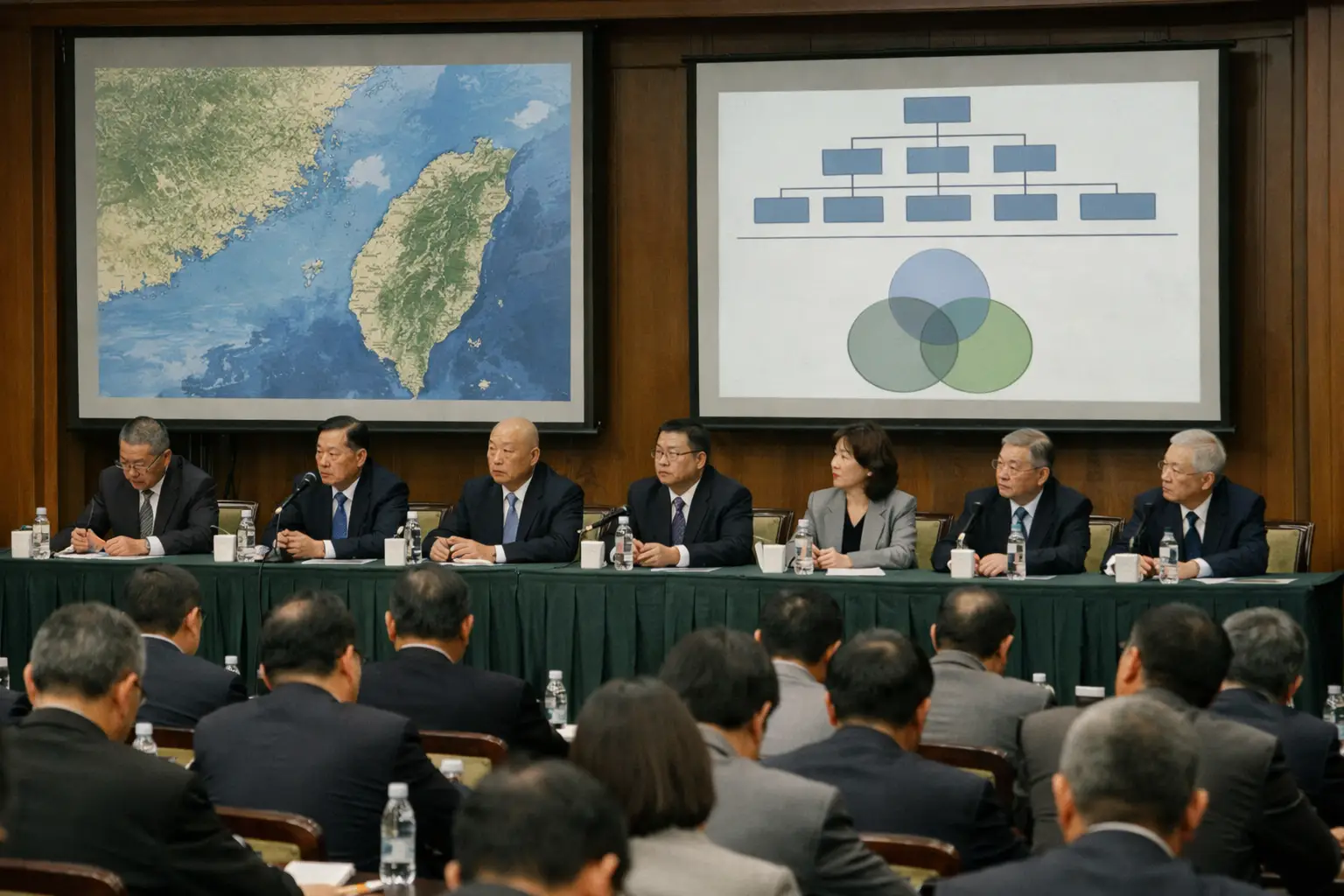
China’s Taiwan blueprint has returned to the policy debate after a recent academic symposium examined Beijing’s notion of a “Taiwan Special Administrative Region.” The discussion matters because it shifts attention from the familiar question of whether China and Taiwan could be unified to the more concrete issue of how power, law and public administration would be organized if Beijing’s preferred outcome were ever imposed or negotiated.
The term Special Administrative Region carries a specific political meaning in Chinese governance. It is associated with Hong Kong and Macao, where separate local systems exist under Chinese sovereignty while the central authorities retain ultimate control over defense and foreign affairs. Applying that model to Taiwan would be far more complex. Taiwan is not a former colony handed over by a foreign power, but a self-governed democracy with its own elected institutions, armed forces, courts and currency. The People’s Republic of China has never administered the island since its founding in 1949.
Beijing’s official position, articulated through bodies such as the Taiwan Affairs Office, presents unification as a national objective and has long linked the idea to a tailored form of “one country, two systems.” Taiwan’s authorities reject that framework. The Mainland Affairs Council maintains that the island’s future must reflect the will of its people, a position reinforced by Taiwan’s competitive elections and separate constitutional order. That divide makes the administrative design of any proposed SAR politically decisive, not merely technical.
A Taiwan SAR model would have to address issues that go well beyond symbolism. Questions would arise over the status of political parties, civil liberties, media freedoms, judicial independence, border controls, military command and the role of Chinese state institutions on the island. It would also need to clarify how Taiwan’s economic system and international commercial links would function under a new sovereign framework. These are not secondary details: they would define daily life for residents and shape the response of governments and markets outside the region.
The symposium’s significance lies in bringing those governing mechanics into sharper focus. Beijing’s claim over Taiwan is often discussed through the language of sovereignty, deterrence and cross-strait tension. The SAR concept adds another layer: the institutional architecture Beijing considers possible after unification. Until such a model is detailed, credible and acceptable to Taiwan’s public, it remains a contested political project rather than a practical roadmap.


