

You have full access to this article via your institution.
A failed experiment shouldn’t mean the end of a project, or affect a researcher’s future grant opportunities.Credit: Getty
Last week, Imperial College London, in collaboration with Nature, hosted a conference on a subject that’s rarely talked about in science: failure. The success of a conference on failure didn’t go unremarked, but beyond the meta-humour there was plenty of opportunity for serious discussions.
Science is built on failure in several ways. Scientific ideas and hypotheses need to be tested, refined or rejected to expand humanity’s knowledge. This means that researchers should expect that an experiment or a project might fail, and know how to navigate the consequences. If scientific progress is the practice of scaling the shoulders of giants, let’s not forget that it can be a slippery climb. The Artemis II mission to the Moon, for instance, learnt much from both the successes and the failures of the Apollo missions during the 1960s and 1970s.

In space failure is an option — often the only one
The conference was a welcome and rare occasion to talk about failure in its many guises. A key reason why failure is discussed so little is because of how academic science is structured. Research is funded, communicated and rewarded mainly on the basis of successful results. There is little room in the research system to recognize what might be considered work in progress, or to avoid penalizing people if things go wrong.
This is understandable to some extent. Policymakers increasingly expect that more of taxpayers’ money — distributed as grants by national science funders, for instance — should go to projects that are likely to provide returns on investment; in other words, results. This approach fails to recognize that things can and do go wrong, and that this is part of science, too. It’s important that when experiments or projects fail, researchers investigate why they did and make changes on the basis of what they learnt.
Yet it is becoming harder to implement such changes. On 16 April, the same day as the conference, the European Research Council announced that unsuccessful applicants for its highly prestigious grants are being discouraged from reapplying in the subsequent year. This measure is being introduced to help the organization cope with a rise in applications. But one consequence of the policy shift is that the council is effectively saying to researchers: don’t bother learning from failure, because second chances will be limited.

‘Disruptive’ science has declined — and no one knows why
At Nature, we have always considered appeals to editors’ decisions. More broadly in publishing, things are also starting to change — for example, through innovative publishing formats such as Registered Reports. These articles contain proposals for studies that are peer reviewed and the paper is accepted before the data are collected, promoting methodological rigour instead of focusing on results. But such innovations are still too few and far between. Research papers, grant applications and CVs don’t usually include the experiments or projects that didn’t work out.
This failure of the research enterprise to provide the time and space for individuals to fail without fear of the consequences risks failure of a grander kind. On a broader scale, it might be one reason why studies seem to show that research is becoming less ‘disruptive’ of established ideas (M. Park et al. Nature 613, 138–144; 2023).
Can we learn from research outside academia? In Silicon Valley, for example, failure is famously ‘hard-wired’. A ‘fail fast, fail often’ culture encourages a falsification approach: finding a method or technology that works means experimenting with many things that don’t. Failure is recognized as a necessary experience on the way to success.
But to what extent can such an approach be applied to academic settings? It’s hard to accept that you might fail, or that you are likely to do so, in a culture that rewards only success. Although research is increasingly performed in teams, the overall accountability for obtaining and managing funding, through grants for example, rests mostly with principal investigators.
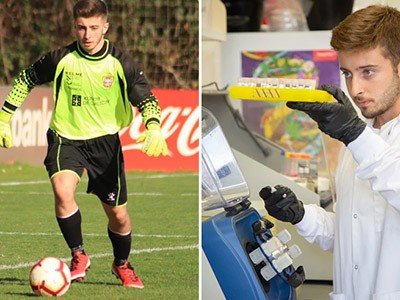
What elite sport prepared me for in the lab — and what it didn’t
Perhaps we need to look beyond science for inspiration. In a Nature Careers column published on 23 April, Javier Nion Fiera, a PhD student in immunology and microbiology at Louisiana State University in Shreveport, compares his experience in science with his experience in sport (he was a goalkeeper in Spain’s under-19 men’s football league). Athletes are given access to video replays and attend coaching sessions to understand what they could do better, but few mechanisms to assess failure exist in academia. “That uncertainty is what makes scientific failure feel different,” he writes. “Without a clear cause, it’s easy to turn the result inwards. Was it my competence that was to blame? My choice of project? The whole idea?”
There are lessons here for people with managerial responsibilities and for working researchers, too. Scientists can access some support through their university’s internal networks and initiatives, such as Imperial’s Good Science Project, which co-organized the conference. Other institutions will have similar projects. Managers of university training programmes, institutions’ research-support offices and other organizations could all be doing more to help researchers to work through failure.
Principal investigators can also help early-career colleagues to think beyond the idea of ‘standing on the shoulders of giants’ by acknowledging that doubt is “inherent to the scientific profession”, as Marie-Emilie Terret, a cell biologist at the Collège de France in Paris, told Nature in a Careers feature (Nature 651, 543–544; 2026).
In a world of team science, there must be a better way to learn from failure, and not to see it as a burden. We all need to be doing a lot more to make failure a normal part of the scientific process. That begins with talking about it.
Source:
www.nature.com


