
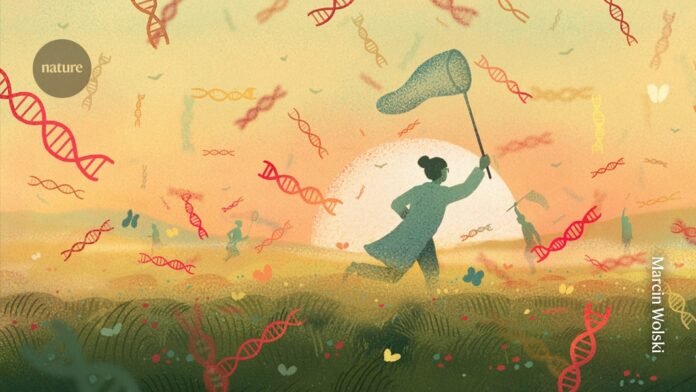
Ryan Kelly is in awe of what floats invisibly in the air.
“It is completely mind-blowing,” says Kelly, who studies environmental DNA (eDNA) at the University of Washington in Seattle. “We are absolutely surrounded by information in the form of DNA and RNA, at all times.”
Rare bird’s detection highlights promise of ‘environmental DNA’
Scientists have long pulled DNA from water and soil, but they have only just started to see the air as a source of genetic information. Over the past decade or so, researchers have been learning how to measure airborne DNA, study its abundance and use it to put together a picture of an ecosystem’s inhabitants and health. Airborne DNA is being used to monitor individual species, and being trialled as a way to detect invasive species or attacks with biological weapons. It is also being tested as a way to judge the success of conservation efforts.
The technique promises to link “the whole [of] biodiversity, the whole world together with a single assay that’s really rapid and that can even be done in the field and analysed in the cloud”, says David Duffy, a researcher who specializes in wildlife disease genomics at the University of Florida in St Augustine.
But there is still a lot to pin down, such as how fast DNA decays in the air and how far it travels. Some genetic material pulled from the air comes from humans, and several scientists are concerned that when using the technique for conservation research, it could inadvertently reveal people’s ethnicity or whether a person has a genetic disorder — and even be used to identify individuals.
Clouds of DNA
Scratch your head and you’ll release DNA-rich cellular material into the air. There, it will mingle with DNA from myriad other sources: your own and others’ exhalations and exfoliations, fragments of hair, feathers, excrement, pollen and spores, and microorganisms such as viruses and microalgae. This DNA, which can include segments that are tens of thousands of base pairs long, will then wander the air for perhaps a few days, often clinging to dust particles. It can travel distances that range from a few metres to several thousand.
Although eDNA is already collected routinely from water, snow and soil, to gather information about biodiversity or to track contaminants or viruses, scientists have not typically monitored sources of DNA in air other than pollen and spores — robust packages designed to travel on the breeze.
But, in the early 2010s, various ecologists began to wonder whether air might contain useful DNA traces beyond those wrapped in such windborne bundles. In 2013, biologists Matt Clark at the Natural History Museum in London and Richard Leggett at the Earlham Institute in Norwich, UK, took air samples in a greenhouse and outside it.
“We were just wondering whether we would get anything,” says Clark. “Actually, we got dozens — hundreds — of things turning up.”
Meanwhile, at Texas Tech University in Lubbock, ecologist Matthew Barnes analysed air samples using techniques developed for collecting waterborne eDNA, and discovered they were teeming with DNA from leaves and flowers, as well as types of pollen not designed to be windborne. He realized then the potential for understanding whole plant communities using air1.
But it was the discovery of tiger DNA near Cambridge, UK, that alerted the wider community to airborne DNA’s potential. Elizabeth Clare at York University in Toronto, Canada, and Joanne Littlefair at University College London wanted to know whether they could find animal DNA in the air. They collected samples at a small zoo in Cambridgeshire, UK, reasoning that they would know the origin of any DNA they found, because the exotic animals were confined to the park.
In the laboratory, the researchers extracted the DNA from the samples, and amplified and sequenced it. They found that they could sniff out tigers 200 metres away from their enclosure, as well as many of the zoo’s other animals, their food — including chicken, horse and pig — and wildlife such as hedgehogs, bats and squirrels. In total, the samples contained DNA from 25 species of mammal and bird, including 17 kept at the zoo2. Another study near Copenhagen Zoo, published at the same time, had similar findings3.
“Airborne animal DNA has always been there, it’s just that we’ve never looked for it,” says Simon Creer, who studies molecular ecology at Bangor University, UK.

Technicians collect fungal spores from the air in central Finland.Credit:Tommi Sassi, University of Jyväskylä
But it was a physicist who found a way to scale the method up. James Allerton, at the National Physical Laboratory in London, suggested that Clare examine samples taken by the UK Heavy Metals monitoring network, which has 25 air pumps, located in cities, in the countryside and at industrial sites.
The researchers studied samples from 15 of the network’s sites and, last year, published4 what they say is the world’s first national survey of terrestrial biodiversity using airborne eDNA. They found common UK animals, as well as exotic pets such as parrots and an invasive fish species, the silver carp (Hypophthalmichthys molitrix), that had not previously been reported in the region. From vertebrates to single-celled protists, they picked up 1,100 taxa.
To check the reliability of their method, the researchers compared their results with data from massive databases such as iNaturalist, in which citizen scientists record what they see. iNaturalist had failed to pick up half of what the team found. In turn, eDNA did not reflect 43% of the iNaturalist observations. Citizen science tended to find more birds and other charismatic, visible species near human habitation. Airborne DNA picked up more of the small, the invisible and the nocturnal, including fungi, lichens, invertebrates and plants other than trees, says Littlefair. “These are really the powerhouses of ecosystem function.”
The method, says the team, is “a realistic solution to monitoring the dynamics of life on land”. Now, the researchers are helping countries with similar monitoring networks to do the same.
Archives of air
But what if you could harness a network that pumps huge amounts of air through its filters, and that has records stretching back decades? In 2015, molecular biologist Per Stenberg at Umeå University in Sweden heard about just such a possibility — a 70-year history of biodiversity, told in wisps of DNA caught on tens of thousands of filters and stored at the Swedish Defence Research Agency in Stockholm.
He was at a seminar about Sweden’s radionuclide-detection network, built in the late 1950s to detect nuclear-weapons tests. The 25 stations suck in hundreds of cubic metres of air per hour and the contents are then stored on glass-fibre filters.
Stenberg set about analysing the filters from a station north of the Arctic Circle. Whereas Littlefair’s team searched for short marker regions of DNA that identify individual species — known as DNA metabarcoding — Stenberg used shotgun sequencing, in which DNA is broken down into tiny pieces, sequenced and matched to known reference genomes using a computer. The shotgun approach consumes more time and energy and requires more-complex statistical techniques than does the metabarcoding technique. But the results are more detailed.
It was four years before he and his collaborator Mats Forsman, the agency’s research director, got results5.
“Viruses, bacteria, fungi, plants, animals, birds, fish … the intestinal parasites of moose,” recounts Stenberg. “I mean, whatever was out there and had a reference to match it, we could see — every single organism that is not extremely rare in the ecosystem.”
The results indicated that the technique could be trusted, he says. “So then it was like: wow. This is something we need to explore.”

Accidental DNA collection by air sensors could revolutionize wildlife tracking
Ecologists are doing just that, documenting weekly, seasonal and cyclic fluctuations in the abundance of many species and matching these to climate variations. They have uncovered long-term community changes — the rise and fall in the abundance of pine trees because of changing forestry management, and a concomitant decline in other trees, mosses, lichens and fungi. They have tracked over time well-known co-variations between several species, such as those between flies and some bacteria, and found new ones.
Europe is dotted with radionuclide-detection stations, which could provide “an unprecedented opportunity to reconstruct ecological history and detect ongoing changes”, say Stenberg and his co-authors.
Such networks are, however, in fixed locations. Some scientists are experimenting with more flexible monitoring. Erin Hahn, who studies conservation genetics at the Australian National Wildlife Collection in Canberra, has designed and 3D-printed passive samplers, which don’t need an energy supply, and given them to landholders across New South Wales.
Her team is still at the pilot stage. “There’s heaps of variables around airflow, light exposure, proximity to game trails,” says Hahn. “We’re just starting to chip away at them to better understand how DNA moves around.” What Hahn ultimately wants is a nimble network that can pinpoint change quickly, flagging invasive species or crashing populations that need management.
Total read-out
For governments, companies, scientists and conservationists aiming to track the health of ecosystems, airborne DNA could provide a comprehensive, regular read-out of biodiversity on land.
“It means that we can rapidly assess environments before, during and after mitigation, and not just think we improve biodiversity, but really have a quantitative measure,” says Duffy, who is evaluating its potential for tracking forest restoration.

Air-sampling devices on a beach in Norfolk, UK, gather material for DNA sequencing.Credit: DarrenHeavens/Earlham Institute
DNA read-outs could also help to chronicle ecosystem vitality, by tracking pathogen load and the genetic diversity of individual species — an indicator of health.
There are other enduring ecological questions that airborne DNA could help to solve. Stenberg’s group is developing models that aim to understand cause and effect in ecosystems.
“We know that foxes eat rabbits, and rabbits eat some plants and so on,” Stenberg says. “But the full ecosystem — when we talk about the bacteria, the nematodes, the insects, the plants, the animals — we basically have no idea.” Uncovering more detail could provide practical information on how ecosystems respond to damage.
Hard to interpret
But there’s a lot of troubleshooting to do first.
Source:
www.nature.com


