
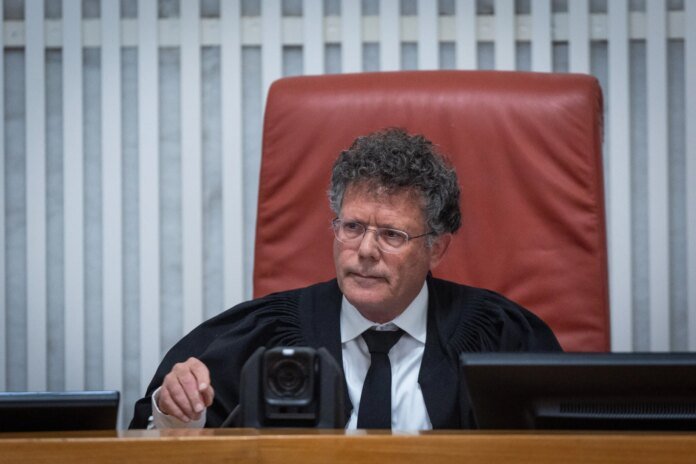
Supreme Court President Isaac Amit, Deputy Supreme Court President Noam Sohlberg, and Justice Daphne Barak-Erez reprimanded Justice Minister Yariv Levin on Sunday, accusing him of abusing his power as chairman of the Judicial Selection Committee to veto judicial candidates he does not approve of and block votes on their appointment.
The three justices, all members of the Judicial Selection Committee, pointed out in a letter that there is a severe shortage of judges on numerous magistrates’ and district courts around the country due to Levin’s ongoing refusal to convene the committee, and called on him to schedule five committee hearings and votes within 45 days to fill the empty positions.
Levin sent a letter on Friday to committee members stating his intention to convene the committee in order to appoint judges to traffic, family, and youth courts, which he said were heavily understaffed.
But the Supreme Court justices insisted that the lack of judges in the magistrate’s and district courts is more pressing, accuse him of “crassly ignoring” the need to appoint 13 judges to the Haifa and Beersheba District Courts, and further asserted that Levin’s claims regarding the needs of the traffic, family and youth courts are not backed up by professional assessments from the Israel Courts Administration.
“Your numbers appear to be totally arbitrary,” Amit, Sohlberg, and Barak-Erez told Levin.
“The delay in appointing judges to all courts — not just those you chose to mention in your letter — harms service to the citizen, and there is no reasonable explanation for your refusal to appoint judges to all courts,” they added.
“It goes without saying that to this day, even though the law does not grant you more than one vote on the committee, and even though, according to… the law, voting on the appointment of a judge to the courts is done by a simple majority, you have abused your authority as the person in charge of convening the committee and under the cover of [demanding] ‘broad consensus,’ imposed a veto in practice that is not within your authority over various candidates and on the votes on the committee,” the three justices concluded.
There are 67 open judicial positions across all magistrate and district courts around the country, as well as four open spots on the Supreme Court, which Levin also refuses to fill since he does not have the votes to elect two of his favored candidates for those positions.
Levin is due to respond to a High Court order from February demanding he justify his ongoing refusal to make key judicial appointments. Levin’s original deadline was delayed due to the Iran war.
The justice minister has a long-running feud with Amit, whose authority Levin doesn’t recognize and whom he has refused to work with.
Levin last convened the Judicial Selection Committee in January last year when it elected Amit president, after being ordered to do so by the top court; Levin boycotted the meeting and has refused to acknowledge Amit’s presidency since.
The government passed highly contentious and far-reaching legislation last year giving politicians greater control of the Judicial Selection Committee, and Levin has vowed not to fill key positions in the courts until that law takes effect after the next election.

Source:
www.timesofisrael.com


