


Andrew Onufriyenko/Moment via Getty Images
I’ve talked about my relative bullishness on value over growth this year, and admittedly, I’ve been wrong so far given ongoing Technology momentum. While I think growth-style investing is (beyond) extended in my opinion, strength certainly can continue and the irrational can get more rational. If that’s where we’re ultimately headed, it’s worth considering the SPDR Portfolio S&P 500 Growth ETF (NYSEARCA:SPYG). SPYG is an exchange-traded fund issued by SPDR State Street Global Advisors. It is specifically designed to track the S&P 500 Growth Index, focusing on growth companies within the S&P 500 regardless of sector. As of now, the fund holds 225 individual securities and has $22.9B in Assets Under Management. It should be noted that while the fund technically targets growth companies across all sectors, it is practically a technology-focused fund due to the preponderance of growth stocks in the tech sector.
Key Holdings of SPYG
The performance of an ETF is significantly influenced by its top holdings. These are the individual stocks that make up the largest percentage of the fund’s portfolio. The key holdings of SPYG are all the familiar ones:
Microsoft Corporation (MSFT): Microsoft, another tech titan, makes up 13.13% of SPYG. With a wide range of products and services, from its Windows operating system to its Azure cloud computing platform, Microsoft has a stable revenue stream that contributes to its growth. Apple Inc. (AAPL): This technology giant is the largest holding in SPYG, making up 11.71% of the fund’s portfolio. Apple’s products are ubiquitous worldwide, and it has consistently posted robust financial performance. Nvidia Corporation (NVDA): As a leading player in the graphics processing unit (GPU) market, Nvidia has seen tremendous growth in recent years, driven by demand in gaming, professional visualization, datacenter, and automotive markets. It makes up 7.32% of the SPYG portfolio. Alphabet Inc. Class A (GOOGL) and Class C (GOOG): These two classes of Alphabet’s stock together make up 6.9% of the portfolio. As the parent company of Google, Alphabet has a diverse range of highly profitable businesses, including search, online advertising, cloud computing, and more.
The top 10 holdings make up 57% of the fund, making this extremely concentrated in terms of company-specific risk driving volatility and overall returns.
Sector Composition of SPYG
As noted before, this is primarily a Tech fund in terms of return contribution:
Information Technology: This sector makes up the largest portion of SPYG, accounting for 46.73% of the fund’s total assets. Consumer Discretionary: This sector, which includes companies that sell non-essential goods and services, makes up 14.57% of the portfolio. Healthcare: The healthcare sector represents 7.55% of the SPYG portfolio. Other Sectors: The remaining portion of the portfolio is split between sectors like financials, energy, consumer defensive, and industrials.
How Does SPYG Compare with Other ETFs?
Comparing an ETF with its peers can provide useful insights into its relative performance and suitability for an investor’s portfolio. Here, we compare SPYG with two similar growth-focused ETFs: iShares S&P 500 Growth ETF (IVW), and the Vanguard Russell 1000 Growth Index Fund ETF Shares (VONG).
SPYG has outperformed IVW slightly (likely due to rebalancing) while it has underperformed VONG which has a larger opportunity set in the Russell 1000, resulting in other stock performance contribution that helped it do better.
stockcharts.com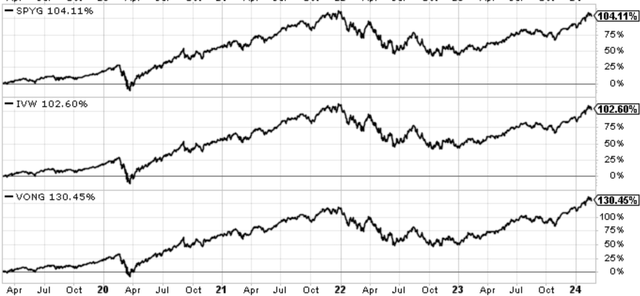
Pros and Cons of SPYG
Just like any investment, SPYG has its share of pros and cons. On the positive side, the fund offers exposure to some of the fastest-growing companies in the U.S., many of which are leading players in their respective industries. This can offer significant potential for capital appreciation. SPYG also has a low expense ratio (0.05%, which means more of your investment goes towards buying assets rather than paying fees.
However, there are also some downsides to consider. Given its heavy focus on growth stocks, SPYG can be more volatile than broader market ETFs, especially during market downturns.
Should You Invest in SPYG?
Investing in SPYG can be an effective way to gain exposure to some of the fastest-growing companies in the U.S. However, like any investment, it’s important to consider your personal investment goals, risk tolerance, and investing horizon before deciding to invest.
The fund’s strong performance, and low expense ratio, make it an attractive option for growth-focused investors. However, those seeking even higher returns and willing to take on more risk might find other ETFs like VONG more suitable.
It’s a good fund for what it does. To me, it’s more a question of what happens next to Technology – the most overcrowded trade of all.
Markets aren’t as efficient as conventional wisdom would have you believe. Gaps often appear between market signals and investor reactions that help give an indication of whether we are in a “risk-on” or “risk-off” environment.
The Lead-Lag Report can give you an edge in reading the market so you can make asset allocation decisions based on award-winning research. I’ll give you the signals–it’s up to you to decide whether to go on offense (i.e., add exposure to risky assets such as stocks when risk is “on”) or play defense (i.e., lean toward more conservative assets such as bonds/cash when risk is “off”).


