
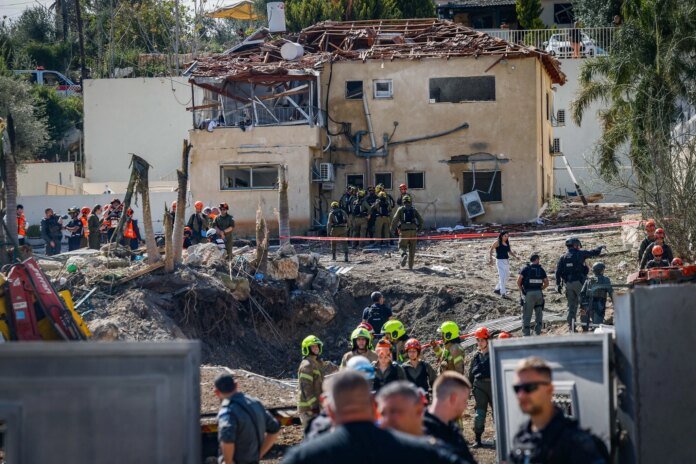
Several people were lightly injured Saturday after an Iranian ballistic missile struck the Jerusalem-area town of Eshtaol, as Iran and Hezbollah continued their missile, rocket and drone fire at Israel throughout the day.
According to first responders, some 19 people were taken in for treatment after being injured by shrapnel and broken glass as a result of the explosion in the town west of the capital, and several more were treated for shock.
The missile, which was assessed to carry a warhead of several hundred kilograms of explosives, caused extensive damage to nearby homes and dozens of vehicles.
According to the military, the Israeli Air Force was investigating the failure to shoot down the missile. Initial probes showed that attempts to intercept the missile were made, but air defenses failed to knock the projectile down.
Hours later, another Iranian ballistic salvo targeted Eilat, with police responding to two sites where missiles or falling fragments impacted open areas near the Red Sea resort city.
No injuries were reported as a result of those strikes.
According to the IDF, one missile was intercepted and another hit an open area.
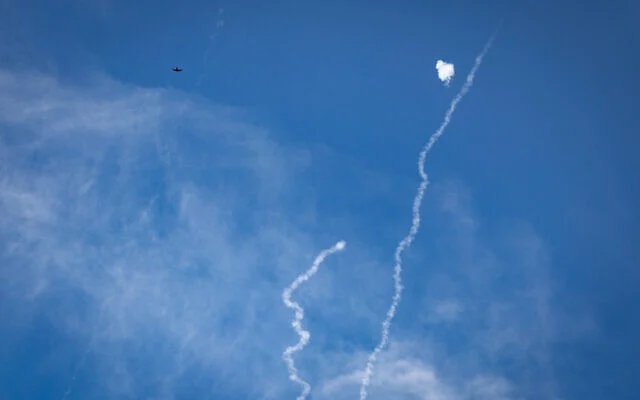
Also targeting Eilat on Saturday were the Iran-backed Houthis in Yemen, who fired a ballistic missile, a cruise missile and a drone, all of which were intercepted by Israeli air defenses with no injuries reported.
Footage shows the moment a suspected Houthi drone from Yemen was shot down by air defenses over Eilat. pic.twitter.com/PwxlEvUC23
— Emanuel (Mannie) Fabian (@manniefabian) March 28, 2026
Meanwhile, in the north, Hezbollah continued its incessant rocket and drone fire at Israel and at Israeli military positions in southern Lebanon, with the IDF saying Saturday evening that the Iran-backed terror group had fired some 250 rockets over the previous 24 hours.
However, the vast majority of the rockets were aimed at troops operating in southern Lebanon, with just 23 projectiles crossing the border into Israel, the IDF added.
Home Front Command extends war guidelines
Amid the continued missile and drone fire at Israel, the IDF Home Front Command said Saturday that its current wartime guidelines were being extended until Monday night at least, meaning educational activities will remain prohibited in most parts of the country.
By Monday at 8 p.m., another assessment will be conducted by the Home Front Command.
Under the current guidelines, educational institutions can operate in some areas of the north, south, and West Bank, provided there is an adequate shelter that can be reached in time.
A full list of locales can be found on the Home Front Command’s website.
Gatherings of up to 100 people indoors and 50 people outdoors are also permitted in those areas, under the same conditions.
In the rest of the country, educational activities are still prohibited. Gatherings are limited to 50 people, provided a shelter can be reached in time, and workplaces can operate under the same conditions.
Since the war began a month ago, 16 people have been killed in Israel by Iranian ballistic missiles, as have four Palestinians in the West Bank.
Iran has fired more than 450 ballistic missiles at Israel since the war began on February 28, with the military reporting an interception rate of 92 percent of attacks heading for populated areas and key infrastructure. In all, nine missiles carrying conventional warheads with hundreds of kilograms of explosives have struck populated areas in Israel, causing extensive damage in at least six cases. There have also been more than 30 incidents of missiles carrying cluster bomb warheads hitting populated areas, with over 150 separate impact sites.
Additionally, two Israelis have been killed by Hezbollah rocket fire at northern Israel since the terror group joined the war.

Source:
www.timesofisrael.com


