

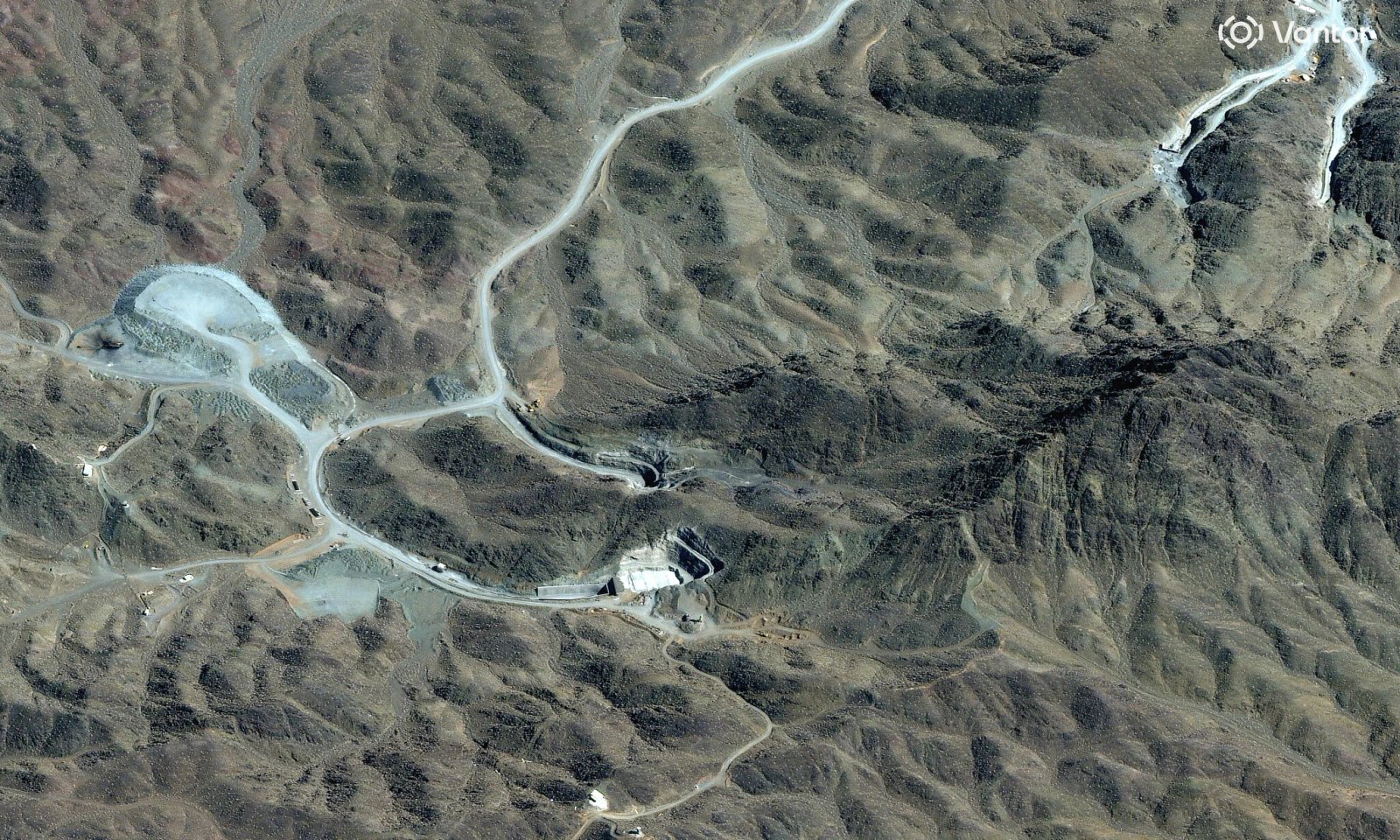
Recent satellite imagery from Iran has shown that construction appears to be taking place at a secret tunnel complex adjacent to the Natanz nuclear facility, the Washington-based Institute for Science and International Security said Thursday, although there was no indication that Tehran had begun repairing damage caused by US and Israeli strikes at its main nuclear facilities.
According to the think tank, the underground enrichment halls at Natanz remain inaccessible, with damaged entrances, destroyed power systems and displaced HVAC chillers still unrepaired.
It said, however, that fresh satellite imagery from late last month indicated that the portion of the Natanz complex known as “Pickaxe Mountain,” or Kuh-e Kolang Gaz La, has been the site of recent vehicle activity and construction, with workers appearing to be reinforcing tunnel entrances.
The underground site tunneled into a mountain near the main Natanz facility is thought to have been under construction since 2020, according to experts quoted by The New York Times last month.
The exact purpose of the site is not known, and inspectors from the International Atomic Energy Agency have never been granted access.
According to the Institute for Science and International Security, there has been persistent activity at the site since April, when a ceasefire was declared in the US-Israeli war with Iran.
Since then, it said, Iran has partially filled some of the tunnel portals, blocking vehicles from accessing them, while a smaller tunnel complex within the site’s perimeter has been sealed. The contents of the sealed tunnels are unknown, it noted, but could be enriched uranium.
It said, however, that the vast majority of the Pickaxe Mountain facility did not yet appear to be operational.
Despite this, the think tank argued that any work carried out at the site violates the US-Iran memorandum of understanding, which requires Tehran to maintain the status quo of its nuclear program during negotiations, including by refraining from construction at nuclear-related sites such as Pickaxe Mountain.
Recent satellite imagery from late June 2026, of the Natanz Nuclear Complex and the nearby Pickaxe Mountain facility, Fordow, and Esfahan, were provided to the Institute by @vantortech.
At Natanz, little activity can be seen. The access points to the below ground enrichment… pic.twitter.com/on6isIGhNA
— Inst for Science (@TheGoodISIS) July 2, 2026
Elsewhere in Iran, the group said there has been no recent observable activity at the Fordo uranium enrichment plant or Isfahan nuclear complex, where tunnel entrances remain blocked with earth.
Both sites were severely damaged by strikes during the 12-day war between Israel and Iran in June 2025.
At Fordo, the institute said that images show that Iran in May added “passive defensive measures in the form of earthen/rocky mounds” near the tunnel entrances, which it said could be to prevent a potential military operation to enter the facility to seize the uranium stockpile stored there.
As for the Isfahan facility, where most of Iran’s 440-kilogram stockpile of uranium enriched to 60 percent — a short step from weapons-grade — is believed by the IAEA to be stored, the think tank said that “there is no observed activity,” and that the tunnel entrances remain blocked. Lesser quantities of enriched uranium are believed to be stored at Natanz and Fordo.
In addition to the work at its nuclear facilities, Iran has rapidly looked to rehabilitate its damaged military sites in the wake of this year’s war, and has reportedly already rebuilt entrances to 50 of 69 tunnel entrances at 18 separate underground missile facilities across the country.
It has also repaired other damaged areas of those bases, including key access roads that the US and Israel bombed during the war, according to a CNN report from May, which quoted experts as saying that Iran still possesses some 1,000 ballistic missiles, most of which are stored in those 18 sites.
The US and Israel launched the war on Iran in a bid to destabilize its leadership and destroy its ballistic missile and nuclear programs. The fighting entered a truce on April 8, and the US and Iran are engaged in peace talks based on a memorandum of understanding they reached last month.
Israel is not a party to the memorandum or the talks, and Israeli officials have criticized the document for failing to secure a concrete concession from Iran on its nuclear program.


Source:
www.timesofisrael.com


