
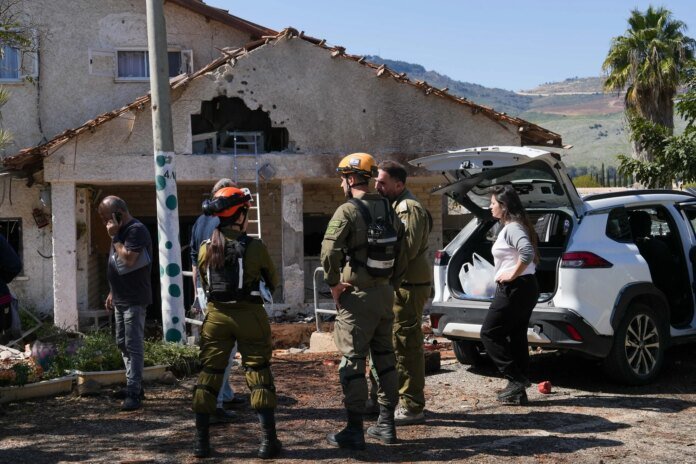
KFAR YUVAL — A few minutes into a visit on Thursday to the home of Vicky Tiferet, a resident of this agricultural community on the northern border with Lebanon, there was a loud explosion about a mile away.
“Don’t worry, it’s outgoing,” Tiferet said casually.
While Tiferet was matter-of-fact, it was hard not to be unnerved.
Only a few dozen yards away was the house where Barak Ayalon, 45, and his mother Miri Ayalon, 76, lived until they were killed by a Hezbollah-fired anti-tank missile in January 2024.
Standing on the street, it’s easy to see that this pastoral farming community, set in the middle of green rolling valleys and hills, is a tourist destination in peaceful times.
However, on a hilltop ridge, just over a mile away, is the Lebanese village of Kafr Kila, a central Hezbollah hub from where a Radwan force planned to invade Israel.
It was from an observation point that Hezbollah operatives aimed at Kfar Yuval, killing Ayalon and his mother.
Ayalon was a staff sergeant in the reserves and a member of Kfar Yuval’s security team, headed by Tiferet’s husband, Oded.
After offering her guests coffee and water, Tiferet sat at the kitchen table with a telephone in one hand and a walkie-talkie in the other.
Nine years ago, Tiferet, a massage therapist, began volunteering at United Hatzalah. Today, she leads a team of 84 volunteers, both Jews and Arabs, in the Galilee Pandhandle. Tiferet sometimes leaves the house at the same time as her husband during emergencies.
“There’s a 50% chance one of us won’t come back,” she said. “The only thing that keeps us going is knowing we’re helping others.”
Two days earlier, she raced to Mahanaim Junction, about 15 miles to the south, where a Hezbollah rocket killed Nuriel Dubin, 27, from Margaliot in the Upper Galilee and wounded two others.

Tiferet’s stoicism in the face of danger seems typical of residents in the north, many of whom were among the 60,000 people evacuated soon after the Iranian-backed terror organization Hezbollah began firing on Israel on October 8, 2023, a day after fellow Iran-backed terror group Hamas invaded southern Israel, sparking the war in Gaza.
According to the IDF, Hezbollah has been firing an average of about 150 rockets per day since hostilities escalated amid the war with Iran that began on February 28, when Israel and the United States began airstrikes targeting the Iranian regime.
Although the war with Hezbollah ended with a ceasefire in November 2024, the IDF has conducted near-daily strikes on Hezbollah members who were violating the truce.
The Israeli military said on Thursday that it has pushed more forces deeper into southern Lebanon as part of an expanded buffer zone after Hezbollah began attacking Israel earlier this month.

A few days after the November 2024 ceasefire, Tiferet, her husband, father and four children returned to Kfar Yuval after months in a crowded hotel in Tiberias. She said that about 90% of the community’s 800 residents have returned.
Despite the near-constant attacks, she said, “We refuse to be evacuated again.”
Her mother and her father-in-law died during the war because being away from their homes “was too difficult for them.”
Tiferet, 44, was born in the Central Asian country of Turkmenistan and moved with her parents to Israel when she was 9, soon after the fall of the Soviet Union.
“I found out we were Jewish the week before we moved,” she said. “My parents were very angry when I told my friends because it was very dangerous for us there.”
She is committed to this country, she said, and believes that “volunteers are what keep Israel going.”
But Tiferet despairs about the future in the north.
We have to stop the enemy so that we won’t have to go through this again in six months
“Food costs more here than it does in the center of the country,” she said. “We have no movie theater, no culture and no shelters for the elderly.”
Her family lives “in the minus” in the bank, she said, and the monthly deficit keeps getting bigger.
What Tiferet fears the most, however, is not Hezbollah’s current rocket attacks.
“We’re afraid that the IDF won’t be allowed to finish the job against Hezbollah,” she said. “We are willing to accept explosions and suffer through explosions and no sleep. We have to stop the enemy so that we won’t have to go through this again in six months.”
‘This isn’t a normal life’
A few miles away in the half-empty city of Kiryat Shmona, Haim Gino sat in the office of his auto repair shop and wondered how he would keep his business going.
In the space of 15 minutes, there were three sirens warning of incoming rocket or missile fire, but Gino met them with a shrug and didn’t move from his desk chair.
By the time you hear the siren, the rocket has already fallen
“It’s absurd,” he told The Times of Israel. “They put a temporary bomb shelter 100 meters from here, but by the time you hear the siren, the rocket has already fallen.”
“How can we work like this?” Gino mused and didn’t wait for an answer. “This isn’t a normal life.”

Almost all of Kiryat Shmona’s 24,000 people were evacuated during the 2023-2024 war. It is estimated that 60% had returned following the ceasefire, but since then, the city has struggled to recover. And then the latest conflict began again.
Despite the war, Gino, who was born in the city and now lives in nearby Kibbutz HaGoshrim, kept his business open.
“But how many people will come here now to fix their car during the war?” he said.
Gino went from seven workers in the garage down to two. He said the government offered financial compensation for people who closed their businesses, but not for people like him who kept them open.
“I don’t know whether to close the shop or keep going. I can’t run a business without customers or workers,” he said. “I am doing whatever I can to keep going, but each time I get my head a little bit above the water, I’m drowning again.”
I can’t run a business without customers or workers
One of the mechanics, Muheen Khoury, has been working at the shop for 32 years.
Khoury, one of three Christian families in Arraba, drives each day to work even though he said, “It’s very dangerous.”
“But we’re like family,” Khoury said, and then joked, “I’ve spent more time with Haim each day than my wife. We celebrate events together.”
Gino, though, is not convinced he can keep the business open.
“This is my baby,” he said. “In the end, what will force me to close the shop isn’t Hezbollah, it’s money.”
‘We won’t let Hezbollah force us to leave our homes’
Head of the Mevo’ot HaHermon regional council, Benny Ben Muvhar, who oversees the 13 communities in the Galilee panhandle, joked with The Times of Israel on the telephone that his name was “Benny Boom.”

Then he quickly turned serious.
“We’re in a war,” he said. “It’s hard, it’s challenging, it’s problematic. But this time, we won’t let Hezbollah force us to leave our homes.”
Along with Kfar Yuval, five other communities in Ben Muvhar’s jurisdiction were evacuated during the war.
“It hurts every time we hear of a soldier or civilian killed or wounded, but I hope the government lets the IDF give us the security we need,” he said. “We have to continue this war and continue to be resilient.”

The 1,000 residents of Sde Eliezer, where Ben Muvhar lives, were not evacuated during the war.
The agricultural community is situated about 10 miles south of Kiryat Shmona and a 10-minute drive from Mahanaim, where the fatal Hezbollah rocket attack occurred.
One of his neighbors, Oded Schwartz, a third-generation sheep farmer with 1,500 sheep, makes a wide variety of artisanal cheeses and yogurt, all from sheep’s milk.
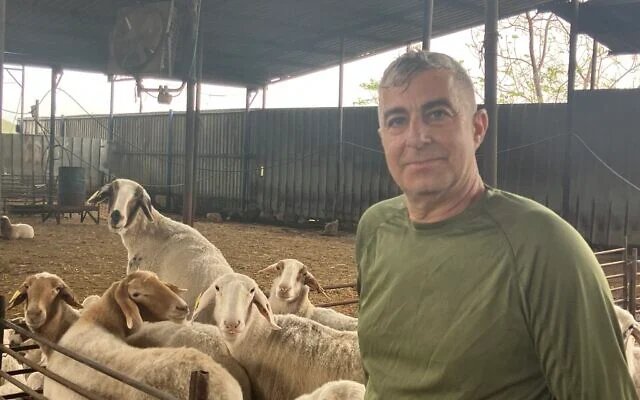
His grandparents, a Satmar Hasidic couple, started the sheep farm in the 1950s after surviving the Holocaust.
Schwartz told The Times of Israel that since October 7, 2023, “We have kept working to make the cheese, we’ve never stopped, even for one day.”
On Thursday, his daughter, Sari, 17, managed the shop because it was during her high school break.

“Try the Adi,” Sari said, cutting a sample slice of cheese and enthusiastically offering it to a customer.
“She’s the fourth-generation sheep farmer,” Schwartz said.
Schwartz took The Times of Israel into his open barn. A steady rain was falling, but under the rafters it was dry and warm. There was a sweet smell of earth. Baby goats lay together in the dirt. Nearby, some of the goats milling about wandered over to the edge of the pen, curious about their visitors.

Schwartz employs three workers from Thailand and five Israelis at the cheese-making facility.
“We’ve had four sirens so far today,” said Schwartz. “Even the sheep are under stress. They give less milk. They have miscarriages.”
The milk is then taken to Kibbutz Yiftah, about 15 miles away, where it is processed into cheese. Production has slowed down, but “we’re still delivering cheese all around Israel.”
“I’m a big optimist,” Schwartz said. “I’m here not only for business but for Zionism. Hezbollah has to do a lot more to make us sad.”
Source:
www.timesofisrael.com


