
This Editor’s Note was sent out earlier Wednesday in ToI’s weekly update email to members of the Times of Israel Community. To receive these Editor’s Notes as they’re released, join the ToI Community here.
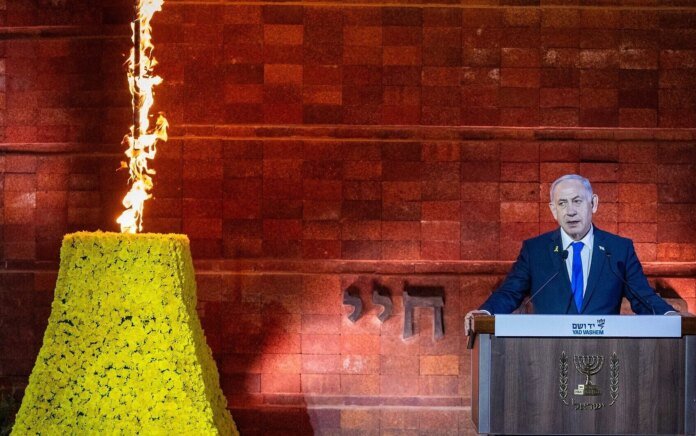
In an address Monday night for Israel’s annual Holocaust Remembrance Day, Prime Minister Benjamin Netanyahu asserted that in the two recent rounds of conflict against the Islamic Republic — last June and this February-March — Israel and the United States had “crushed the evil regime in Iran to dust.”
“The regime of the ayatollahs sought to develop nuclear bombs and manufacture tens of thousands of lethal ballistic missiles intended to annihilate us,” he specified at the Yad Vashem Holocaust Memorial Museum, and then claimed: “They thought they could do this unhindered, but no more. Our nation has learned the lesson.”
“Year after year I stood here,” Netanyahu continued. “I pledged at the Holocaust Remembrance Day ceremony: ‘We will not allow Iran to develop nuclear weapons’. And as prime minister of Israel, I promised: ‘There will not be a second Holocaust.’”
“This year,” he declared triumphantly, “we turned that promise into reality.”
Except we didn’t.
In a much-mocked address to the United Nations General Assembly in 2012, derided for the crude bomb diagram Netanyahu unveiled to try to illustrate the dangers of the Iranian regime’s nuclear weapons program, the prime minister correctly warned that the “red line” for halting the ayatollahs’ march to the bomb “must be drawn first and foremost in one vital part of their program: on Iran’s efforts to enrich uranium.”
“For a country like Iran,” he explained, “it takes many, many years to enrich uranium for a bomb. That requires thousands of centrifuges spinning in tandem in very big industrial plants. Those Iranian plants are visible and they’re still vulnerable.
“In contrast,” he went on, “Iran could produce the nuclear detonator – the fuse – in a lot less time, maybe under a year, maybe only a few months. The detonator can be made in a small workshop the size of a classroom. It may be very difficult to find and target that workshop,” he warned. “The same is true for the small facility in which they could assemble a warhead or a nuclear device that could be placed in a container ship. Chances are you won’t find that facility either.”
And therefore, Netanyahu hammered home his point, “the only way that you can credibly prevent Iran from developing a nuclear weapon, is to prevent Iran from amassing enough enriched uranium for a bomb… The relevant question is not when Iran will get the bomb. The relevant question is at what stage can we no longer stop Iran from getting the bomb.”
But Iran, terribly, was not stopped.

Among its many flaws, the thoroughly inadequate 2016 Joint Comprehensive Plan of Action (JCPOA), overseen by US president Barack Obama, did not require the Iranian regime to dismantle its enrichment facilities and halt all uranium enrichment. Indeed, it allowed the regime to continue research and development of still faster centrifuges.
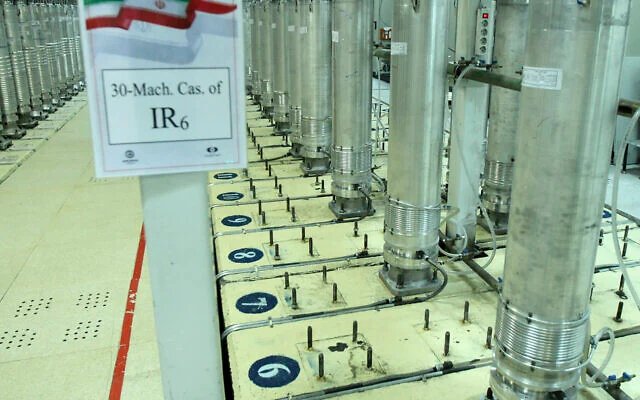
And after US President Donald Trump, in his first term of office, withdrew from the deal in 2018, the regime booted the UN’s nuclear watchdog inspectors, hugely expanded and accelerated its enrichment facilities and processes — while striving to render them immune from attack — and gradually amassed some 450 kilograms of 60% enriched uranium, enough for 11 nuclear bombs.
By Netanyahu’s correct 2012 account, in other words, Iran completed the hard, time-consuming, vulnerable part of the nuclear-bomb-making process. What lay ahead was enriching that 60% stockpile to weapons-grade, and weaponization — relatively rapid processes that do not require vast, potentially easy-to-spot facilities.
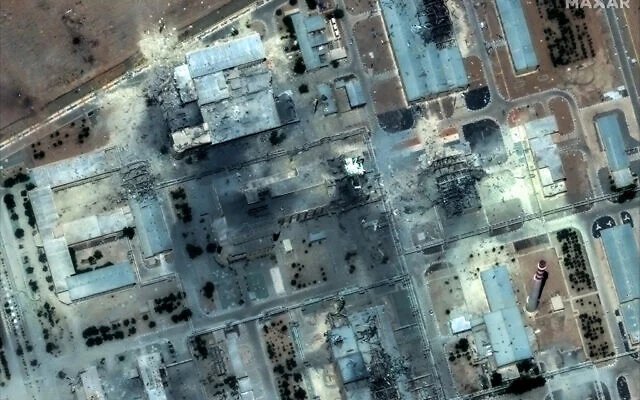
All of which underlines why last June’s resort to force was vital. The regime was rapidly closing in on the bomb, with that stockpile — near-impregnably stored, according to the IAEA, at its three key enrichment facilities at Isfahan (primarily), Natanz and Fordo — constituting its fastest path to a nuclear arsenal. Battering those sites, with the US B-2 Spirit stealth bombers delivering that war’s final devastating blow, the US and Israel significantly set back and complicated the regime’s bid for the bomb.
Core goals yet to be achieved
Despite Netanyahu’s swaggering claims of definitive success this week, however, the joint resort to force that began on February 28 risks exacerbating rather than alleviating the danger — depending on how the conflict is ultimately brought to a close.
It’s the combination of that regime and that weapon that spells existential danger for Israel, and endless peril throughout the Middle East and beyond.
But the stated Trump-Netanyahu goal of creating the climate in which the Iranian public could oust the regime once the American and Israeli bombs stopped falling has not been achieved to date. Avner Vilan, a former Israeli security official and expert on Iran’s nuclear program, spoke to me yesterday about “the dangerous optimism” regarding the likelihood of the campaign causing the collapse of the regime, and the absent strategic planning for developments as predictable as Iran swiftly moving to close and leverage its control over the Strait of Hormuz.
And nor has that 450-kilogram stockpile that would enable the regime to most quickly attain the bomb been retrieved and removed from Iran.
Both of those core and necessary goals — mercifully adopted by a US president more warmly disposed to Israel than some of his base, most potential successors, and much of America — may yet be achieved. But unless or until they are, nobody should be claiming victory — and least of all the prime minister of Israel, Iran’s prime target.
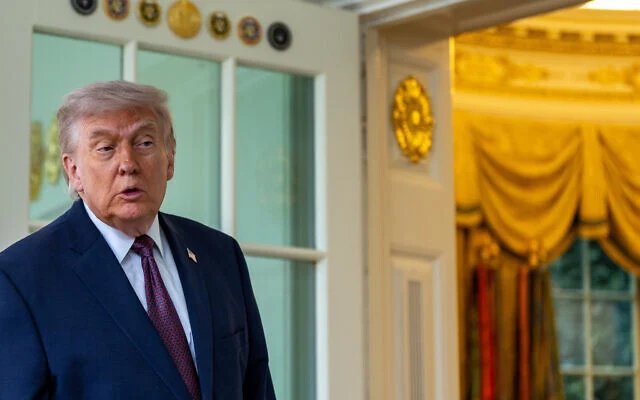
The unknowable and unpredictable Trump is publicly seeking a deal, while also thus far insisting that its terms must include the removal of those underground containers with the 60% enriched uranium: “We’re going to get the dust back,” he said again on Tuesday.
That is indeed essential — and it has to be all 450 kilograms, with no wiggle room for the regime to claim that a few dozen kilos here or there can’t be retrieved, since, Vilan noted, a few dozen kilos is enough for a bomb.

But as Vilan observed in our conversation, even the removal of that stockpile — if attained via negotiation rather than a high-risk, apparently improbable special forces operation — would likely also entail the lifting of economic sanctions on the regime, a veritable lifeline that will further enhance its capacity to survive.
The January protests in Iran, and the mass-murdering crackdown, that set in motion the process that led to this war, he noted, stemmed from Iran’s economic crisis. “It was affecting everyday life.” The regime was unable to provide something as basic as fresh water. The mounting frustration could potentially have caused cracks in the regime even among its ideological loyalists, Vilan assessed. But by going to war now, the US and Israel “created cohesion,” with the regime able to argue that “all the suffering is the result of external attack and threats.”
“If we had waited,” Vilan posited, “maybe the regime would have collapsed.”
Moreover, while the US and Israel targeted a heavy water plant and other elements of the nuclear program in recent weeks, including the remains of enrichment facilities, it was the June 2025 war that massively debilitated those major sites.
Iran, well aware that an attack might be imminent, is nonetheless not believed to have transported any of its stockpile away from its underground facilities prior to last June’s war. The presence of the enriched uranium was last verified in mid-May 2025, Vilan noted, “and there would have been hysteria” if some was missing. But the regime is widely assessed to have centrifuges tucked away, and potentially even installed in one or more small facilities, capable of completing the enrichment process. And now, more aware than ever of its vulnerability to attack as a non-nuclear state, it has a still higher incentive to attain the bomb.
Inaccurate, irresponsible narratives
Trump keeps claiming that the six weeks of war achieved regime change, and that the ostensible “new” leadership is “less radical” and “more reasonable.” That’s simply not true.
And Netanyahu, with his blustering claim to have averted the second Holocaust that he so rightly warned against for so many years, is peddling a still more irresponsible narrative.
It’s easy to mock the prime minister’s empty assurances by noting that he delivered his Holocaust Remembrance Day speech in a pre-recorded session, because the security situation — with only a fragile ceasefire in place, Iran demonstrably still capable of firing missiles, and Hezbollah battering the north — did not allow for Israel to safely commemorate the Holocaust at the usual live ceremony with its audience of hundreds. Next week’s Independence Day events are to be held under the same security limitations. It’s easy to further mock his denial of reality when the Shin Bet security service, at his request, has just submitted an assessment that Netanyahu cannot safely appear for hearings in his corruption trial because Iran might seek to target him in the Tel Aviv court building.
But those are only the most superficial critiques of a far more dangerous phenomenon. The fact is that the second Holocaust has not been conclusively averted, and Netanyahu — for so many years the world’s most relentless campaigner against Iran’s nuclear program — should know this better than almost anyone.
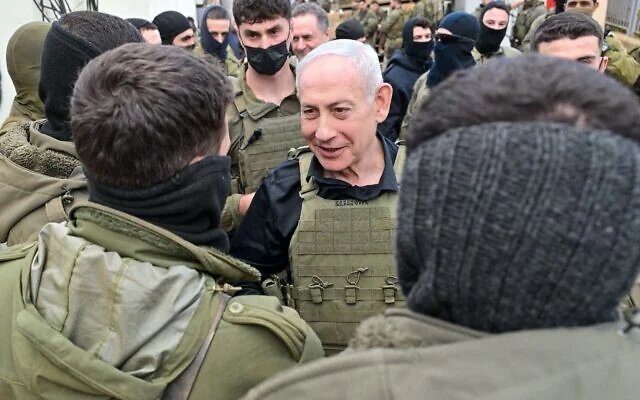
His motivation in claiming success, unforgivable for the prime minister of the State of Israel, is easy to understand, politically. Israel is about to enter an election campaign that Netanyahu will lose if the electorate sees Iran, Hezbollah and Hamas as ongoing potent threats. So Netanyahu the politician, who refused to step down after failing to prevent Hamas’s October 7, 2023, invasion and massacre — the deadliest day for Jews since the Holocaust and in the history of modern Israel — has to assert victory as a central plank of his reelection campaign.
But October 7, 2023, was allowed to happen because Israel under Netanyahu was fatally complacent — blithely asserting that Hamas was deterred, uninterested in escalated conflict and sated by the funding he was encouraging Qatar to send into Gaza. The nation was tearing itself apart amid his coalition’s (ongoing) efforts to demonize and ultimately destroy the independence of our judiciary. And the political and military leadership simply refused to internalize the unmistakable evidence that Hamas was preparing to invade. The full picture of this abject and still unfathomable failure has yet to be thoroughly established, because Netanyahu has steadfastly refused to countenance the necessary state commission of inquiry.
Now, two and a half years later, Netanyahu the politician is assuring the nation that Iran, too, no longer poses a dire threat, that he and Trump have dealt with the danger. And there is a risk to the State of Israel and its people, today as in 2023, that Netanyahu the politician will be swept up by his own bluster and will start to believe his own rhetoric.
“Had we not acted, the names Natanz, Fordo, Isfahan and Parchin might have been remembered eternally in infamy, just like Auschwitz, Treblinka, Majdanek, and Sobibor,” he solemnly claimed at Yad Vashem.
But that danger has not, in fact, been alleviated.
And Netanyahu, not the divisive party chief seeking reelection but the Israeli prime minister — who knows full well that there has been no regime change in Iran, and knows exactly what that selfsame Iranian regime is capable of — has a national obligation to recognize, explain and confront that reality, however politically uncomfortable it may be.
Source:
www.timesofisrael.com


