
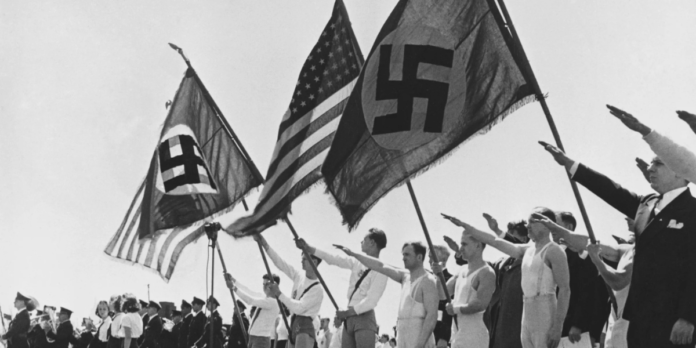
DAYTON, OHIO – MARCH 1938
Article continues after advertisement
Residents were shocked when Gerhard Wilhelm Kunze, the German-American Bund’s national public relations officer, spoke at Liederkranz Hall on St. Patrick’s Day. For many, this felt like a betrayal, a reminder that the shadow of fascism wasn’t confined to Europe. It was there, in their own city, in the heart of America.
Two hours away, in Chicago, the origins of this movement took root with the Free Society of Teutonia. What started innocuously as a German social club, complete with jovial beer-drinking and songs of the home-land, gradually morphed into something far more sinister. The society’s anti-Semitic and anti–Treaty of Versailles rhetoric hardened. Members marched, drilled, and fantasized about a rebirth of German glory under the swastika. Among them, Walter Kappe was a pivotal figure.
Kappe’s journey from a young, angry man in postwar Germany to the helm of Teutonia was one fueled by deep resentment and ambition. At just seventeen he abandoned the University of Göttingen and threw himself into the chaos of the Deutsche Freikorps, a paramilitary group with violent nationalist ideals. By 1923, he was swept up in Hitler’s orbit, caught in the fever of the failed Beer Hall Putsch. The imprisonment of Hitler cemented his ideology. For Kappe, Germany’s humiliations at the hands of the Treaty of Versailles were personal, a wound that cut deep.
When the despair of post-WWI life became too suffocating, Kappe boarded a ship to America in 1925, a man driven to reinvent himself. He worked in a Kankakee farm implement factory, just another nameless immigrant. But the life of a laborer wasn’t for him, and soon enough, he found his way into the newsroom of the Chicago Abendpost, writing propaganda disguised as journalism. His skill with words made him in-dispensable to Teutonia and later the German-American Bund, where he was named press and propaganda chief.
The swastika was no longer just a symbol from faraway lands—it was a bold reminder that hatred, once thought distant, had seeped into their own backyards.
But Kappe was no mere mouthpiece. He envisioned a Nazified America, one that mirrored the triumphs of Hitler’s Germany. He crafted Bund publications, rallied sympathizers, and built alliances with men like Dr. Fred Thomas in Detroit, who openly supported Nazism and harassed Jewish leaders. Through it all, Kappe knew exactly what he was doing—laying the groundwork for something much bigger.
By 1936, the Bund was a powerful force, under their elected leader Gerhard Wilhelm Kunze, organizing rallies with swastikas flying proudly beside American flags. They spoke of German American pride, but it was a thin veil for the hatred lurking beneath. Bund camps, places like Camp Siegfried in New York and Camp Nordland in New Jersey, were hives of Nazi indoctrination. Word had it that upward of twenty camps had sprung up across the country.
From New York to Pennsylvania, from Wisconsin to New Jersey, whispers circulated that Dayton was next. Thousands of children had already passed through these camps, some as young as six, wearing uniforms with Hitler Youth insignia. They saluted the swastika, trained in military drills, and chanted songs of the Fatherland. Perhaps worst of all, they spread lies and hatred of Jews. These camps were not just summer retreats—they were factories producing a new generation of Americans loyal to Nazi ideals.
The city’s residents were rattled. This wasn’t distant Berlin or even the streets of New York. This was Dayton, where neighbors knew one another’s names, where families went to church on Sundays and gathered for community picnics. But now, those same streets felt less safe. The swastika was no longer just a symbol from faraway lands—it was a bold reminder that hatred, once thought distant, had seeped into their own backyards.
NEW YORK, NY – LATE 1930s
A mission had been given to Jewish crime lord Meyer Lansky. One that was just too interesting for him to ignore.
The Mob’s Accountant, renowned as the mastermind behind Murder Incorporated—an organization responsible for between four hundred and one thousand contract killings throughout the ’20s and ’30s—had become one of the most feared men in a fearsome city. Despite his illicit activities, Lansky had carved out a reputation for upholding his word, navigating the treacherous realm of organized crime with a peculiar sense of integrity. So, he was intrigued when he answered the phone and found himself on the line with Special Sessions Judge Nathan David Perlman.
Perlman, a former congressman recently appointed to the New York bench of magistrates by Mayor Fiorello La Guardia, possessed connections spanning both high and low society. Recognizing a burgeoning Nazi problem in America, Perlman took it upon himself to address the issue. In the meeting, Perlman outlined the escalating confidence of Nazis openly expressing anti-Semitic sentiments. The Nazi Bund, with more than twenty thousand members and growing, had become the nation’s largest anti-Semitic group. Perlman was not the type who would normally have had dealings with gangsters, but he was active in many Jewish causes, and dangerous times called for dangerous measures.
Perlman assured Lansky that money and legal assistance would be put at his disposal. The only stipulation was that no Nazis be killed. They could be beaten up, but not terminated. Lansky reluctantly agreed. No killing. Always very sensitive about anti-Semitism, Lansky was acutely aware of what the Nazis were doing to Jews. “I was a Jew and I felt for those Jews in Europe who were suffering,” he said. “They were my brothers.” Lansky refused the judge’s offer of money and assistance but asked Perlman to ensure that after he went into action he would not be criticized by the Jewish press. The judge promised to do what he could.
When the authorities couldn’t—or wouldn’t—get their hands dirty, they turned to folks like him to clean up the mess.
After the call concluded, Lansky ventured into a new mission where organized crime met a higher cause, and precedent would be set. Crime boss Lucky Luciano, who was three years into his fifty-year prison term—but still firmly at the helm of the Five Families—gave Lansky his blessing. Lansky rounded up some of his tough associates and went around New York disrupting Nazi meetings. Young Jews with no ties to Lansky or the rackets also volunteered to help, and he and his crew taught them how to use their fists and handle themselves in a fight.
It began with the disruption of a Bund rally in Manhattan’s Yorkville area, where members had gathered to celebrate Der Führer’s forty-ninth birthday and Austria’s annexation. Arriving that evening, Lansky was infuriated to see hundreds dressed in brown shirts and the stage adorned with a swastika and “decorated with pictures of Hitler, the birthday boy.” The speaker launched into a rant, and despite their limited number (only about fifteen), Lansky’s group, disguised as American Legion members, swiftly took action.
Entering the hall, they attacked attendees, even tossing some individuals out of windows. Fistfights erupted, inducing panic among most of the Nazis, who eventually fled. Lansky and his associates pursued and delivered beatings that left some incapacitated for months. In the aftermath, Mickey Cohen didn’t mind bragging about the evening to anyone in their tight circle who listened. “So we raided the joint. We went over there, grabbed everything in sight, all their bullshit signs, and smacked the shit out of them, broke them up the best we could. Nobody could pay me for this work. It was my patriotic duty.”
Lansky’s minions operated with “military precision,” adhering to a strict code of conduct. Positioned strategically at entrances and exits, they prevented violent Bundists or Nazi sympathizers from escaping unharmed. Soon, authorities turned to him with confidence, relying on his commitment to follow instructions, albeit with a touch of creative freedom. Emphasizing the lack of fatalities or permanent injuries at these events, Lansky acknowledged the aftermath typically involved dislocated limbs, bloodied heads and noses, and frequently, dental work. He “enjoyed beating up Nazis,” and admitted, “There were times when we treated some big anti-Semite in a very special way, but the main point was to teach them that Jews cannot be kicked around.”
Lansky believed that the city’s Jewish leaders approved of his actions, but they couldn’t prevent the Jewish press from condemning him. Perlman’s assurances to temper negative coverage of Lansky in Jewish newspapers didn’t quite meet with Lansky’s expectations. Rabbi Stephen Wise, quoted in Jewish papers, labeled the “Yorkville Bund Busters” as “Jewish gangsters.” Lansky felt betrayed: “They wanted the Nazis dealt with but were afraid to do it themselves. I did it for them, and when it was over, they called me a gangster. No one ever called me a gangster until Rabbi Wise did.”
Lansky had seen it before, and this time was no different. When the authorities couldn’t—or wouldn’t—get their hands dirty, they turned to folks like him to clean up the mess. And he did it, swiftly and without hesitation, because it needed to be done. But once the fight was over and the threat stamped out, the same people who needed him were the first to take the credit and cast him away to where they wouldn’t have to look at him any longer. But this fight was just getting started.
AMERICA – NOVEMBER 1938
“Hitler Seizes 20,000 Jews,” declared The Chicago Daily Tribune. The Los Angeles Times echoed with “Nazis Terrorize Jews in Wild Orgy,” while The New York Times proclaimed, “Nazis Smash, Loot and Burn Jewish Shops and Temples Until Goebbels Calls Halt.”
The world recoiled at Kristallnacht—November 9, 1938—“the Night of Broken Glass,” a harbinger of Hitler’s plans for ethnic cleansing. Sparked by the shooting of a German diplomat by a seventeen-year-old Polish Jew, Hitler unleashed mobs to destroy Jewish homes, businesses, and synagogues. Nearly one hundred Jews were killed, and more than thirty thousand men were sent to concentration camps.
President Roosevelt, shocked, withdrew the US ambassador from Germany, but global action remained weak. Frustrated, many Americans searched for ways to intervene. “Those who value tolerance and humanity can no more stay silent,” The Hartford Courant declared.
Despite mounting outrage, the American Nazi movement, led by Fritz Kuhn, gained momentum. The Bund planned its largest rally yet for February 20, 1939, at Madison Square Garden. The marquee read: “Pro American Rally.” Inside, Nazi armbands, swastikas, and storm-troopers filled the aisles. The rally opened with the Pledge of Allegiance. Kuhn and his leaders called it a “mass demonstration for true Americanization,” mixing patriotic imagery with Nazi symbols and anti-Semitic rhetoric. As the evening unfolded, the crowd cheered for Kuhn’s slanderous remarks, including a jab at President Roosevelt:
“President Frank D. Rosenfeld.” The crowd laughed.
George Dasch didn’t agree with the crowd, however. As a teenager, he had stowed away on a steamship to get to America. Overcoming his immigrant status, he chased the American dream. He worked his way through the New York restaurant scene. He traveled the wide-open country and even served in the American Army Air Corps in Hawaii, securing an honorable discharge with an “excellent” character rating before marrying Rosemarie “Snooks” Guilli in 1930. Invited by a family member, who had been hounding him to attend a Bund meeting for years, George reflected on the landscape of German American societies before Fritz Kuhn’s emergence. “Before the creation of the Bund in this country, we had numerous societies for German Americans . . . but they were, at their core, Americans first. They were largely benevolent organizations with the shared purpose of ‘keeping the house fires burning.’ However, with the advent of the Bund, these organizations were coerced into aligning with the New Friends of Germany or face dissolution.”
George’s disenchantment deepened as Fritz Kuhn unleashed a torrent of vile hatred against American ideals. In contrast to the values George once associated with these groups, he saw no semblance of patriotism that night. While some succumbed to the fervor, aligning with the increasingly vocal and unchecked American Nazis, opposition remained tragically scarce.
Outside Madison Square Garden, chaos erupted as a seething crowd grew louder. Meyer Lansky’s men no longer needed to disrupt Nazi rallies—fed-up Americans did it themselves. Mayor La Guardia deployed 1,700 officers to control the surge. Inside, twenty-two thou-sand Bund members gathered, while an equal number defied them outside. Demonstrators included WWI veterans, housewives, and even a Broadway orchestra playing “The Star-Spangled Banner.”
It wasn’t just a job; it was access to news that might otherwise be censored, an insight into the nerve center of German operations, and most important, his chance to do something for the country he had always loved: America.
Isadore Greenbaum, a twenty-six-year-old Jewish plumber, snuck past the barricades, stormed the stage, and shouted “Down with Hitler!” before being brutally beaten by Bund stormtroopers.
Leveraging the violence, the Bund gained headlines. But within a year, it collapsed. Support had eroded as reports of genocide flooded in, Fritz Kuhn was jailed for embezzlement, and the Bund was outlawed. However, the end of the Bund marked the rise of a new era—spies and underground Nazi networks grew across the United States, obsessed with American technology surpassing their own.
BERLIN, GERMANY – JUNE 3, 1941
George Dasch never thought he’d end up here—sitting in the Abwehr headquarters, waiting to meet a man by the name of Lieutenant Walter Kappe. Only months earlier, he had been a New York waiter, a far cry from the feverish nationalism that gripped some of his fellow Germans in America. He kept to himself, avoiding the Bund and the whispers of “the cause.” But life had a way of upending the expected, and now he found himself in Berlin, restless, in a country that felt as foreign as it did familiar, desperate for any glimmer of hope.
When Kappe finally arrived, he carried an air of brisk confidence, which cut through Dasch’s anxiety. “I’ve found you a position,” he said. Dasch’s heart skipped—a job at the Sonderdienst Seehaus, a govern-ment intelligence office monitoring foreign broadcasts, under Abwehr chief Admiral Wilhelm Canaris. It wasn’t just a job; it was a chance to claw his way back to stability. Kappe mentioned that Dasch’s command of English had caught the eye of superiors, a skill they believed would serve him well. It was his first real break.
But his welcome to Germany had been anything but smooth. Berlin was a city stripped bare, its grand avenues shadowed by a wartime reality that few had anticipated. Food was scarce, rationed in pitiful portions that left families hungry. Essentials like meat and butter were luxuries, jealously guarded and strictly controlled.
Yet, nothing haunted Dasch more than the absence of his wife, Snooks. They had spent months planning a trip to Germany together, waiting on word from the consulate for available passage. When the message finally came, it offered only one option: leave that very evening. Snooks was still in the hospital, recovering from surgery. There was no time for goodbyes. George had to choose—go now and hope she could follow once she healed, or lose the opportunity entirely. George had called his sister, leaving her with the impossible task of explaining his departure to Snooks, and boarded a boat teeming with Nazi supporters. Among them was a man named Werner Thiel, who clashed with him over every trivial matter after George refused to salute Hitler. Thiel turned the journey into an unending confrontation.
When George arrived in Germany on May 13, the ordeal continued. The country he returned to was unrecognizable, and without party ties, jobs were nearly impossible to find. His mother, disillusioned, admitted she had made a mistake leaving America in 1939. George had nowhere to turn. Then came his first break.
Kappe had promised to look into the whereabouts of Snooks—she hadn’t been heard from since boarding a ship to Germany to join George. He had also extended an offer—an assignment with an “American group” at the Seehaus. Kappe was no ordinary officer. Once a Bund organizer in America, he had shaped nationalist narratives through Deutscher Weckruf und Beobachter, the German American newspaper. His work spread Nazi propaganda across the country, reaching tens of thousands of American homes. But in 1937, things took a turn.
After being expelled from the Bund due to internal power struggles and rivalry with Fritz Kuhn, Kappe returned to Germany, where he took a role as the propaganda director for a Berlin radio station that broadcast Nazi ideology to the Americans. When war erupted in 1939, Kappe briefly served in the army before being recruited into the Abwehr, the German Armed Forces Secret Service. Now he was recruiting men with knowledge of the United States.
For George, this work was a godsend. They weren’t just transcribing radio chatter; they were monitoring propaganda, tracking global news, pulling intelligence from international broadcasts. Dasch’s role was to listen—hour after hour, dissecting the nuances of English-language reports, parsing every shift in tone, every coded phrase. It wasn’t just a job; it was access to news that might otherwise be censored, an insight into the nerve center of German operations, and most important, his chance to do something for the country he had always loved: America.
LONG ISLAND, NEW YORK – JUNE 27, 1941
The cool air of Centerport swept across William “Bill” Sebold as he stood on the porch of a secluded cottage on the north shore, cigarette smoke twisting in the faint moonlight. The night was quiet, but Sebold’s mind buzzed with the weight of what was happening. He had been waiting for this moment—a culmination of nearly two years spent playing a dangerous game, straddling the line between life and death. The FBI was closing in, and soon the network of Nazi spies he had helped entrap would be dismantled. But even then, as the raid unfolded, relief mingled with dread. His life, his decisions—every move he had made—all came to a crescendo that night.
The Germans believed him theirs; yet every word was filtered to the FBI, who began piecing together the larger conspiracy.
It had all started innocently enough in 1939, when William Sebold, a naturalized American, returned to Germany to visit his family. But this Germany wasn’t the one he had known. Hitler’s grip had turned his homeland into a machine of intimidation and fear. Sebold was summoned to a dull, unmarked office. His passport was taken, the order blunt: work for the Abwehr—Germany’s military intelligence agency—or his family would suffer. Stripped of choice, Sebold found himself enlisted, handed the alias “Harry Sawyer,” and trained in the craft of espionage. Over the next few months, he learned the dark art of deception: shortwave radio operations, coded messages, and disguises that turned him into a shadow among men.
Sebold, however, felt his resolve harden with every clandestine skill he acquired. He knew he could not betray his adopted country. Before he left Europe, he managed to slip away to the US consul in Genoa, where he spilled the details of his recruitment, his mission, his handlers. The FBI was waiting when he returned to New York in 1940.
Inside a cramped Manhattan office, he unfurled the tangled web of espionage, giving the FBI a golden ticket. He handed over the plans they needed, tucked into a wristwatch, and listed names and addresses of prominent Nazi agents operating within US borders. He pointed them to figures like Frederick Joubert Duquesne, the notorious South African who had sabotaged British ships in the First World War and held a vicious hatred for Britain; Herman Lang, an engineer with direct access to the Norden bombsight, one of America’s most guarded military technologies; and Lilly Stein, a former model who could charm secrets out of just about anyone in New York’s high society.
The FBI seized the opportunity to redeem itself. Just two years prior, Hoover had claimed a victory over Nazi spies, only to have key figures slip through their fingers. This time, the Bureau wasn’t about to let history repeat itself. With Sebold as their double agent, they launched “Ducase”—a counterintelligence operation that made the Germans think they were pulling the strings when it was actually the FBI holding all the cards.
Sebold’s midtown Manhattan office became the nerve center of the operation. Once a glamorous part of the beaux arts Knickerbocker Hotel, the sixth-floor rooms were turned into a hotbed of clandestine activity. Thanks to favors from Commander Vincent Astor—a trusted friend of Roosevelt who had earlier procured Japanese intelligence for the Bureau—the FBI secured Rooms 627, 628, and 629, shielded by the building’s owner. Newsweek staffers and other tenants worked in blissful ignorance of the quiet storm that had brewed just down the hall.
The office bore a modest sign reading “William G. Sebold Diesel Eng.,” an inconspicuous façade that beckoned Nazi spies to spill their secrets. The Bureau bugged every inch of the place: the desk hid recording devices, and a two-way mirror disguised a small room where an agent armed with a spring-wound motion picture camera documented every visitor. Each handshake, each lean across the desk, each guarded whisper between Sebold and his “colleagues” was captured, slowly weav-ing a net around the Nazi espionage web on American soil.
Duquesne, Stein, Lang—they all came to see Sebold and unknowingly set themselves up for exposure. Sebold played his part—nodding and taking notes, and slipping them just enough useful information to keep Berlin satisfied. Over fourteen months, he sent 301 messages to Germany and received 167 in return. The Germans believed him theirs; yet every word was filtered to the FBI, who began piecing together the larger conspiracy.
One of those pieces was Kurt Ludwig—an independent operator recruited personally by Heinrich Himmler. Ludwig was ambitious, his methods bold. Posing as a college student, he hitchhiked to military bases and eyed troop movements and installations. One FBI report noted: “On June 18, he walked down Twelfth Avenue from 59th Street. He was watching piers. When he came to Normandie’s pier he stopped for some time . . . Then he walked on looking back.” Ludwig’s daring tactics were unraveling; the Bureau knew it was time . . .
As the city’s lights dimmed, thirty-three Nazi spies were arrested in a swift sweep that reverberated across the nation. It was the largest espionage takedown in American history, exposing the chilling depth of Nazi activity on US soil. The blueprints for the Norden bomb-sight, confidential information from Sperry Gyroscope, secret military positions—these weren’t just stolen secrets; they were pieces of America’s lifeblood, now seen as targets in the hands of an enemy that many had thought too distant to touch them.
In Germany, Hitler unleashed one of his infamous tirades, a theatrical display of fury that rattled his inner circle. Sebold, meanwhile, could only wait in his secluded Long Island hideout, the reality of his role in dismantling the largest Nazi spy ring in America pressing heavily on his mind. His work nearly done, he would soon disappear into obscurity, part of America’s Witness Protection Program. But across the Atlantic, Hitler’s war machine churned relentlessly, and the spies Sebold helped expose were only one piece of a much larger game.
__________________________________
From The Dangerous Shore. Used with the permission of the publisher, William Morrow. Copyright © 2026 by Sara Vladic
Fuente:
lithub.com


