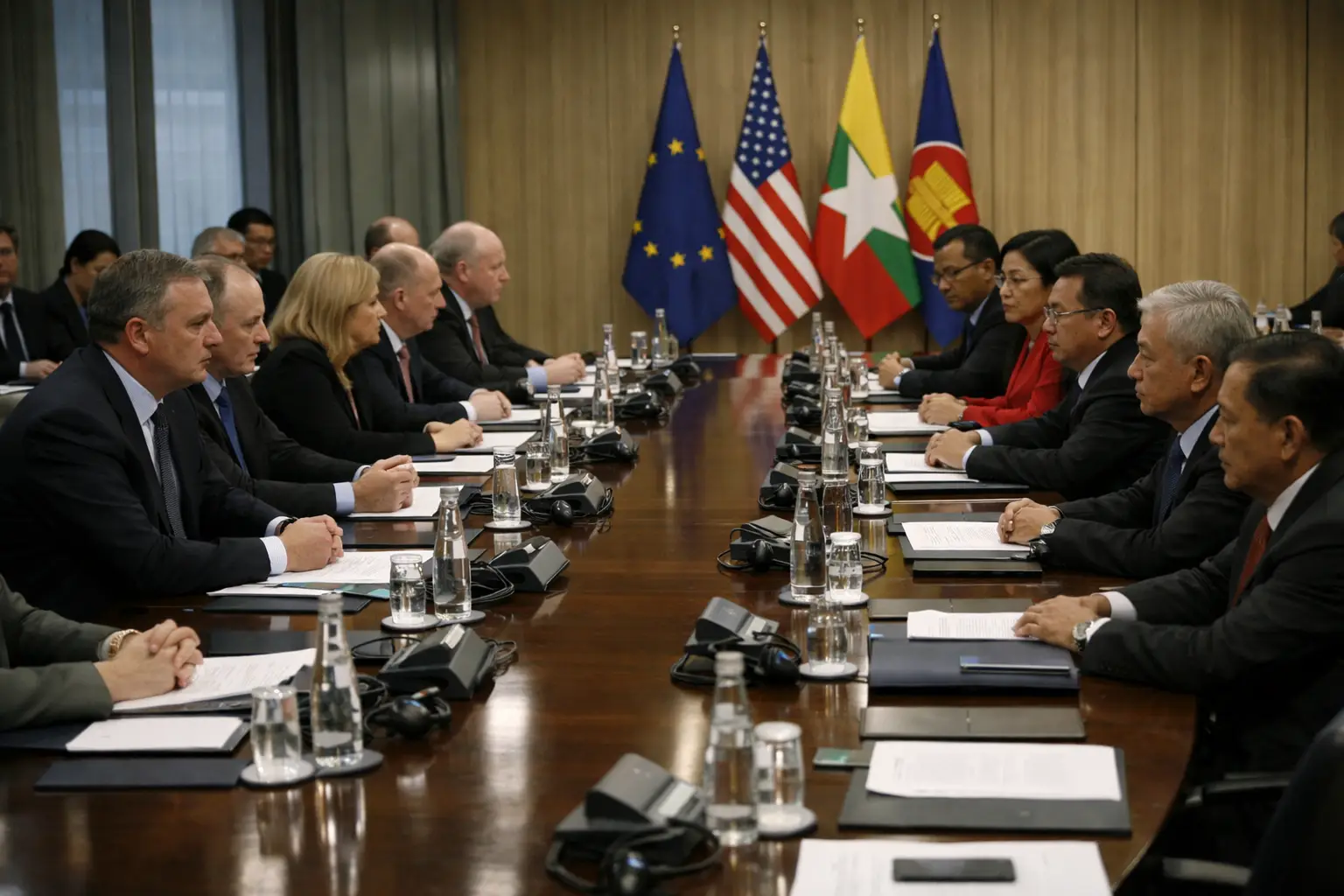
Washington’s renewed contacts with the military-backed authorities in Myanmar are putting fresh pressure on the European Union, whose policy has remained anchored in diplomatic distance from the junta. The move by the United States, alongside the resumption of contacts by several Southeast Asian governments, has reopened a difficult debate in European capitals: whether isolation still serves the bloc’s objectives, or whether it leaves Brussels with less influence over a crisis on which other actors are beginning to re-engage.
The EU’s approach has been shaped by the military takeover that overturned Myanmar’s elected civilian leadership and triggered a prolonged political and humanitarian emergency. Brussels has relied on restrictive measures, political non-recognition and limited official engagement to signal that the military’s control should not be normalised. That position has given the EU a clear normative line, but the latest diplomatic movement around Myanmar exposes a practical weakness: leverage can diminish when channels of communication are held open by others while Europe remains largely outside the room.
For Southeast Asian governments, renewed engagement reflects a different set of priorities. Myanmar is not a distant crisis for the region; it is part of its security, migration and economic environment. The Association of Southeast Asian Nations has struggled to forge a unified response, and individual governments have increasingly pursued contacts that reflect national interests as well as regional calculations. This does not amount to an endorsement of military rule, but it does show that a strict diplomatic freeze is no longer the only approach among countries dealing directly with Myanmar’s instability.
The question for the European Union is not simply whether to follow Washington or regional capitals. It is whether its current mix of pressure, sanctions and limited diplomacy can still affect outcomes inside Myanmar. Any change would carry risks: engagement could be interpreted as legitimising the military-backed government, while continued absence could reduce the EU’s ability to shape humanitarian access, political dialogue or future negotiations. The reopening of conversations by others therefore leaves Brussels confronting a strategic dilemma rather than a procedural adjustment.