
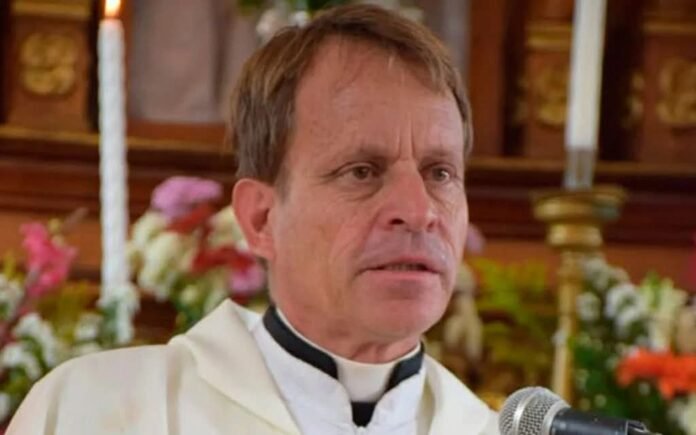
SÃO PAULO, Brazil – The Ecuadorian police have not yet determined the motive behind the killing of Father Maximiliano Estupiñán Gaisbauer, 64, who was found dead in his house in Quito on Mar. 23.
His body, discovered by a house worker in the yard, showed signs of violence, especially to the head, and a trail of blood could be seen nearby.
According to Liria Gordillo, a niece of the priest, Father Max — as he was known among churchgoers — was probably caught off guard by criminals upon arriving home at night. She told TV station Ecuavisa that some of his belongings were missing: an old laptop, a smartphone, a watch, a bracelet, and US$200.
“For those things he was killed,” Gordillo said.
On Mar. 26, footage from CCTV cameras in the neighborhood and in the priest’s house showed men inside the premises. Officers hope the images can help them identify the perpetrators.
“Until now, the police have not announced any new findings,” María Helena Estupiñán, Max’s younger sister, told Crux Now.
The crime shocked many in Ecuador, which has been facing one of the worst security crises in its history. Although President Daniel Noboa has focused on combating violence since taking office at the end of 2023, his measures — including the deployment of military personnel on the streets and in prisons — have failed to change the situation in the Andean nation.
On Mar. 25, during the funeral Mass, Cardinal Alfredo Espinoza, Archbishop of Quito, said in his homily that the crime “was not an isolated incident” and that it “reflected a deep wound” in the country.
“Today, from this altar, we cannot remain silent,” Esponiza said.
“The blood of our brother cries out to heaven,” the cardinal said.
“It cries out for justice. It cries out for truth. It calls for a profound change in the heart of our society,” Espinoza also said.
“We cannot grow accustomed to violence. We cannot normalize crime. We cannot live as if nothing were happening,” Espinoza said.
Espinoza described Max as a “good, simple, and humble priest” who is remembered with affection by his former students at Saint Louis Seminary and by members of the parishes where he worked.
“I affirm with conviction that he was a priest who ‘died with his boots on’,” Espinoza said.
“His rubber boots were a very distinctive characteristic of his,” Espinoza recounted.
“A few months ago,” the cardinal said, “when I saw him without them, we joked about it. I asked him about them and told him I didn’t recognize him anymore.”
Many people on social media recalled Father Max wearing his boots, a sign of his readiness to help anyone at any time.
“How could one forget his ever-present jeans, rubber boots, and shirts? They were signs that he was always, always working, whether on maintenance at the school or in the activities he carried out in rural areas,” David Tatayo Narváez, a former seminary student who first met Max at 13, told Crux Now.
Tatayo said Father Max’s “most distinctive traits were his devotion, his friendly way of interacting with all the students and with everyone, his profound advice, his charisma, and above all his positive smile.”
“Remembering him, it’s impossible not to become sentimental,” he said.
On social media, Tatayo — now a 33-year-old multimedia and graphic designer — lamented the insecurity in Ecuador that has taken the life of such a devout man.
“Father Max was always an honorable person,” Tatayo said, “and it truly hurts to know that something like this could happen to someone so good.
Tatayo said he feels “both pain and outrage over everything that happened.”
“The country is going through an unparalleled crisis of violence,” He said, “with criminals having more rights than citizens,” adding, “if human justice does not reach his attackers, then God’s justice will make itself present.”
María Helena, Max’s sister, said he was the oldest of four siblings. Their mother was German and their father was from Ecuador.
“He was always a very special person. Our mother was deeply Catholic, and Max used to delight in the beauty of Catholic things, in silence, in reverence for the sacred,” she said.
The two remained in constant contact. He would visit her twice a week and they spoke on the phone frequently.
She said her brother “had a great connection with elderly people, to whom he would constantly visit and to whom he would bring the sacraments.”
“He was also always helping children and teenagers,” she said, noting also how he would give them school supplies when they were needed and even help with things like scheduling dentist appointments.
María Helena said Father Max had been robbed at gunpoint not long ago, while driving on a road.
“I used to think his neighborhood was relatively safe, but that no longer exists. The whole country is violent. People kill so easily nowadays. They will kill for a cellphone,” she said.
She remembered her brother as “a person who didn’t like any kind of conflict, who was sympathetic and understanding.”
“It’s so impactful. We can only hope for justice,” she concluded.
Source:
cruxnow.com


