

Pope Leo XIV celebrated Mass for the Solemnity of Saints Peter and Paul – martyrs and co-patrons of the city and the diocese of Rome – in St. Peter’s Basilica on Monday.
It was the second of two major gatherings of senior prelates over the past four days, which together offer subtle indications about how Leo intends to give institutional form to “synodality” and tackle practical issues of governance.
“[I]t is important,” the pope said in his homily, “to look to these two saints – Peter and Paul – to understand how we, in turn, can be apostles and builders of unity, and generous servants of the truth in charity.”
Also present were nearly three dozen prelates appointed in the past year to lead major metropolitan archdioceses around the world, who received the liturgical vestment that is the special sign of their leadership.
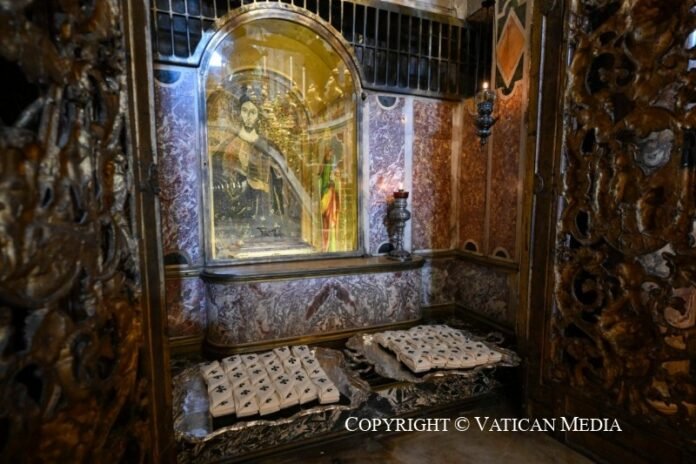
The pallium, as the vestment is called in the Church’s Western tradition, is a thin strip of white lamb’s wool, about 2 to 3 inches wide, with six black silk crosses hand-stitched at intervals. Foot-long weighted pendants hang from the front and back to keep it in place.
“These bands of white wool adorned with crosses indeed express the commitment of every shepherd — and also of every Christian — to take upon their shoulders the brothers and sisters entrusted to them,” Leo said, “like so many lambs of the Lord’s flock.”
The pontiff also said the vestments signify the wearers’ willingness “to sacrifice their energy, time, effort, and even their lives,” for those in their pastoral charge.
The Pallium, rich in history and symbol
The wool for the special vestments comes from kid lambs received by the pope and blessed in Rome’s Basilica of St. Agnes Outside the Walls on St. Agnes’ feast day – January 21 – lambs traditionally raised by Trappist monks.
Benedictine sisters of the Basilica of St. Cecilia in Trastevere craft the vestments from the wool, traditionally after shearing the animals during Holy Week.
June 29 has been a solemnity in Rome – and a public holiday – for the better part of two millennia, and is an expression of the Church herself, involving in various ways Christians in every state of life – clerics, religious, laity – and expressing the Church’s universality.
For centuries, the pallium itself has been a symbol of metropolitan archbishops’ authority within their respective jurisdictions.
They do not wear the vestment when celebrating outside their archdioceses, except in Rome when they receive it.
The pallium is also a symbol of communion with the Bishop of Rome, who is the Church’s supreme pastor.
Tradition, ancient and modern
It was only in 1983 that Pope St. John Paul II began the practice of “imposing” the pallium on newly appointed metropolitan archbishops in Rome on the Solemnity of Saints Peter and Paul.
In 2015, Pope Francis decided to send the pallia to new archbishops and have the apostolic nuncio – the papal ambassador – impose the vestment during a ceremony celebrated locally.
“The meaning of this change,” then-Monsignor Guido Marini – papal Master of Ceremonies – told Vatican Radio at the time, “is to put more emphasis on the relationship of the metropolitan archbishops – the newly nominated – with their local Church.”
Marini explained that the change was of a piece with the “journey of synodality in the Catholic Church, which, from the beginning of his pontificate, [Francis] has constantly emphasized as particularly urgent and precious.”
The change under Francis conveyed something of the sense informing the late pontiff’s thinking about synodality, a major theme of his whole pontificate.
As Crux Now’s editor-in-chief Charles Collins put it in an analysis, “The move of the imposition of the pallium from Rome to the home archdioceses of the archbishops was one of the first official acts concerning one of Pope Francis’s key programs.”
It was news, therefore, when Pope Leo XIV last year restored the imposition ceremony to the Mass of Saints Peter and Paul in the Vatican.
RELATED: Pope Leo XIV gives first indication of how he might change ‘Synodality’
In his homily on Monday, Leo did not utter the word “synodality.”
He only said it once in his 2025 homily, and then only in greeting the Synod of the Ukrainian Greek Catholic Church, the members of which were in Rome for an eleven-day meeting that would begin on June 30.
In the Christian East, both Orthodox and Catholic, the Synod is a governing body with real legislative powers within a broad but well-defined remit.
In the West, synods largely fell out of use as instruments of governance centuries ago, with most of their responsibilities absorbed by local bishops and especially by the papacy itself, but Pope St. Paul VI established a body called the Synod of Bishops in the wake of the Vatican Council II to be a stable consultative body.
The Synod of Bishops established by Paul VI, however, was from the beginning little more than a talking shop.
Pope Francis used the Synod of Bishops’ General Secretariat as a steering committee with broad powers to direct and implement his vision for a “synodal” Church.
Prelates from around the world participated in the various assemblies of the Synod of Bishops and were mostly content to let the proceedings be managed from the Apostolic Palace while they got to know one another and enjoyed Roman restaurants for a few weeks.
They took less kindly to being directed by a new bureaucracy suddenly empowered not only to steer general assemblies but also to manage and order activities between assemblies, to issue reports (sometimes de facto decrees), commission studies and questionnaires, and otherwise create a great deal of busy-work for bishops and their already put-upon staffers.
As I noted in my 2025 book, Leo XIV: The New Pope and Catholic Reform, the then-newly elected Pope Leo XIV gave the General Secretariat of the Synod of Bishops fairly short shrift when he received them in June of last year.
“I cannot remain with you all afternoon,” Leo told his guests, but said he “would be happy to take this opportunity to share an idea” he considered central “and then to listen to you in the time available to me.”
The idea was that the Synod of Bishops was what Paul VI created it to be.
“The Synod of Bishops naturally retains its institutional physiognomy,” Leo told the Secretariat, “and at the same time is enriched by the fruits that have matured in this season” of reflection on the notion of “synodality” under Francis.
The chief drivers of the “synodal process” struggled throughout almost the whole of Francis’s twelve-year reign to say what it was, while Francis himself admitted the notion was nebulous even in his own mind, though while he lived he never ceased in his efforts to make “synodality” a force capable of radically reshaping the Church.
Leo went on to describe the legacy of the Francis era vis-à-vis synodality as “a style, an attitude that helps us to be Church, promoting authentic experiences of participation and communion.”
That is not a blueprint for a revolutionary alteration of either the Church’s self-understanding or her modes and orders of government, nor will it ever power radical reshaping of the Church’s institutional profile.
A ‘new’ take on ‘Synodality’?
It would be easy – too easy by half – to take the absence of explicit discussion in a homily on a major solemnity with its own rich history and symbolic weight as a sign Leo is putting a key element of his predecessor’s reign on the back burner.
Quite the opposite is the case.
Synodality was a major focus of the extraordinary consistory Leo held this past weekend.
In remarks closing the two-day business meeting of 178 cardinals – electors and those past voting age – the pontiff subtly but unmistakably acknowledged that the meaning of “synodality” remains an open question, one in need of pastors’ discernment.
“It seems to me,” Leo said in closing remarks on Saturday, “that the question of synodality is not primarily: Who has the power to decide?”
“The question,” Leo said, “is more profound: How do we together safeguard the gift that the Lord has entrusted to his Church?”
“When this question becomes the center of our discernment,” Leo said, “the questions of authority, co-responsibility, and decisions also find their rightful place, illuminated by the mission and shared fidelity to the Gospel.”
Then, the pontiff entrusted the cardinals “once again with the journey of implementing the Synod.”
It may be parsing too closely, but the pope may have been indicating – again and ever-so-subtly – his intention to rely on the College of Cardinals as his principal advisory and executive body, rather than the Synod of Bishops.
RELATED: Leo XIV’s second ‘business’ consistory produced few headlines, but that’s by design
“[S]ynodality,” Leo also said, “is not a collection of meetings, nor a working method.”
The pontiff was quoting – or closely paraphrasing – the General Secretary of the Synod of Bishops, Cardinal Mario Grech, who had addressed the body on the theme of synodality.
“It is a spiritual style,” Leo said, “born from encounter, [which] grows through listening and matures through discernment.”
It wasn’t the first time Leo had described synodality as a “style,” nor was it the first time Leo had spoken of what synodality is not.
“The real question,” Leo said, “is not how many conversations we will be able to organize, but what evangelical quality our meetings will have.”
RELATED: Church may not be an international corporation, but Synod office seems to love business meetings
“When we listen to one another with humility and freedom, making room for the Spirit,” he said, “our conversations do not remain an exchange of ideas, but become a place of conversion, in which we grow together in fidelity to the Lord.”
Leo XIV has already announced his intention to hold regular meetings of the whole College of Cardinals, at least annually.
Whether this will mean fewer synodal meetings – or at least fewer meetings about synodal meetings – remains to be seen, but the indication is that Leo would like to talk less and do more.
Only, what is it that local Churches are supposed to do more of?
While we’re at it: How, precisely, does Leo XIV intend to use the College of Cardinals in his work of governing the universal Church?
Those questions are still seeking a concrete answer.
Follow Chris Altieri on X: @craltieri
Source:
cruxnow.com


