
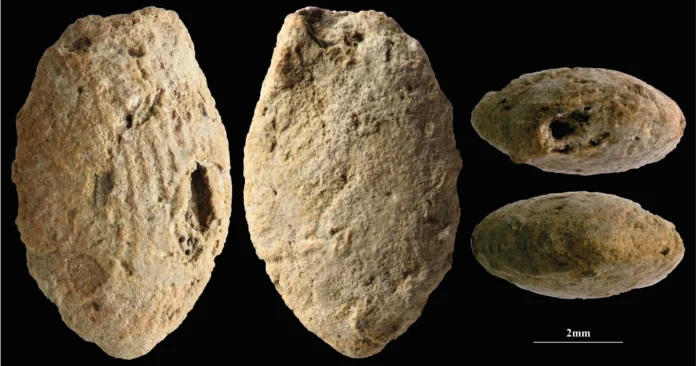
A group of Israeli and international researchers uncovered the largest collection of prehistoric clay beads ever documented worldwide among the items excavated at several sites in northern Israel, a new study published in Science Advances on Wednesday has revealed.
They identified over 1,000 human-made artifacts, including the 142 beads presented in the paper, at sites that date back 12,000 to 15,000 years. The robust sample size has allowed the research team to form unprecedented hypotheses about prehistoric life in the Natufian culture.
“Before this study, we only knew of four beads made of clay from this period anywhere in the world,” Laurent Davin from the Hebrew University of Jerusalem, the lead author of the study, told The Times of Israel over the phone.
For the study, Davin and fellow researchers reviewed and analyzed dozens of thousands of what Davin described as “clay lumps” excavated at el-Wad, Nahal Oren, Hayonim, and Eynan-Mallaha over the decades and stored by the various organizations that carried out the digs (Hebrew University, University of Haifa, and Centre de recherche français à Jérusalem).
“The idea behind the study was to look into the beginnings of the symbolic use of clay, which was previously thought to be related to the emergence of an agricultural lifestyle around 11,000 years ago,” Davin said. “We believed it might have started earlier, in the very first villages of humanity, the Natufian culture.”
The Natufians lived in the Levant at the very end of the Paleolithic period (approximately 15,000 to 11,700 years ago) and are considered a critical link between the last Paleolithic hunter-gatherers and the first Neolithic farmers. They were the first to live in sedentary settlements but still maintained a hunter-gatherer lifestyle, without growing their own food.
All the sites whose artifacts were checked in the study are associated with the Natufian culture. Their time periods were determined by radiocarbon dating of dozens of samples collected at each site.
Some beads feature geometric forms, such as cylinders, discs, and ellipses. Many were inspired by plants from the surrounding environment and the communities’ diet, including wild barley, einkorn wheat, lentils, and peas.
This feature suggests the jewelry carried a symbolic meaning, possibly related to how those ancient artisans perceived and expressed their identity.

Davin explained that it was surprising to see how beads found in different villages, two on Mount Carmel and two in the Galilee, shared a common typology.
“When we look at the ornaments from these sites made of other raw materials such as shells, bones, and stones, they are very different from each other,” he noted. “Therefore, we always thought that each site had its own identity.”
“With clay, [the shapes are] the same,” he noted. “So it looks like clay was the common, basic system of ornaments, a common symbolic [language].”
Many of the beads were also painted red with ochre, marking the earliest documented instance of a specific technique known as engobe (a liquid clay layer coating the surface of the artifacts).
“Previously, we thought that this technique only started with the emergence of pottery way later, around 7000 years ago,” Davin said.

The researchers also estimated the approximate ages of the jewelry-makers based on about 50 fingerprints they found on the beads.
Based on their size, they could determine whether they belonged to children, young adults or women (it is not possible to differentiate between the two groups as their fingerprints are similar in size), or adult men.
“It was a multi-generational community,” said Davin. “This is a game-changer because it’s the first time that we can identify the manufacturers of such early artifacts.”
“We discovered that some of the beads were made by children, and they were the same as the beads made by adults,” he explained. “This tells us that children had access to the same materials as adults, that we are not talking about children playing with mud and making stuff. They were doing exactly what adults were doing, which is really interesting.”
According to Davin, this might be interpreted as children learning how ornaments were made and, possibly, what they represented.
“Maybe they were learning how to display their identity,” he said.
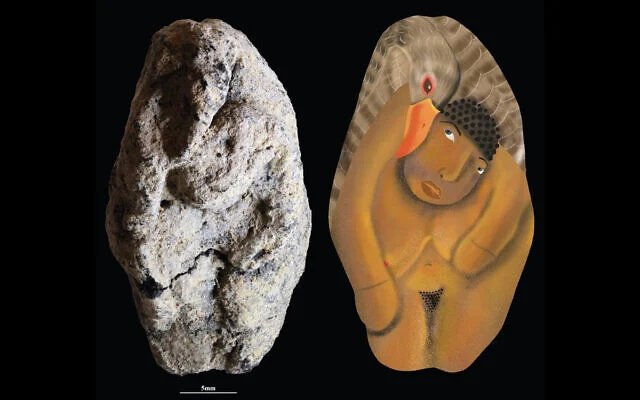
During the research, Davin also identified several small clay figurines, including an unprecedented artifact depicting a woman and a goose, the earliest figurine ever recorded to portray an interaction between humans and animals.
Information about additional figurines will be published academically in the future.
The researchers are also looking into the origin of the clay. According to Davin, in most cases, the ancient artisans likely found the clay in the surroundings of their villages, but at least a few artifacts from Eynan-Mallaha seem to be made of clay from the floor of the village’s houses, based on the residues of bones, flint, and other sediments found in the material that appear to be the same of the dirt from the floors.
Finally, for the first time, the archaeologists identified some residual strings in the holes of some of the beads.
“We are going to be able to determine which plant and technique they used to make a necklace string,” Davin said. “We never had something like it for this period.”

Source:
www.timesofisrael.com


