

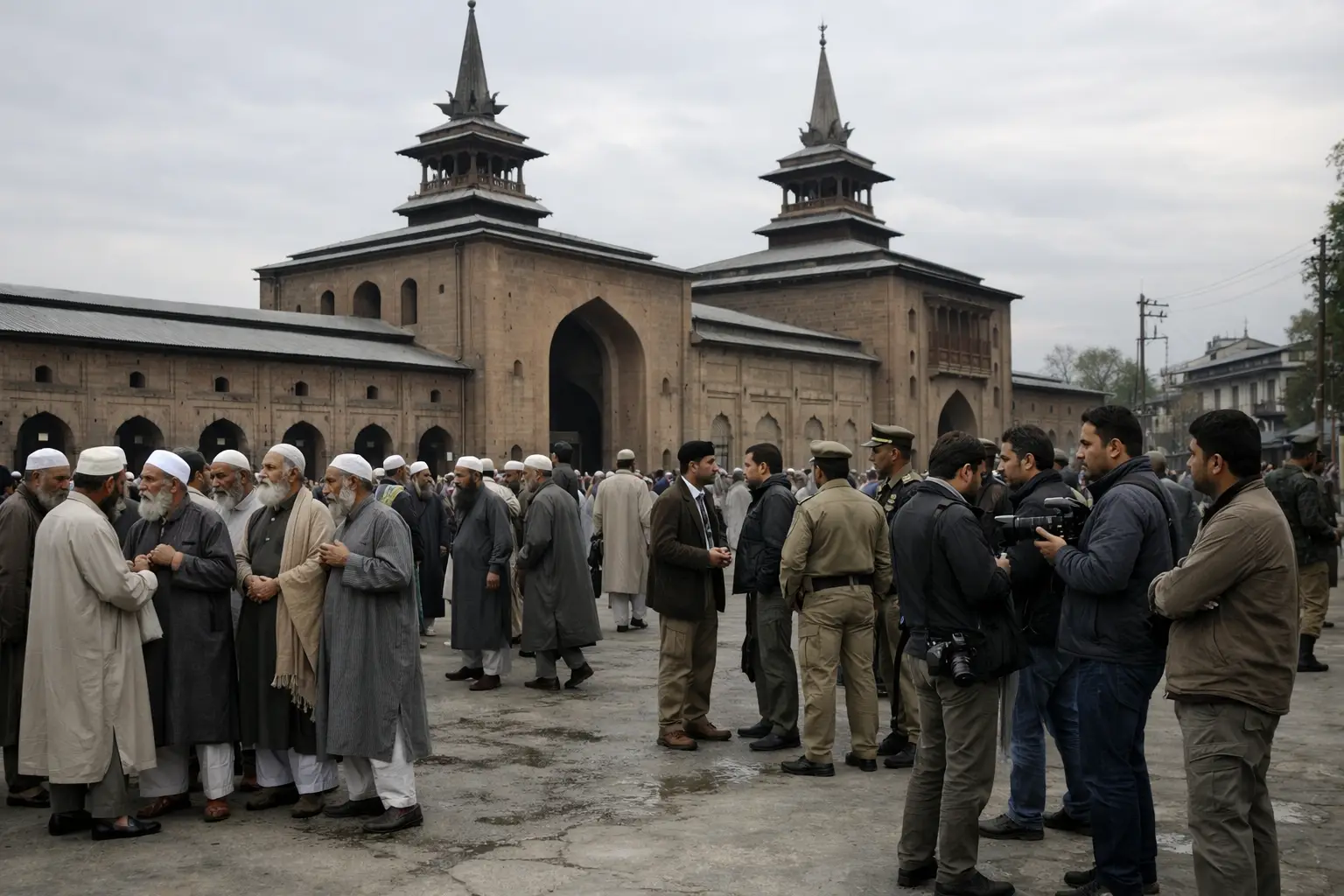
Questions over religious authority in Kashmir have placed the relationship between faith and state power back at the center of the region’s political debate. The issue is not whether Islam is present in public life: in the Indian-administered territory, religion, communal identity and political legitimacy have long interacted. The narrower and more sensitive question is whether administrative action is now being interpreted as an attempt to shape Islamic practice itself.
The concern carries particular weight because Kashmir’s public sphere has rarely separated religious expression from political meaning. A statement now circulating in the debate captures that mood by describing Islam and politics in Kashmir as historically inseparable and suggesting that the same connection is visible again. The remark does not establish a policy change on its own, but it illustrates why any perceived intervention in religious life can quickly become a broader political issue.
The Government of India has held more direct administrative authority over Jammu and Kashmir since the former state’s constitutional status was changed in 2019 and it was reorganized as a union territory. That shift remains central to how many developments in the region are read. Measures connected to public order, institutions, education or local administration can be assessed not only for their legal form, but also for their effect on trust between residents and the state.
Kashmir’s Muslim-majority character makes questions about religious practice especially sensitive. Mosques, clerics, religious education and community traditions are not merely private matters in a society where faith has helped define collective identity. Any debate over state involvement therefore risks extending beyond worship into representation, autonomy and political confidence. For that reason, even limited administrative decisions can acquire symbolic importance when they touch institutions associated with Islamic life.
At this stage, the available information points to a dispute over interpretation rather than a documented, specific measure proving expanded control over Islamic practice. The significance lies in the perception itself: in Kashmir, where the boundaries between religion and politics are historically fragile, the credibility of public administration depends not only on what the state does, but also on how its actions are understood by the communities affected.


