
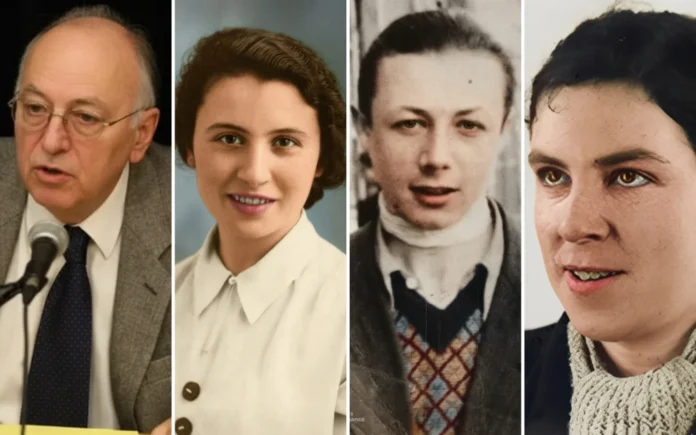
Four Jewish rescuers who saved other Jews during the Holocaust were recognized Tuesday in a ceremony organized by B’nai B’rith World Center-Jerusalem and KKL-JNF Jewish National Fund.
The 24th annual event is the only major commemoration of the heroism of Jews who endangered their own lives to rescue fellow Jews during the Holocaust, B’nai B’rith said. The ceremony was held in Jerusalem at the Van Leer Institute.
“On Holocaust Remembrance Day, we salute the heroism of Jews who saved their people in the darkest hours,” said KKL–JNF Chairman Eyal Ostrinsky. “Their legacy reminds us that Zionism is the rebirth of the Jewish people in its land, and that it is our duty to continue strengthening the State of Israel for generations to come.”
The Jewish Rescuers Citation was created in 2011 as a joint program of the B’nai B’rith World Center and the Committee to Recognize the Heroism of Jewish Rescuers during the Holocaust in an effort to help correct the generally held misconception that Jews failed or were unable to come to the aid of fellow Jews. It has honored 667 recipients.
“The phenomena of Jewish rescue and the inspiring stories of many hundreds of Jews who labored to save their endangered brethren throughout Europe from deportation and murder have yet to be fully researched and receive appropriate public attention,” B’nai B’rith said in a statement.
“With great heroism, Jews in Germany and every country across Axis and occupied Europe employed subterfuge, forgery, smuggling, concealment, and other methods to ensure that Jews survived the Holocaust or assisted them in escaping to a safe haven. In doing so, they foiled the Nazi goal of total annihilation of the Jews.”
This year’s honorees are:
Shoshana Jansje Litten Serlui, who directed a Youth Aliyah training farm in the Netherlands. After the Nazi occupation in 1940, she worked with underground networks to forge documents, secure hiding places and orchestrate escapes. She helped ensure the survival of her students even as deportations intensified. Ultimately captured by the SS in 1944, she perished on a death march in 1945. Her husband was murdered in Auschwitz.
Ellen-Ellie Waterman, also of the Netherlands, played a key role in forging identity papers and establishing hiding places. Even after going underground herself, she continued to assist hundreds of Jews in hiding, maintaining operations despite the arrest of fellow resistance members.
Simha Kazik Rotem, a fighter in the Warsaw Ghetto Uprising, used his ability to pass as non-Jewish to move between the ghetto and the outside world. He smuggled weapons and later guided dozens of fighters to safety through the sewers as the uprising was crushed. He immigrated to Israel after the war.
Paul Giniewski, active in the French Zionist underground, risked his life delivering forged documents and recruiting local officials to aid Jews in hiding. Arrested multiple times, he survived the war and later became a prominent journalist in France.

Source:
www.timesofisrael.com


