
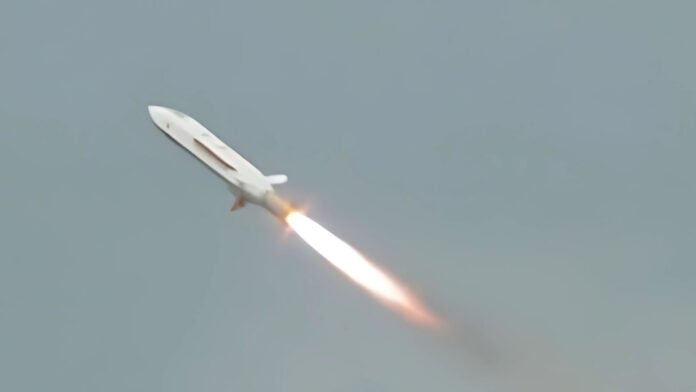
Japan is fielding new coastal defense missiles and actively developing new ones, including a hypersonic guided missile, in a push to increase its island defense capabilities amid rising regional tensions and a rapidly evolving security environment in the Indo-Pacific.
This strategic shift marks a departure from Tokyo’s traditional “defensive-only” posture, as the Ministry of Defense accelerates the deployment of long-range standoff capabilities. By integrating a multi-layered network of Type 25 missiles, high-velocity glide vehicles (HVGVs), and hypersonic technology, Japan aims to create a credible “rapid counterstrike” deterrent. As the 2030ies deadline approaches, these advancements signal Japan’s commitment to securing its remote southwestern islands and maintaining stability across the First Island Chain.
Type 25 SSM
In March 2026, the Japan Ground Self-Defense Force (JGSDF) deployed its latest coastal defense missile, the Type 25 Surface-to-Ship Missile (Type 25 SSM), at Camp Kengun in Kumamoto Prefecture, located in Japan’s Kyushu region.
The Type 25 SSM had previously been developed under the designation “Upgraded Type 12 Surface-to-Ship Missile.” Launched from ground-based platforms and designed to engage hostile surface vessels at sea, it represents a significant leap in capability compared to earlier systems operated by the JGSDF. In terms of range, for example, the currently deployed Type 12 SSM is estimated to have a range of approximately 200 km, whereas the Type 25 SSM is believed to achieve a range of around 1,000 km.
In addition, the Type 25 SSM incorporates a low-observable (stealth-conscious) design to reduce detectability by enemy radar systems. It is also equipped with an “Update-to-Date Command (UTDC)” capability, enabling in-flight retargeting via satellite communications from ground control stations. This allows the missile to adjust its flight path dynamically in response to moving targets.
Furthermore, derivatives of the Type 25 SSM are under development, including a ship-launched variant (Upgraded Type 12 SSM [ship-launched]) and an air-launched variant (Upgraded Type 12 SSM [air-launched]). Both are scheduled to enter service in fiscal year 2028. The ship-launched version is expected to be initially deployed aboard the JMSDF destroyer Teruzuki, homeported at Yokosuka, while the air-launched version is planned for integration with upgraded F-2 fighter aircraft based at Hyakuri Air Base in Ibaraki Prefecture.
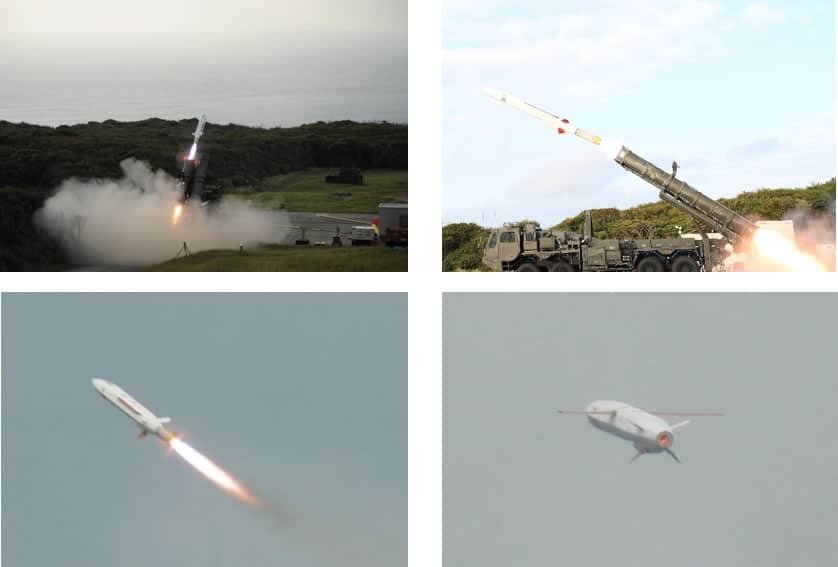
The Type 25 SSM constitutes a core component of Japan’s “stand-off defense capability,” which the Ministry of Defense is actively developing. This concept refers to the ability to engage and neutralize invading enemy forces at extended ranges before they can approach or land on Japanese territory. In simple terms, it involves striking adversaries from a safe distance using long-range munitions such as cruise missiles. For instance, enemy forces landing on Japan’s remote islands or approaching naval task groups could be targeted from secure locations in Kyushu or even Honshu.
In Japan, the development of stand-off defense capabilities began with the 2018 National Defense Program Guidelines and the accompanying Medium Term Defense Program. In response to China’s military buildup, these documents emphasized the need to significantly enhance Japan’s island defense posture, including the southwestern island chain.
Subsequently, in December 2020, the Japanese government approved a policy titled “On the Development of a New Missile Defense System and Strengthening of Stand-Off Defense Capabilities,” which explicitly included the development of the upgraded Type 12 SSM. In December 2022, the so-called “Three Security Documents”—comprising the revised National Security Strategy, National Defense Strategy, and Defense Buildup Program—were adopted, mandating the deployment of ground-launched and ship-launched stand-off missiles (long-range missiles) by fiscal year 2027. The Type 25 SSM is one such ground-launched system.
New coastal defense missiles under development by ATLA
These security documents outline a two-phase approach to developing stand-off defense capabilities. The first phase, targeted for completion by fiscal year 2027, aims to establish the necessary systems—including sensors and missile platforms—required to detect and engage targets at long range. The second phase, extending to fiscal year 2032, seeks to diversify strike options, including the introduction of next-generation stand-off missiles.
New Surface-to-Ship / Surface-to-Surface Precision-Guided Missile
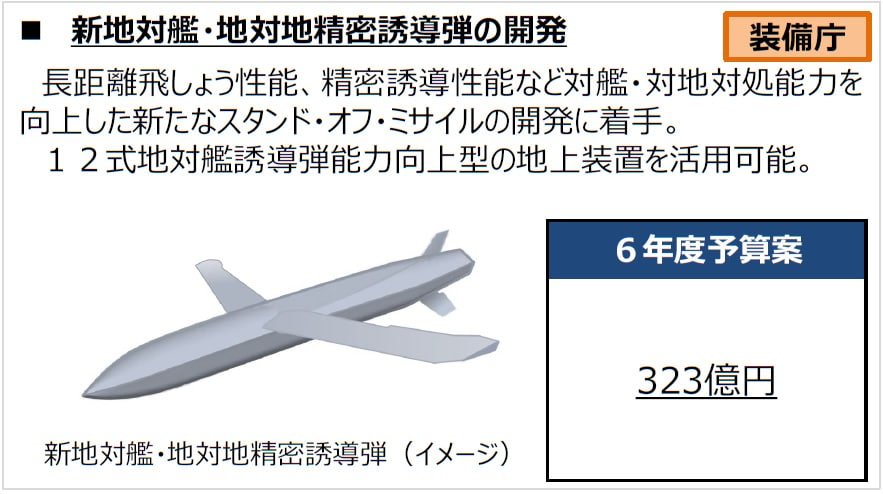
Indeed, this second phase includes the development of a more advanced system than the Type 25 SSM: the “New Surface-to-Ship / Surface-to-Surface Precision-Guided Missile.” Development of this missile began in 2025. Compared to existing systems, it is expected to feature superior guidance accuracy and penetration capability. As its name suggests, it will be capable of engaging not only enemy vessels at sea but also high-value land targets such as airfields, ports, and command-and-control facilities.
Naval News reached out to Japan’s Acquisition, Technology & Logistics Agency (ATLA), which is responsible for the development of this new missile. According to ATLA, the system will offer enhanced guidance performance compared to the Type 25 SSM, including the ability to classify targets and designate specific aim points.
Regarding the “New Surface-to-Ship / Surface-to-Surface Precision-Guided Missile,” ATLA stated:
“Development has been initiated with the aim of enabling more precise target classification and aim-point designation compared to the Type 25 Surface-to-Ship Missile, thereby allowing effective engagement of targets requiring higher precision. However, we refrain from disclosing specific performance characteristics and specifications, as doing so could reveal the capabilities and operational concepts of the Self-Defense Forces.”
This new Surface-to-Ship / Surface-to-Surface Precision-Guided Missile is expected to be capable—similar to the U.S. Navy’s air-launched anti-ship missile AGM-158C LRASM—of identifying vulnerabilities in enemy vessels and conducting precision strikes against those specific points.
Hypersonic guided missile
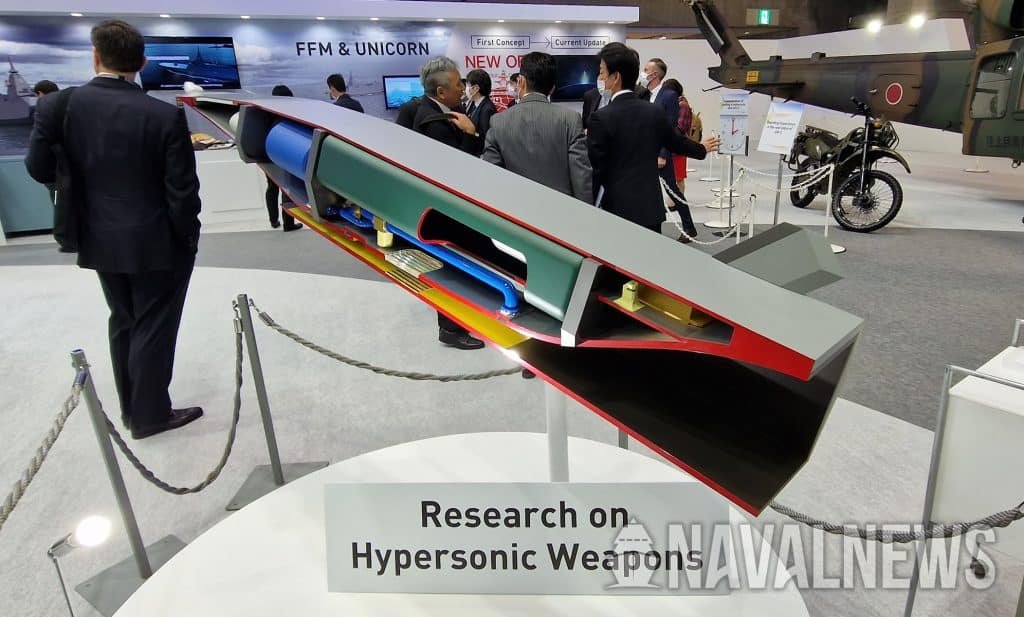
In addition, Japan’s Ministry of Defense is developing another anti-ship missile designed to be difficult for adversaries to intercept: a hypersonic guided missile. This system is defined by its ability to fly at speeds exceeding Mach 5 and is equipped with a specialized propulsion system known as a Dual-Mode Scramjet (DMSJ), which combines ramjet and scramjet engine technologies.
The scramjet engine is expected to have high engine efficiency in a wide range of speeds, from Mach 5 to 15, because the air inhaled from the intake is compressed and combusted at supersonic speed when the missile flying at Mach 5 or higher. That means that the scramjet engine would need to be accelerated the missile to hypersonic speeds to operate, and that would require acceleration by a rocket booster. However, a large rocket booster would be required to accelerate to hypersonic speeds, which would increase the overall length of the missile, including the booster.
Therefore, ATLA planned to combine the capabilities of the ramjet engine, which operates efficiently in the Mach 3 to 5 speed range(supersonic speed), with the scramjet engine (DMSJ) to reduce the proportion of the rocket booster. In this way, the rocket booster only needs to accelerate the missile to supersonic speed, and from there, the ramjet engine accelerates the missile to hypersonic speed, which then activates the scramjet engine to cruise.
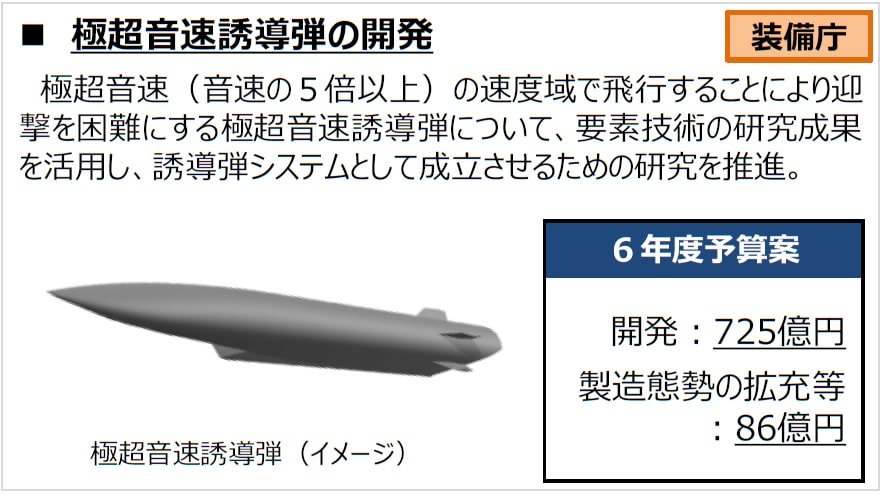
According to the ATLA, the hypersonic guided missile can cruise at high altitudes at hypersonic speeds while maneuvering, making it difficult for enemy air defense systems to intercept it. This is because the missile flies at an altitude higher than that of a typical lower level air defense system and lower than that of an upper level air defense system, and further altering the flight route makes it difficult to predict the point of intercept, making it difficult for existing air defense systems to respond it. That’s why ATLA calls the missile a “game changer”.
According to documents released by ATLA, the combined guidance system of satellite and inertial navigation will be used to guide the hypersonic guided missile. In addition, radio and lightwave image seekers will be used to identify targets, and this missile will be capable of all-weather operations. The missile is expected to be capable of carrying a penetrating warhead to destroy the flight decks of enemy aircraft carriers and a high-density Explosively Formed Penetrator (EFP) warhead to suppress enemies on the ground. Development of this missile began in 2023, with an initial target of completing development and achieving operational deployment by 2032. However, as the necessary technological milestones for mass production have reportedly been achieved, Japan’s FY2026 budget includes not only ¥73.2 billion for continued development but also ¥30.1 billion allocated for initial procurement toward full-scale production.
Source:
www.navalnews.com


