

An Israel Museum exhibit that opened shortly before the onset of the ongoing war with Iran underlines how Israeli artists have long been working through trauma.
“Yudith Levin: Break of Dawn” opens by showing visitors that Levin was 7 years old when her older brother was killed in a military plane crash in 1956.
Aviation, mourning, and trauma all became themes in Levin’s work, as shown in this solo exhibit, which runs through July.
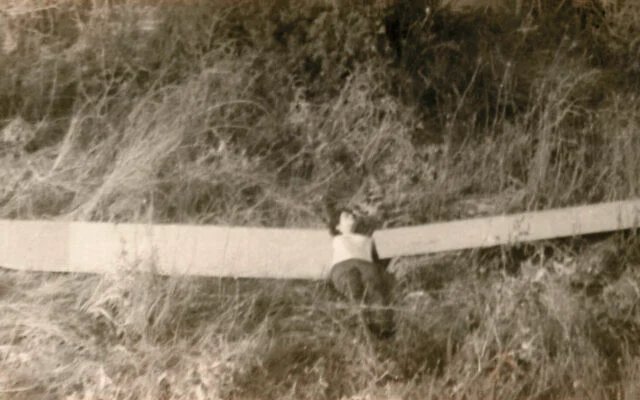
The exhibit begins with “Wings,” a set of photographs created by the now 77-year-old Levin in 1974, as she posed under the wings of a grounded fighter jet, channeling her brother, which is hung next to one of Levin’s 2025 paintings, titled “Airplane.”
“There’s 50 years between these two pieces,” said curator Amitai Mendelsohn.
The exhibit moves into Levin’s 1970s-era installations, “The Annunciation,” “Pieta,” and others, made from plywood, found pieces and painted wooden slats that often include a blank painted wall.
They are works inspired by the mythological motifs of Icarus and Daedalus — the craftsman father who made wings of feathers and wax for his son that melted when he flew too close to the sun — and Prometheus, who stole fire from Olympus — and the Christian motifs of “Pieta,” Michaelangelo’s sculpture of Jesus in the arms of his mother Mary after being taken off the cross.
“Yudith is an artist who isn’t afraid of the most difficult things,” said Mendelsohn.
“Her whole life, she was laden by the trauma of her brother,” said Mendelsohn. “And then this whole issue of work goes from something very personal to something collective — the situation in Israel and loss and war. It’s a trio of references, personal and Israeli war and security, and those ancient myths.”
The solo exhibit moves from Levin’s bare, collage-like installations to canvases she painted with acrylics starting in the 1980s through the present.
A canvas of black-painted shapes clearly delineates Theodor Herzl leaning on his balcony in “Missing Herzl,” alongside the unexpected strokes that form the unmistakable shape of a woman in a dress in “Red.”

Finally, there are Levin’s more recent works reacting to the bloody October 7, 2023, Hamas terror onslaught, when some 1,200 people were brutally slaughtered in the communities bordering the Gaza Strip and at the Nova desert rave, and another 251 people taken hostage in the coastal enclave.

There are the twin orange orbs that represent the red hair of the young Bibas boys, abducted with their mother, Shiri Bibas, and killed in Hamas captivity, in “Toys for the Boys,” which mirrors the same orange circle from Levin’s 2011 “Icarus,” an orange streak of hair in “Mother,” and two redheads above a green orb in “Redheads.”
“In the end, Yudith is telling you a kind of feeling, it could be anxiety or sorrow or horror,” said Mendelsohn. “She’s often trying to show the horror, especially in her works of the last two years, through the power of the paint, of the artistic gesture, the way art can try to contain these horrible events, but in a way that isn’t obscene.”

Source:
www.timesofisrael.com


