

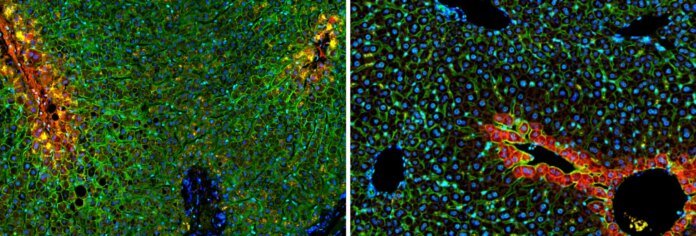
A research team led by scientists at the Weizmann Institute of Science, Sheba Medical Center, and the Mayo Clinic in Minnesota has developed the first open digital atlas of a healthy human liver.
The peer-reviewed findings, recently published in Nature, reveal that the human liver functions in eight precise zones rather than three, as was previously believed.
“The map shows the division of labor in the human liver at a resolution of two microns,” Weizmann’s Prof. Shalev Itzkovitz, the study’s lead researcher, told The Times of Israel.
To put that in perspective, the width of a human hair is about 50 microns.
Using cutting-edge single-cell RNA sequencing, the scientists analyzed the genetic activity of thousands of individual cells simultaneously. High-resolution spatial mapping enabled them to pinpoint the physical location of each cell within the liver.
With these methods, Itzovitz said, the team was able to dispel another scientific misconception by showing that mouse and human livers do not work the same way.
“That’s a surprising discovery,” Itzkovitz said.
The atlas will allow scientists to move beyond dependence on mouse models, enabling the development of precise therapies that target specific zones to treat liver diseases, including metabolically dysregulated steatotic liver disease (MASLD), also known as fatty liver disease.
The human liver: A multitasker
The human liver is the body’s largest and heaviest internal organ.
Within the liver are tiny lobules, shaped like honeycomb hexagons. These filter blood, metabolize nutrients from food, and produce bile and essential proteins.
“The liver is such a central organ for human metabolism and carries out about 500 tasks,” Itzkovitz said.
However, not all liver cells perform all of these functions.
“The liver functions somewhat like an ant colony,” Itzkovitz said. “There is a division of labor between cells, just as there is among ants.”
For example, some ants specialize in defense, others in food production, and still others in caring for their young.
“Similarly, different subtypes of liver cells carry out different tasks in distinct locations,” Itzkovitz said.
The first in-depth study of a healthy human liver
Until now, scientists have been unable to study healthy human liver tissue from a living donor.
“Previous studies relied on tissue adjacent to disease, such as cancer,” Itzkovitz said. “When you have cancer, even outside the liver, it can completely rewire the metabolism of the liver, so it becomes very different than that of a healthy liver.”
The researchers analyzed liver samples from eight healthy donors aged 20 to 40, “live organ donors, often donating to family members with end-stage liver disease,” Itzkovitz said. “This allowed us to establish a true baseline of the healthy human liver.”

The samples were obtained through collaborations with Sheba’s Prof. Ido Nachmany and Prof. Niv Pencovich, and with Mayo’s Dr. Timucin Taner.
The lead author, Dr. Oran Yakubovsky, is both a surgeon at Sheba and a PhD student in Itzkovitz’s lab.
The lab was struck in the Iranian missile attack on the Weizmann Institute in June 2025. Still, Izkovitz said that the researchers were able to “salvage samples and continue the work to completion.”
“We’re passionate about science, and we really believe we’re trying to do something good for mankind, so it’s a big motivation,” he added.
Of mice and human livers
One of the biggest surprises was how the human liver functions differently from that of mice, pigs, and cows, Itzkovitz said.
In the mouse liver, outer cells are more metabolically active than central cells. In humans, it is the opposite.

“This distinction has important implications,” Itzkovitz said. “Mouse models are incredibly valuable for studying liver biology, but when you want to model liver diseases, these are differences that are critical to note.”
Targeted treatment for fatty liver disease
In both mice and humans, a healthy liver builds lipids, the fatty compounds that provide storage protection and insulation, and burns them for energy. However, only the human liver performs this process in the inner lobule.
But in fatty liver disease, too much sugar and insulin levels force the cells in the human liver’s central lobule to create fat at a rate the body doesn’t need.

In the past, research was unable to pinpoint exactly where in the human liver these cells were creating the fat, and drugs were designed based on mouse models, with livers that function differently.
Researchers will now be able to develop smarter drugs that zero in on cells within the inner lobule, without damaging the rest of the organ.
“The study provides one of the clearest maps yet of how the healthy human liver is organized in space, giving scientists a far better baseline for understanding normal function and early disease,” said Natalie Porat-Shliom, head of the cell biology and imaging section at the National Cancer Institute in Maryland.
Porat-Shliom was not involved in the study.
She told The Times of Israel that the study’s “greatest importance” is showing that commonly used tissue near a diseased area “is not truly healthy, and this finding could reshape how liver studies define controls and interpret disease biology.”
She added that the atlas “also provides a powerful reference for developing more accurate diagnostics and treatments.”
“With precise mapping,” Itzkovitz said, “it may become possible to develop treatments that will target the specific regions of the liver.”
Source:
www.timesofisrael.com


