
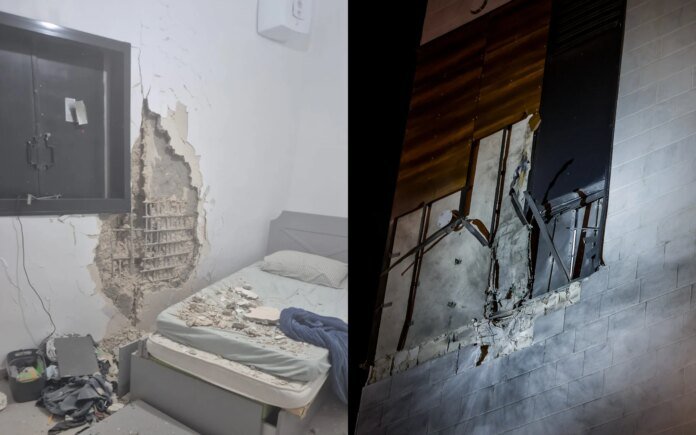
A cluster munition from an Iranian ballistic missile damaged the wall of a bomb-safe room in central Israel during an attack earlier this week, but those inside the shelter were unharmed, according to a Home Front Command investigation released Friday.
The Petah Tikva incident apparently marked the first time that a cluster munition has directly hit a bomb-safe room in Israel.
The Home Front Command investigation found that the submunition with several kilograms of explosives struck the outside wall of the bombproof room, close to the window, during the Tuesday attack.
Two children and their babysitters were sheltering in the room at the time.
The munition itself did not penetrate the shelter, but the wall is suspected to have been “breached” by the blast, due to the angle and location of the impact, the probe found.
“Despite the intensity of the direct impact, the large shockwave, and the amount of shrapnel, the wall of the bombproof room sustained most of the impact and saved the lives of those inside,” said Lt. Col. Moshe Shlomo, chief of the Home Front Command’s engineering department.
The Home Front Command reiterated that bombproof rooms are the safest place to be during ballistic missile attacks, especially in new buildings.
The reinforced rooms have saved countless lives in the missile attacks from Iran, it said.
Unlike Iran’s conventional warheads, the cluster bombs open up while descending — often at a very great height — and scatter between 24 and 80 smaller munitions, each with a few kilograms of explosives, in a radius of up to 10 kilometers (6 miles), according to the IDF.
The munitions do not have their own propulsion or guidance and simply fall to the ground, where they are designed to explode on impact. Some of the submunitions do not explode upon hitting the ground, and can then still pose a danger to anyone who happens upon them.
There have been more than 30 incidents of missiles carrying cluster bomb warheads hitting populated areas, with over 150 separate impact sites.

Ten people in Israel and the West Bank have been killed by cluster munition impacts, the most recent on Friday night when a man was killed in Tel Aviv.
Military officials said last week that since the cluster bombs are unlikely to cause significant harm if civilians are sheltering, there are times when the IAF chooses not to shoot down all or some of the bomblets to conserve its stockpile of short-range interceptors.
More than 450 ballistic missiles have been launched from Iran at Israel since the start of the war against the Islamic Republic’s regime, with the military reporting an interception rate of 92 percent of attacks heading for populated areas and key infrastructure.

Source:
www.timesofisrael.com


