

New missile and drone attacks on Israel by Iranian-backed Houthi rebels in Yemen on Saturday raised concern that Tehran’s proxies may again try to block Red Sea shipping routes, as Iran’s chokehold on the Strait of Hormuz keeps another key global trade passage virtually closed.
The Houthis, who hadn’t attacked Israel since last year, said they fired at “sensitive Israeli military sites” in southern Israel. The Israel Defense Forces said it intercepted all attempted attacks.
When asked about the Houthis, Israeli military spokesperson Brig. Gen. Effie Defrin replied: “We are preparing for a multifront war.”
The rebels are a key part of Iran’s “Axis of Resistance” network of regional terrorist proxies that also includes Gaza’s Hamas and Lebanon’s Hezbollah.
They control the Yemeni capital of Sanaa and much of the country’s north, and since 2014 have fought a civil war against the internationally recognized government that’s backed by a Saudi-led coalition.
Unlike other “resistance” groups like Hezbollah and pro-Iran militias in Iraq, the Houthi rebels had held back fire for nearly a month after the US and Israel launched a bombing campaign on Iran on February 28.
The campaign seeks to degrade the Iranian regime’s military capabilities, distance threats posed by Iran — including its nuclear and ballistic missile programs — and “create the conditions” for the Iranian people to topple the regime, the military and other Israeli leaders have said.
Iran has responded by firing missiles and drones across the region and threatening shipping in the Persian Gulf’s Strait of Hormuz, bringing maritime traffic to a virtual standstill in the world’s most important waterway for oil and gas deliveries.
Now that the Houthis have entered the war with attacks on Israel, there are growing concerns that they could also renew their attacks on Red Sea shipping, which they targeted following the Hamas-led onslaught of October 7, 2023, that sparked the war in Gaza.
Such a move would further disrupt markets and energy prices that have been shaken by the closure of Hormuz, through which roughly 20% of the world’s oil normally travels. The rebels also have the capability of striking oil facilities in the Persian Gulf, as they did previously during the Yemen civil war.
‘Houthis will jump in harshly’
The Houthis said they won’t allow the US and Israel to use the Red Sea for attacks on Iran. “Our fingers are on the trigger,” Brig. Gen. Yahya Saree, a military spokesman for the Houthis, said in a statement on Friday.
The Houthi attacks on vessels would not only further push up oil prices but also destabilize “all of maritime security,” said Ahmed Nagi, a senior Yemen analyst at the International Crisis Group. “The impact would not be limited to the energy market.”
Since the closure of the Strait of Hormuz, Saudi Arabia has been sending millions of barrels of crude oil a day through Bab el-Mandeb, at the southern tip of the Arabian Peninsula.
The 32-kilometer (20-mile)-wide strait is one of the busiest for global oil trade. A fourth of global container trade also transits through the strait on its way to and from the Suez Canal. Disrupting transit through Bab al-Mandeb forces shipping firms to route their vessels around the Cape of Good Hope, as they did in 2024 and 2025, significantly increasing costs.
About 12% of the world’s trade typically passes through Suez, including oil, natural gas, grain and everything from toys to electronics.
“It would be devastating for so many countries,” Nagi said. “If we see more pressure on the Iranians, or there’s any escalation, the Houthis will jump in harshly.”
Such attacks will add more pressure on energy supplies for the 27-nation European Union, which relies on imported natural gas to power factories, generate electricity and heat homes. Tankers carrying liquefied natural gas — which is supercooled to travel by ship instead of pipeline — routinely pass through the Red Sea.
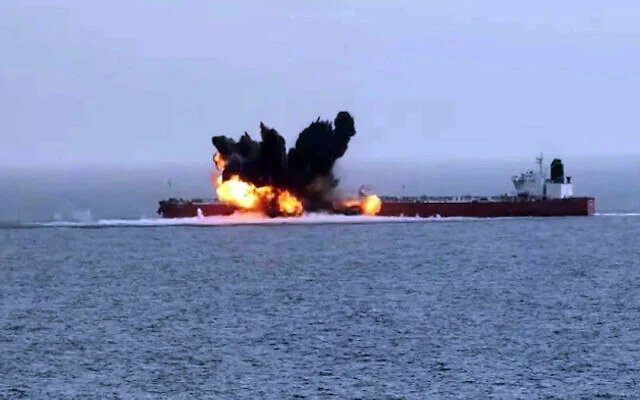
The Houthis — whose slogan calls for “Death to America, Death to Israel, [and] a Curse on the Jews” — started attacking Israel and Red Sea shipping in November 2023, saying the attacks were in support of Hamas.
At sea, the Houthis attacked over 100 merchant vessels with missiles and drones, sinking two ships and killing four sailors.
The US and Israel responded with a punishing air campaign across the Houthi-held areas in Yemen.
US President Donald Trump announced in May 2025 that he was halting US strikes on the Houthis after a deal that saw the rebels stop their attacks on ships in the Red Sea, even as they continued attacking Israel.
The Houthis halted their attacks on Israel during the Gaza ceasefires in January-March 2025 and again between October 2025 and March 2026.
In all, the Houthis launched over 130 ballistic missiles and dozens of explosive-laden drones at Israel, including one that killed a civilian and wounded several others in Tel Aviv in July 2024, prompting Israel’s first strike in Yemen.

Source:
www.timesofisrael.com


