

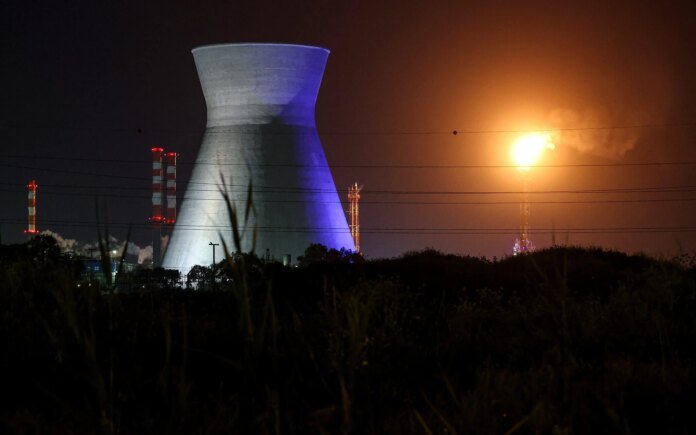
The High Court of Justice has ruled that the National Planning and Building Council acted lawfully in allowing the Bazan oil refineries in Haifa to build a new power facility without a building permit, due to special circumstances, but stressed that it is valid for only three years.
The new gas-driven facility requested by Bazan is intended to replace an old one damaged by Iranian missiles during Israel’s previous war with Iran in June 2025.
The facility was hit twice during that war, and twice again during the military operation against Iran earlier this year. During last year’s military confrontation, three Bazan workers were killed in a missile-related fire.
The court did, however, note in its Sunday ruling that the refineries will have to be closed in accordance with a government decision to do so by the end of the decade.
The case against the new power station was brought by the Haifa Municipality, the Haifa Bay Area Cities Association for Environmental Protection and environmental organizations, including Green Course.
Central to the issue of exemption from a permit is a temporary order under the planning and building law, which allows the Interior Ministry to waive certain provisions of the national planning law to fast-track projects “of national importance and urgency.” It was designed to allow quick repairs and rehabilitation following the October 7, 2023, Hamas invasion of southern Israel and the subsequent war.
The order, known as Section 266E, has been employed in dozens of cases to help rebuild communities along the Gaza border.
In July, in response to an Energy Ministry request, the Interior Ministry proposed exempting Bazan from the requirement to provide detailed plans or obtain a building permit for repairs to damage caused during the war with Iran. It explained that “significant damage was caused [by the Iranian attack] to essential facilities required for the refinery’s continued operation and production of its products, including the power plant responsible for generating electricity and steam used by the facilities in the complex, as well as pipelines and operational infrastructure.”

During an October discussion at the National Planning Council, the Haifa Bay Cities Association for Environmental Protection argued that Bazan had successfully continued to operate with cleaner electricity supplied by the national grid, and thus could go on doing so, without the need for a new facility that would add to Haifa’s already over-polluted air.
Elad Pinchas, head of environmental planning at the Environmental Protection Ministry, said at that meeting that there had been no substantive discussion about the alternatives.
The National Planning and Building Council subsequently responded that, “after examining all existing alternatives,” it had chosen to approve replacing the damaged power station with a facility that featured “improved technology, while also allowing for the potential dismantling of the facility in the future when activity at the Bazan site ceases.”
After Sunday’s hearing, Haifa Mayor Yona Yahav said, “I am glad that the judges agreed that Bazan needs to be closed, and that even if the power plant is established, contrary to our position, it must not thwart the important government decision to evacuate this dangerous and polluting factory from Haifa Bay.”
Elad Hochman, CEO of Green Course, noted that the lack of visible work at Bazan’s compound undermined claims that a new power station was a national emergency.

He added, “Even if established, this facility is only temporary and will be required to be evacuated. The real solution is not an expansion of Bazan, but its full closure by 2029 in accordance with the government decision. Haifa’s residents should not continue to pay with their health because of devious planning schemes.”
Bazan did not respond to a query by press time.
Residents, environmental activists, and others have pressed for years to have the Bazan compound closed and the materials it produces imported due to the heavy pollution it causes in Haifa and its surroundings, indications of a high prevalence of cancer and asthma in the area, and fears of attack that indeed materialized during Israel’s wars with Iran.
In 2022, the cabinet decided to shut down the refineries and related oil storage complex within a decade and instead import the materials they produce, known as distillates. However, last month it emerged that the Energy Ministry has been working to overturn the government decision and relocate the complex to southern Israel to avoid relying solely on imports.


Source:
www.timesofisrael.com


