

In statements to investigators, Vladyslav D. said he was paid more than $2,000 (£1,487) in cryptocurrency for his efforts. His motive was clear.
And what about the Leipzig case?
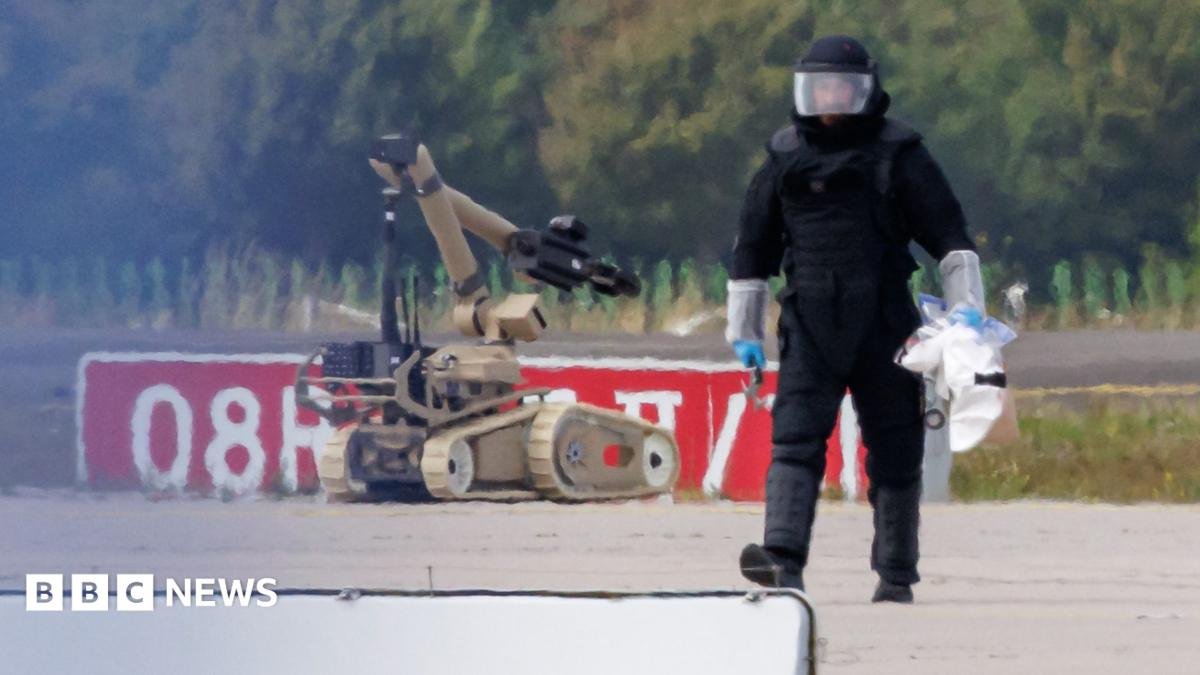
Few details about the drone bomb are yet public.
Some German sources report that the explosive was Semtex, which contains RDX – the explosive found in the food cans in a Lithuanian cemetery.
We do not know how much the drone found at the airport was carrying and the physical damage may have been limited.
“The drone casing, if it was metal, might have put a hole in the plane but just a blast wave probably would just have dented it unless they put some fragmentation inside,” explosives expert Professor Jackie Akhavan of Cranfield University explained.
But if Russia was behind this, its aim was more likely to sow fear.
Andrei Soldatov, an expert on Russia’s intelligence agencies, said it “makes sense” to suspect Moscow, pointing to a clear pattern of sabotage and hostile activity, from arson attacks on facilities supporting Ukraine to drones over sensitive sites in Europe.
Germany is one of Kyiv’s biggest suppliers of military aid.
“It’s a message. You get something like that [bomb] into one of the biggest European airports and you send the message that, ‘Guys, we can do that. Remember’,” Soldatov explained.
“You hint to the adversary that you might cause a really big problem: that tomorrow might be more serious.”
And the potential motive? Moscow is under intense pressure from Ukraine’s long-scale drone attacks, he said, and the fact that Russian President Vladimir Putin “has been humiliated, repeatedly”.
Source:
www.bbc.co.uk


