
The Seabed Warfare Observatory (L’Observatoire Maîtrise des Fonds Marins, or MFM) has been set up within the strategic research support structure established by the Directorate General for International Relations (DGRIS) on behalf of France’s Ministry of the Armed Forces.
The MFM research organisation, which is headed by retired French Navy Rear Admiral Jacques Mallard, sits within the Toulon-based ‘think tank’ FMES (Fondation pour la Maîtrise des Enjeux Stratégiques). MFM is now producing a regular report with three reports in total scheduled for publication in 2026.
The report, called a ‘monitoring note’, includes assessing latest developments in the seabed warfare domain, and looking in particular at risks to critical undersea infrastructure (CUI). MFM said the monitoring note provides a summary of events occurring within the report’s timeframe (for example, the first issue is covering January – March 2026). It also analyses any trends, within the context of providing insights for strategic decision making.
The report, called a ‘monitoring note’, includes assessing latest developments in the seabed warfare domain, and looking in particular at risks to critical undersea infrastructure (CUI). MFM said the monitoring note provides a summary of events occurring within the report’s timeframe (for example, the first issue is covering January – March 2026). It also analyses any trends, within the context of providing insights for strategic decision making.
“The seabed is now a major strategic area, marked by intensified rivalries between great powers and the proliferation of hybrid threats that are difficult to attribute,” the MFM said. The seabed is both an arena for economic development and a new area of conflict risk, overlaying issues relating to sovereignty, security, and freedom of military action, it added. “In this context, the MFM serves as a strategic tool designed to better understand, anticipate, and structure thinking on these emerging dynamics,” the MFM continued.
In introducing the first monitoring note, the MFM said that in the context of rising geopolitical, technological, and hybrid warfare challenges, the deep sea had become a priority for countries – although the domain remains vulnerable and difficult to access, thus being poorly protected given its global economic significance and consequently being a prime target for destabilisation strategies that exploit challenges in attribution.
The monitoring note highlighted the continuing CUI risk in the Baltic Sea. It listed three instances of CUI damage between December 2025 and January 2026: on 30 December 2025, an internet telecommunications cable connecting Estonia and Sweden was damaged; on 31 December 2025, a cargo ship damaged a cable connecting Estonia and Finland, with Finnish authorities indicating an act of sabotage; and on 2 January 2026, a telecommunications cable connecting Latvia and Lithuania was cut, prompting Latvia to begin an investigation.
The report also pointed to suspicious activities being conducted by commercial ships around CUI sites off the UK and Portuguese coasts (in January and February 2026, respectively).
The note discussed several recent developments regarding how northern European countries are responding to the threat, at unilateral, bilateral, and multilateral levels. For example, Finland has established an integrated surveillance mechanism in the northern Baltic Sea, consisting of a network of artificial intelligence-enhanced regional hubs exchanging surveillance data, threat assessments, and real-time risk analyses. Ireland has announced enhanced bilateral relationships with France and the UK, and with the European Union and NATO, while standing up its own national maritime security centre.
The report argued that such examples illustrate “a major shift in awareness” amongst countries, adding that the risk is now being fully addressed.
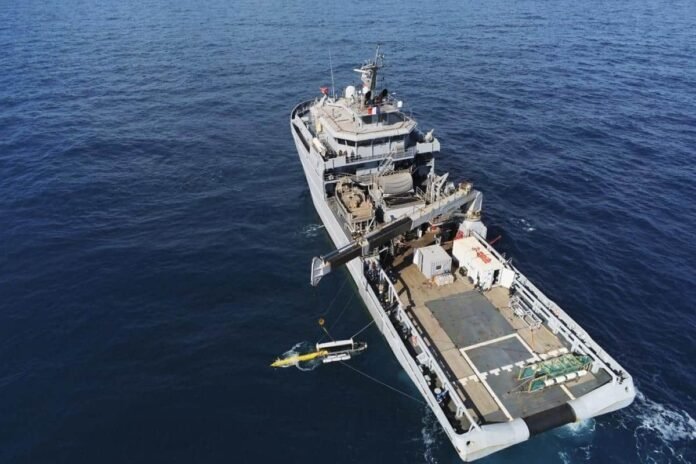
The French Navy itself is a central player in the European and NATO responses to the CUI risk and the wider requirement to develop seabed presence and operational output. Under its ‘Calliope’ mission, the navy is testing – and operating – new technologies on operational activities across French waters, including down to depths of 6,000 m, to ensure France has all the capabilities it needs. As regards the role in CUI incidents in the Baltic and elsewhere that Russia’s ‘shadow fleet’ shipping may be playing, the navy is also boarding ships it suspects as being part of that ‘shadow fleet’.
Source:
www.navalnews.com


